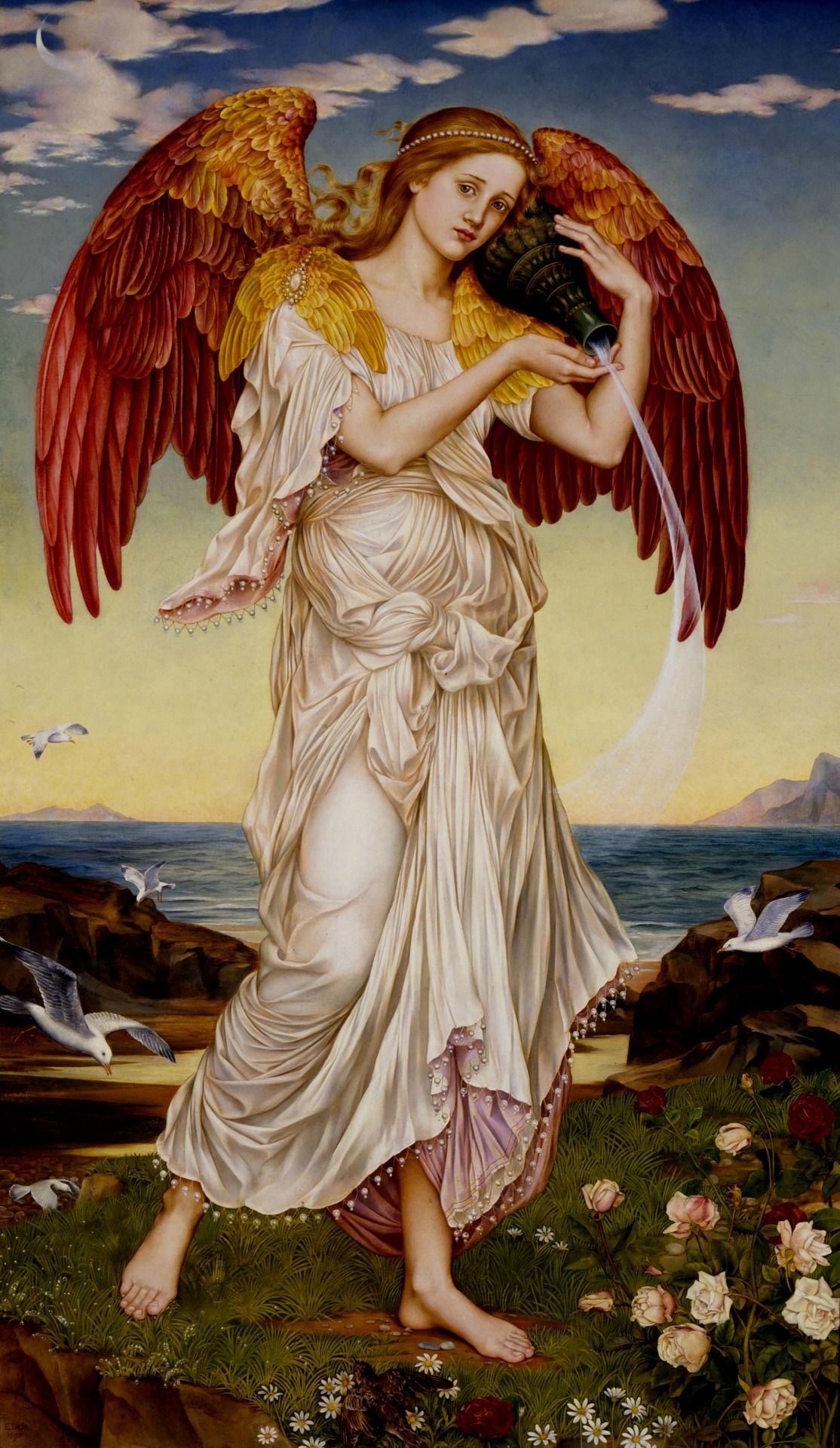
Eos – The Greek Goddess of the Dawn
Eos was the ancient Greek goddess of the dawn, the radiant divine figure who opened the gates of heaven each morning and announced the arrival of the sun. She represented the first light of day, the transition from darkness to illumination, and the eternal renewal of life. In Greek mythology, Eos was a beautiful and powerful goddess whose daily journey across the heavens brought colour to the sky and awakened the world from its nightly slumber.
Known to the ancient Greeks as the rosy-fingered goddess, Eos was celebrated for her beauty, grace, and magnificent appearance. Her arrival was imagined as a glorious spectacle in which the eastern horizon glowed with shades of pink, gold, and crimson. As she emerged from the darkness, the stars faded, the heavens brightened, and the world prepared to welcome another day.
Although Eos was not one of the twelve Olympian gods, she belonged to an ancient generation of divine beings whose powers governed the fundamental processes of the universe. Her influence extended beyond the physical appearance of dawn, symbolising hope, transformation, love, loss, and the passage of time.
The Origins and Family of Eos
Eos belonged to the Titans, the generation of deities who preceded the Olympian gods. According to Hesiod's Theogony, she was the daughter of Hyperion, the Titan associated with heavenly light, and Theia, the Titaness connected with divine brilliance and vision.
Her siblings were Helios, the god and personification of the sun, and Selene, the goddess of the moon. Together, these three celestial deities governed the daily cycle of heavenly illumination. Selene travelled through the night sky, Eos announced the coming of morning, and Helios brought the full brilliance of daylight.
This divine family represented the orderly movement of the heavens and the continuous succession of night and day. Their activities formed part of the natural rhythm upon which human life depended.
As a daughter of the Titans, Eos possessed an ancient authority that remained significant after Zeus and the Olympian gods established their rule. Unlike many members of the older divine generation, she continued to perform her celestial duties without interruption.
The Appearance of the Dawn Goddess
Ancient Greek poets described Eos as an extraordinarily beautiful goddess whose appearance illuminated the heavens. She was frequently called rosy-fingered Eos, an expression made famous in the epic poetry attributed to Homer. The phrase suggested the delicate pink and red streaks spreading across the eastern sky as morning approached.
Another traditional description was saffron-robed Eos, referring to the golden-yellow light that accompanies sunrise. The colours of her garments symbolised the changing appearance of the heavens as darkness gave way to daylight.
In Greek art, Eos was commonly represented as a graceful young woman wearing flowing robes and possessing magnificent wings. These wings allowed her to move swiftly across the heavens, carrying the first light of morning to the sleeping world.
She was sometimes depicted holding a torch, a symbol of illumination, or driving a magnificent chariot drawn by horses. Her beauty was associated with youth, vitality, and the promise of a new beginning.
Eos and the Coming of Day
The most important responsibility of Eos was to announce the arrival of daylight. Each morning, she rose from the eastern edge of the world, traditionally imagined as lying near the waters of Oceanus, the great river that encircled the earth.
Her appearance marked the end of the night and the beginning of a new cycle of activity. As Eos advanced across the heavens, the stars disappeared, birds began to sing, and the world gradually awakened.
Greek mythology frequently placed her arrival immediately before the appearance of Helios. In poetic descriptions, Eos spread her light across the sky, preparing the heavens for her brother's journey.
Some traditions described her as travelling in a chariot drawn by shining horses, while others emphasised her winged flight. The horses associated with her chariot were sometimes named Lampos and Phaethon, names suggesting brilliance and radiance.
Her daily appearance demonstrated the reliability of the cosmic order. Regardless of the events taking place among gods and mortals, Eos returned each morning to fulfil her ancient responsibility.
Eos in the Poetry of Homer
Eos occupies a prominent place in the Iliad and the Odyssey, where her appearance frequently marks the beginning of a new day. Homer repeatedly describes the arrival of rosy-fingered Dawn as an elegant transition between night and morning.
These references served an important literary purpose. They marked the passage of time while reminding audiences that the natural rhythms of the universe continued even during periods of war, suffering, and uncertainty.
In the Iliad, the appearance of Eos often introduces renewed fighting during the Trojan War. Warriors awaken, armies prepare for battle, and the events of another day begin beneath the growing light.
In the Odyssey, her arrival accompanies the adventures of Odysseus as he struggles to return home. Each dawn brings new challenges, encounters, and opportunities for progress.
The repeated appearance of Eos illustrates how deeply the ancient Greeks connected their understanding of time with the movements of divine beings. Dawn was not merely a natural phenomenon but the visible manifestation of a goddess fulfilling her cosmic duty.
Eos and the Titan Astraeus
According to Hesiod, Eos became the consort of Astraeus, a Titan associated with the stars and the celestial order. Their union symbolically brought together the powers of dawn and the starry heavens.
From this relationship came several important divine offspring, including the Anemoi, the gods of the winds, and the celestial stars.
The four principal winds were Boreas, the north wind; Zephyrus, the west wind; Notus, the south wind; and Eurus, commonly associated with the east wind in later traditions. Each exercised influence over weather, navigation, agriculture, and the changing seasons.
Hesiod also associated Eos and Astraeus with Eosphorus, the Morning Star, identified with the planet Venus when it appeared before sunrise.
These children reflected the close relationship between dawn, atmospheric movement, and the visible heavens. The morning breeze, fading stars, and rising light were understood as interconnected expressions of divine activity.
Eos and the Morning Star
One of the most beautiful associations of Eos was her connection with Eosphorus, whose name means the bringer of dawn. Eosphorus represented the brilliant celestial body visible shortly before sunrise, now understood to be the planet Venus.
To ancient observers, this bright object appeared to announce the approach of morning. Its presence in the eastern sky was therefore naturally associated with the goddess who brought daylight.
The same planet was also known as Hesperus when visible in the evening sky. Although the Morning Star and Evening Star appeared at different times, Greek astronomical understanding eventually recognised them as appearances of the same celestial body.
The relationship between Eos and Eosphorus reflected the ancient Greek tendency to explain natural phenomena through divine personalities and family relationships.
The Loves of Eos
Despite her divine responsibilities, Eos was also famous for her passionate relationships with mortal men. Several Greek myths describe her falling deeply in love with beautiful young heroes, often with tragic consequences.
One tradition connected her romantic adventures with Aphrodite, the goddess of love. According to the account preserved by Apollodorus, Aphrodite punished Eos with an insatiable desire for young men after discovering that she had shared the bed of Ares, the god of war.
As a result, Eos became associated with a succession of mortal lovers, including Tithonus, Cephalus, Orion, and Cleitus.
These stories explored the difficulties of relationships between immortal gods and mortal humans. Although Eos possessed eternal life and supernatural power, she could not always protect those she loved from ageing, suffering, or death.
Eos and Tithonus – The Tragedy of Eternal Life
The most famous love story involving Eos concerns Tithonus, a handsome Trojan prince. Tithonus was traditionally described as a son of Laomedon, king of Troy, and a member of the Trojan royal family.
Eos became captivated by his beauty and carried him away to live with her. Their relationship was one of profound affection, and the goddess desired to remain with her mortal lover forever.
Knowing that Tithonus would eventually grow old and die, Eos approached Zeus and requested that he grant the young prince immortality. Zeus agreed, allowing Tithonus to live eternally.
However, Eos made a terrible mistake. She had asked for everlasting life but had neglected to request everlasting youth.
As the years passed, Tithonus continued to age. His strength disappeared, his beauty faded, and his body became increasingly frail. Although death could no longer claim him, he remained subject to the physical decline of old age.
Eos watched helplessly as the man she loved deteriorated. Eventually, according to the Homeric Hymn to Aphrodite, she confined him within a chamber, where his voice continued even as his strength vanished.
Later traditions developed the story further, claiming that Tithonus was transformed into a cicada, an insect famous for its persistent singing.
The myth became one of the most powerful Greek reflections on immortality. It demonstrated that eternal existence without eternal youth might become a curse rather than a blessing.
The story also revealed the limitations of divine power. Even a goddess capable of illuminating the heavens could not reverse every consequence of her choices.
The Children of Eos and Tithonus
According to Greek mythology, Eos and Tithonus became the parents of two sons, Memnon and Emathion.
Memnon became a celebrated warrior and king associated with distant eastern or southern lands, while Emathion appeared in traditions concerning the royal families of the ancient world.
Both sons inherited connections with heroic mythology, but Memnon became particularly important because of his involvement in the Trojan War.
The relationship between Eos and her children demonstrated another dimension of her character. Although she represented the perpetual renewal of morning, she could experience the same grief and emotional suffering as mortal mothers.
Memnon – The Warrior Son of Eos
Memnon was one of the most celebrated sons of Eos. In the traditions surrounding the Trojan War, he was a mighty warrior who arrived to assist the Trojans during their desperate struggle against the Greeks.
He was often described as a king of the Ethiopians, although ancient Greek geographical descriptions of Ethiopia referred broadly to peoples living in distant regions, especially toward the southern and eastern edges of the known world.
Memnon was renowned for his beauty, strength, and exceptional skill in battle. His divine ancestry placed him among the great heroic figures of Greek mythology.
According to the lost epic Aethiopis, whose story survives through later summaries and references, Memnon entered the Trojan War after the death of Hector and fought on behalf of Troy.
During the fighting, he killed Antilochus, the son of the elderly Greek hero Nestor. This act brought him into direct conflict with Achilles, the greatest warrior of the Greek army.
The two champions eventually faced one another in a dramatic duel. Both possessed divine mothers, and both were renowned for their extraordinary abilities.
Despite his courage, Memnon was killed by Achilles, leaving Eos devastated by the loss of her beloved son.
The Grief of Eos
The death of Memnon revealed the sorrowful side of the dawn goddess. Although Eos was immortal, her son was not protected from the violence of heroic warfare.
Ancient myths describe her mourning Memnon with overwhelming grief. Some traditions claimed that the drops of morning dew were her tears, shed each dawn for the son she had lost.
Other accounts connected her sorrow with the appearance of birds known as the Memnonides, which were said to gather and fight around the tomb of Memnon.
In later versions of the story, Zeus granted Memnon immortality in response to his mother's grief, honouring the fallen warrior and acknowledging the suffering of Eos.
The story transformed dawn into a symbol of both renewal and remembrance. Each morning brought the promise of another day, yet it could also recall the sorrow of those who had been lost.
Eos therefore embodied a striking contradiction. She brought fresh light into the world while carrying within herself the enduring memory of death.
Eos and Cephalus
Another important myth concerns the relationship between Eos and Cephalus, a handsome mortal hunter associated with Athens and the surrounding region of Attica.
According to several ancient traditions, Eos became enamoured of Cephalus and carried him away while he was hunting. His beauty attracted the goddess, who hoped to persuade him to become her lover.
However, Cephalus was married to Procris, the daughter of Erechtheus, and their relationship formed the centre of a complicated and tragic story.
In the version told by Ovid, the goddess Aurora, the Roman equivalent of Eos, abducted Cephalus but eventually released him when he continued to long for his wife.
Before allowing him to return, Aurora planted doubts in his mind about Procris and her faithfulness.
These suspicions contributed to a series of misunderstandings that ultimately destroyed the marriage. In the most famous version of the myth, Cephalus accidentally killed Procris with a hunting spear after mistaking movement in the undergrowth for an animal.
The story linked Eos with the unpredictable power of desire, jealousy, and human uncertainty. Her divine affection, rather than producing happiness, became connected with a mortal tragedy.
Eos and Orion
Eos was also associated with Orion, the legendary giant hunter whose extraordinary beauty and strength attracted the attention of several goddesses.
In the Odyssey, Homer refers to the love of Dawn for Orion. Their relationship provoked the anger of Artemis, who killed Orion on the island of Ortygia.
This brief reference forms part of a warning about the dangers faced by mortal men who become lovers of goddesses.
Other Greek traditions offered different explanations for Orion's death, including accounts involving a giant scorpion or conflicts with Artemis and Apollo.
The story involving Eos nevertheless illustrates a recurring pattern in her mythology. Her attraction to mortal men exposed them to the rivalries and dangers of the divine world.
Eos and Cleitus
Another lesser-known lover of Eos was Cleitus, a figure mentioned in the Odyssey. Cleitus was described as a beautiful young man whom the goddess carried away because of his exceptional appearance.
According to the poem, Eos took Cleitus so that he might live among the immortals.
Although the surviving account provides few details, the story reinforces the association between Eos and her attraction to youthful mortal beauty.
It also reflects a wider mythological theme in which gods remove favoured mortals from the human world and transport them into divine existence.
The Chariot and Horses of Eos
Like several celestial deities, Eos was sometimes imagined driving a magnificent chariot through the heavens. This vehicle symbolised the swift and regular movement of dawn across the sky.
Her horses were associated with brightness, speed, and the glowing colours of morning. Ancient authors sometimes identified them as Lampos and Phaethon, names connected with shining light.
In artistic representations, the chariot could be depicted emerging from the sea or ascending into the heavens, surrounded by the first rays of sunrise.
Other images presented Eos with wings rather than a chariot, emphasising her ability to travel freely between the earth and the sky.
These different forms of representation were not necessarily contradictory. Greek mythology frequently allowed divine figures to appear in several forms, each expressing a different aspect of their nature.
Eos and the Gates of Heaven
In the poetic imagination of the ancient Greeks, Eos was closely associated with the opening of the heavenly gates through which the sun began its daily journey.
The appearance of dawn signalled that the boundary between night and day had been crossed. Eos occupied this moment of transition, standing between the darkness of the past night and the illumination of the approaching sun.
Her role as the herald of daylight made her a figure of cosmic importance. Without the arrival of dawn, the familiar sequence of human activity could not begin.
The opening of the heavens also carried symbolic meaning. It suggested revelation, awakening, and the restoration of order after the uncertainty of darkness.
Eos and the Passage of Time
Among the most significant aspects of Eos was her connection with time. Unlike gods associated with individual events or particular places, Eos appeared every morning without exception.
Her unchanging duty contrasted sharply with the changing circumstances of mortal existence. Human beings were born, grew old, and died, while Eos continued to announce the arrival of each new day.
This contrast became especially powerful in the myth of Tithonus. The goddess retained her youthful beauty, but her mortal lover suffered the devastating effects of endless ageing.
The story of Memnon presented another variation on the same theme. Eos survived her heroic son, enduring a grief that could never be erased by the passage of time.
Through these myths, the ancient Greeks explored the relationship between cosmic permanence and human mortality.
Eos in Ancient Greek Art
Eos was a popular subject in ancient Greek vase painting, particularly during the Archaic and Classical periods. Artists depicted her in scenes illustrating her celestial duties, romantic adventures, and maternal grief.
One of the most recognisable artistic representations showed Eos as a winged woman pursuing or carrying a handsome young man. These scenes were commonly associated with her relationships with Cephalus or Tithonus.
Another important subject was Eos carrying the lifeless body of Memnon. These images portrayed the goddess as a grieving mother, her wings spread as she supported her fallen son.
Such representations could be deeply moving, combining the beauty of a celestial goddess with the sorrow of a mother confronting death.
Greek artists frequently dressed Eos in flowing garments and surrounded her with symbols of movement. Her wings, graceful posture, and youthful appearance helped distinguish her from mortal women.
In some works, she appeared in association with Helios and Selene, visually expressing the relationship between dawn, sunlight, and moonlight.
The Symbolism of Eos
Eos represented far more than the physical beginning of daylight. Her mythology gave her a wide range of symbolic meanings that reflected important aspects of ancient Greek thought.
As the goddess of dawn, she embodied renewal and the possibility of new beginnings. Every sunrise suggested that the darkness of the previous night had ended and that the world had been given another opportunity.
Her radiant appearance represented beauty, youth, and the awakening of nature. The colours of the morning sky were understood as expressions of her divine presence.
At the same time, her tragic relationships introduced darker themes. The stories of Tithonus and Memnon connected Eos with the inevitability of ageing, the pain of separation, and the limitations of immortality.
Her mythology also suggested that love could overcome the boundaries between divine and mortal existence, but not necessarily without suffering.
Through these contrasting qualities, Eos became a complex figure who embodied both the joy of beginning and the sorrow of inevitable change.
The Worship of Eos in Ancient Greece
Although Eos was an important figure in Greek mythology and literature, evidence for an extensive independent cult dedicated to her is limited.
Unlike Zeus, Athena, Apollo, or Artemis, she was not widely associated with major temples, large religious festivals, or powerful civic institutions.
Her significance was primarily expressed through poetry, mythology, and artistic representation. She formed part of the wider sacred understanding of the natural world rather than occupying a central position in the religious institutions of individual cities.
Nevertheless, the Greeks regarded celestial phenomena as expressions of divine order. Dawn, sunlight, moonlight, and the movements of the stars were all connected with the activities of supernatural beings.
Eos therefore remained an important presence within Greek religious imagination, even without the extensive cult worship enjoyed by many Olympian deities.
Eos and the Olympian Gods
Although Eos belonged to the older generation of Titans, her mythology brought her into contact with several Olympian gods.
Zeus appeared in the story of Tithonus as the ruler capable of granting immortality. His decision revealed both the extraordinary power of the Olympian king and the unexpected consequences of divine favours.
Aphrodite was associated with the desire that led Eos to pursue mortal lovers. Her involvement illustrated the influence of love and attraction even among immortal beings.
Ares appeared in traditions explaining the origins of Aphrodite's anger toward Eos, while Artemis was connected with the death of Orion.
These relationships demonstrated that the ancient Titans were not entirely separated from the Olympian order. Some continued to participate in the personal and political relationships of the divine world.
Eos and Aurora in Roman Mythology
The Roman equivalent of Eos was Aurora, the goddess of dawn. Like her Greek counterpart, Aurora was imagined as a radiant figure who announced the arrival of the sun and spread light across the heavens.
Roman poets adopted many Greek traditions concerning the dawn goddess, including her beauty, celestial journey, and relationships with mortal men.
In Roman literature, Aurora was often described wearing saffron-coloured garments and travelling across the sky in a shining chariot.
The poet Ovid included Aurora in his Metamorphoses, particularly in the story of Cephalus and Procris. Through such works, the Greek myths associated with Eos became part of the Roman literary tradition.
The name Aurora later became associated with the natural phenomenon known as the aurora borealis, or northern lights, and the aurora australis, or southern lights. Although these phenomena are scientifically distinct from dawn, their luminous appearance inspired the use of the Roman goddess's name.
Eos and the Natural World
For the ancient Greeks, dawn was one of the most immediately visible manifestations of the divine presence within nature.
Every morning, the eastern sky changed from darkness to shades of violet, pink, orange, and gold. These colours provided a vivid foundation for the poetic descriptions of Eos.
The association between dawn and awakening was particularly important in agricultural societies. Farmers began their work with the first light, travellers resumed their journeys, and communities prepared for the activities of the day.
Greek poets frequently placed birdsong, the fading stars, and the first movements of human activity alongside the appearance of Eos.
Her mythology therefore connected cosmic events with ordinary human experience. The arrival of the goddess was simultaneously a heavenly occurrence and a familiar part of daily life.
The Difference Between Eos, Helios, and Selene
Although Eos, Helios, and Selene were closely related, each possessed a distinct role within Greek cosmology.
Eos represented the dawn itself, the transitional period when the first light appeared before the full arrival of the sun.
Helios personified the sun and was responsible for its daily journey across the heavens. His brilliance illuminated the world during daylight hours.
Selene represented the moon and travelled through the night sky, frequently depicted driving a chariot drawn by horses.
Together, the three siblings embodied the continuous movement of celestial light. Their family relationship expressed the natural connection between moonlight, dawn, and sunlight.
Although later Greek traditions increasingly associated Apollo with the sun and Artemis with the moon, Helios and Selene remained important divine personifications. Eos likewise retained her distinct identity as the goddess of dawn.
Eos in Greek Philosophy and Literature
The figure of Eos provided Greek writers with a powerful means of exploring beauty, mortality, and the nature of existence.
In epic poetry, her arrival established the rhythm of the narrative and emphasised the passage of time. The repeated return of dawn contrasted with the unpredictable fortunes of heroes and kingdoms.
The story of Tithonus became especially important as an illustration of the distinction between immortality and eternal youth.
Greek poets used the fate of Tithonus to reflect upon the limitations of human desire and the consequences of attempting to escape the natural conditions of mortal life.
The goddess also appeared in traditions concerning love and loss, where her divine status heightened the emotional contrast between eternal existence and human vulnerability.
Although Eos was not primarily a philosophical deity, her myths provided material for reflection on the relationship between time, nature, desire, and the human condition.
The Legacy of Eos
Eos remained an enduring figure in European art, literature, and cultural imagination long after the decline of ancient Greek religion.
Her Roman identity, Aurora, appeared frequently in Renaissance and later European painting, sculpture, and poetry. Artists represented the goddess as a beautiful woman emerging from darkness, surrounded by light and accompanied by celestial attendants.
The image of dawn continued to symbolise awakening, hope, beauty, and transformation. These associations preserved many of the ideas originally expressed through the Greek goddess.
The name Eos also survives in scientific terminology. In geology, the Eocene Epoch derives its name from Greek elements meaning dawn and recent, reflecting the appearance of many modern groups of mammals during that period.
In astronomy and cultural symbolism, references to Aurora and Eos continue to evoke the brilliance of morning light.
Her story remains particularly memorable because she is both a radiant cosmic goddess and a deeply emotional mythological character. The beauty of her daily arrival exists alongside the tragedies of her lovers and children.
The Enduring Meaning of the Dawn Goddess
Eos occupies a distinctive position in Greek mythology as the divine embodiment of a phenomenon experienced by every generation of humanity. Her arrival was universal, predictable, and essential to the rhythm of life.
Yet the myths surrounding her reveal that even the most beautiful and powerful divine beings were not immune to sorrow. Her love for Tithonus exposed the cruelty of endless ageing, while her grief for Memnon demonstrated the suffering caused by mortal death.
These stories gave Eos a depth that extended far beyond her role as the herald of sunrise. She represented the beauty of beginnings, the certainty of change, and the emotional complexity of existence.
Her eternal return each morning also expressed an important idea within ancient Greek thought: the natural world continues through cycles of renewal, even as individual lives pass away.
For the Greeks, Eos was the golden promise of a new day, a divine presence who brought light to the earth and restored the visible order of the heavens.
Whether appearing as the rosy-fingered goddess of Homer, the grieving mother of Memnon, or the devoted lover of Tithonus, Eos remains one of the most poetic and emotionally compelling figures in ancient Greek mythology.
Her legacy endures in the colours of the morning sky, the symbolism of sunrise, and the timeless human recognition that every dawn brings both the memory of yesterday and the possibility of tomorrow.