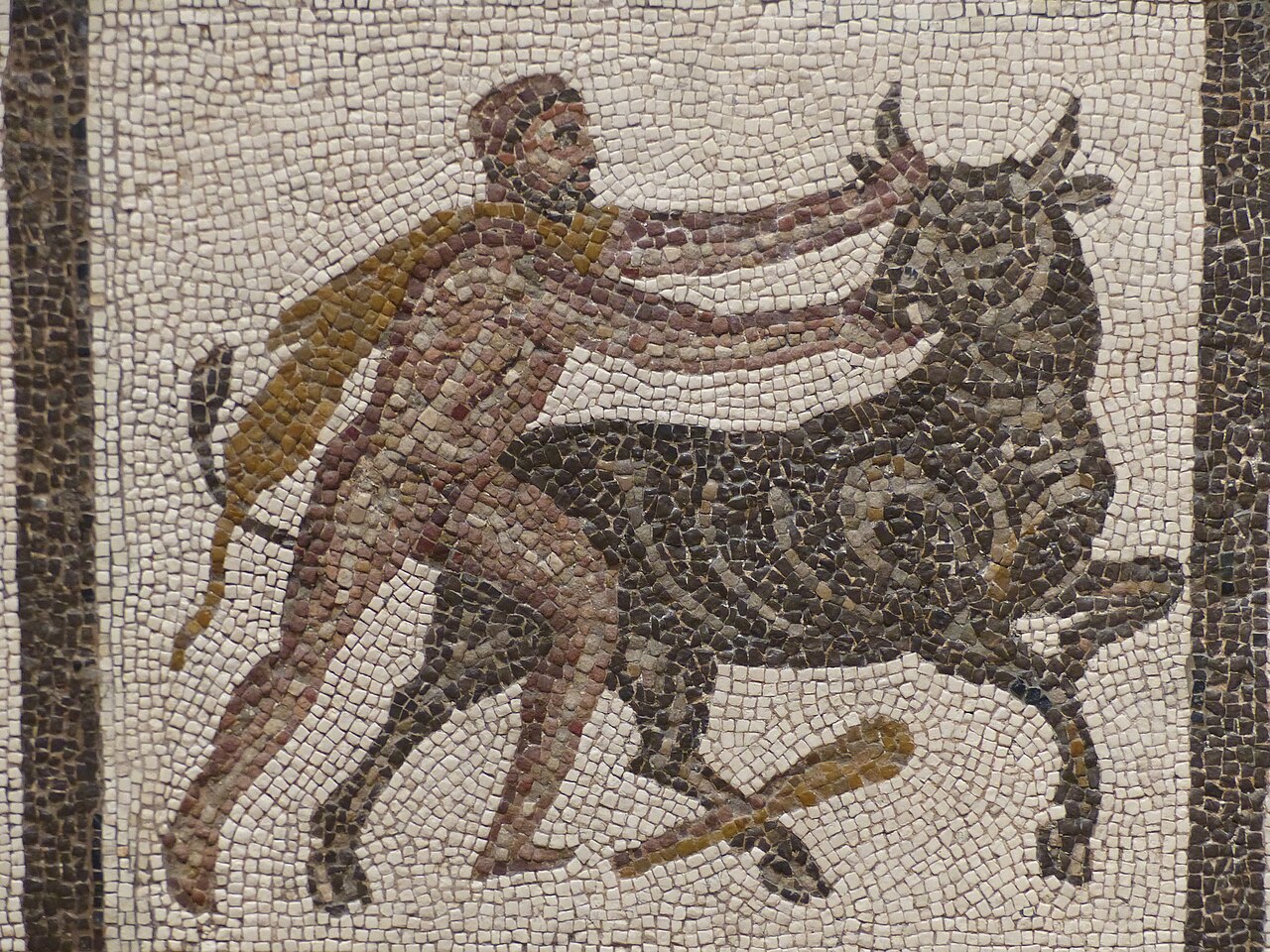
The seventh labour of Heracles was the capture of the Cretan Bull, a magnificent and dangerous animal that had become a threat to the island of Crete.
The Capture of the Cretan Bull
The bull was no ordinary creature. It was associated with Poseidon, god of the sea, earthquakes and horses, and it possessed extraordinary strength, speed and ferocity.
King Eurystheus ordered Heracles to travel from the Greek mainland to Crete, capture the bull alive and bring it back to Mycenae.
The command carried Heracles beyond the Peloponnese and into the legendary kingdom of King Minos.
The labour connected the adventures of Heracles with the myths of Crete, the Minotaur, Queen Pasiphae and the Athenian hero Theseus.
Heracles had already captured the Ceryneian Hind and the Erymanthian Boar alive. However, the Cretan Bull was larger, more aggressive and powerful enough to devastate fields and settlements.
The seventh labour required Heracles to subdue the animal without killing it.
He could not rely upon his poisoned arrows because even a slight wound from Hydra venom would have caused death.
Instead, he had to face the bull directly, wrestle it into submission and transport it safely across the sea.
Heracles and the Twelve Labours
Heracles was the son of Zeus, king of the gods, and Alcmene, a mortal woman descended from the hero Perseus.
Hera, the wife of Zeus, hated Heracles because he was born from one of her husband’s relationships with a mortal.
She persecuted him throughout his life and eventually caused him to experience a terrible period of madness.
During this madness, Heracles killed members of his own family.
When his sanity returned, he was overwhelmed by grief and guilt.
Heracles travelled to the Oracle of Apollo at Delphi and asked how he might be purified.
The oracle ordered him to serve King Eurystheus of Tiryns and Mycenae.
Eurystheus assigned him a series of difficult and dangerous tasks that became known as the Labours of Heracles.
King Eurystheus
Eurystheus possessed authority over Heracles because of events surrounding their births.
Zeus had declared that the next descendant of Perseus to be born would rule over the others.
Hera delayed the birth of Heracles and caused Eurystheus to be born first.
Eurystheus therefore gained the kingship, even though he lacked the courage and strength of Heracles.
The king feared the hero and hoped that one of the labours would destroy him.
Each time Heracles returned successfully, Eurystheus created another task intended to be even more dangerous.
The First Six Labours
Before travelling to Crete, Heracles had completed six labours.
He had killed the invulnerable Nemean Lion and taken its skin as armour.
He had destroyed the Lernaean Hydra with the help of his nephew Iolaus.
He had captured the sacred Ceryneian Hind alive after pursuing it for an entire year.
He had captured the Erymanthian Boar and carried it back to Eurystheus.
He had cleaned the Augean Stables in a single day by redirecting rivers through them.
He had also defeated the Stymphalian Birds by frightening them from their marsh with a bronze rattle given by Athena.
The seventh labour began a new stage in which Heracles travelled farther from the mainland of Greece.
The Island of Crete
Crete is the largest of the Greek islands and lies in the eastern Mediterranean Sea.
In mythology, it was a land of ancient kings, sacred caves, powerful gods and extraordinary creatures.
Zeus was said to have been hidden and raised in a cave on Crete after his mother Rhea saved him from his father Cronus.
The island was also ruled by King Minos, whose palace at Knossos became one of the most famous locations in Greek legend.
Crete was associated with bulls in both mythology and ancient religious imagery.
The Cretan Bull therefore belonged to a landscape in which the animal possessed royal, divine and ceremonial importance.
King Minos
King Minos was the son of Zeus and Europa.
According to myth, Zeus approached Europa in the form of a beautiful white bull.
Europa climbed onto the animal’s back, and Zeus carried her across the sea to Crete.
There she became the mother of Minos, Rhadamanthys and Sarpedon.
Minos later became king of Crete and was remembered as a powerful lawgiver.
After his death, he was sometimes described as one of the judges of the dead in the Underworld.
Minos Claims the Throne
When Minos sought the kingship of Crete, he claimed that the gods supported his right to rule.
To prove this, he prayed to Poseidon and asked the god to send a sign from the sea.
Minos promised that he would sacrifice whatever creature Poseidon provided.
Poseidon caused a magnificent bull to emerge from the water.
The animal’s appearance convinced the people that Minos had divine support.
Minos gained the throne, but he failed to honour the promise that had secured his authority.
The Bull from the Sea
The bull sent by Poseidon was exceptionally beautiful and powerful.
It was often imagined as white, shining and physically perfect.
Its supernatural origin made it a suitable sacrifice for the god who had sent it.
Minos was expected to kill the bull upon an altar and dedicate it to Poseidon.
Instead, he became unwilling to lose such an impressive animal.
Minos Breaks His Promise
Minos kept the divine bull within his own herds.
He sacrificed another animal in its place, hoping that Poseidon would accept the substitution.
The decision was an act of dishonesty and religious disrespect.
Minos had gained political power through a promise to a god and then refused to fulfil that promise.
Poseidon responded with punishment.
Poseidon’s Anger
Poseidon became furious when Minos kept the bull.
Different traditions describe the punishment in several ways.
In some accounts, the god caused the bull to become wild and uncontrollable.
In others, he caused Queen Pasiphae, the wife of Minos, to develop an unnatural desire for the animal.
Both punishments transformed the divine sign of kingship into a source of shame and destruction.
Queen Pasiphae
Pasiphae was the daughter of the sun god Helios and the wife of King Minos.
She was also the sister of the enchantress Circe and the sorceress Aeetes in some genealogies.
Under the influence of Poseidon’s punishment, Pasiphae became obsessed with the Cretan Bull.
She turned to the skilled inventor Daedalus for assistance.
Daedalus
Daedalus was a master craftsman, architect and inventor living at the court of Minos.
He built a hollow wooden cow covered with real animal hide.
Pasiphae concealed herself inside the construction so that she could approach the bull.
From this unnatural union came the Minotaur, a creature with the body of a man and the head of a bull.
The Birth of the Minotaur
The Minotaur was named Asterion or Asterius in some traditions.
It became a symbol of the consequences of Minos’ broken promise.
A divine bull had been sent as proof of rightful kingship.
Minos’ refusal to sacrifice it produced a monster within his own royal household.
The shame could not easily be destroyed or hidden.
The Labyrinth
Minos ordered Daedalus to construct the Labyrinth, a vast and confusing structure beneath or near the palace of Knossos.
The Minotaur was imprisoned inside it.
The twisting passages made escape almost impossible.
Later, the Athenians were forced to send young men and women to Crete as victims for the creature.
The hero Theseus eventually entered the Labyrinth and killed the Minotaur with the help of Minos’ daughter Ariadne.
Was the Cretan Bull the Father of the Minotaur?
In the most famous tradition, the bull captured by Heracles was the same animal that fathered the Minotaur.
This connection placed the seventh labour within the larger story of Minos, Pasiphae and the Labyrinth.
However, ancient mythology often contained variations.
Some accounts may have separated the bull involved with Pasiphae from the animal later captured by Heracles.
The most familiar version treats them as the same supernatural creature.
The Bull Becomes Wild
After Poseidon’s punishment, the bull became violent and escaped royal control.
It roamed across Crete, damaging farmland and threatening villages.
The animal uprooted trees, trampled crops and attacked anyone who approached.
Some later traditions claimed that it breathed fire from its nostrils.
Whether or not fire formed part of the earliest myth, the bull was clearly represented as dangerous and impossible for ordinary people to restrain.
The Destruction of the Countryside
Crete depended upon agriculture, livestock and trade.
A giant bull wandering freely through cultivated land could destroy months of work within a short time.
Fields were trampled, fences broken and herds scattered.
Farmers could not safely challenge the creature because of its divine strength.
The punishment intended for Minos therefore brought suffering upon ordinary people throughout the island.
The Bull as a Royal Problem
The bull had originally proved Minos’ right to rule.
Its later violence exposed his failure to keep his promise.
The animal became a living reminder that the king’s authority rested upon an act of deception.
Minos could not easily kill it because of its divine origin and enormous power.
He also could not control it.
The creature therefore represented a political and religious failure as well as a physical danger.
Eurystheus Orders the Labour
Eurystheus learned of the wild bull and ordered Heracles to capture it.
The king may have believed that the sea journey, the power of the animal and the dangers of Crete would finally defeat the hero.
The bull had to be taken alive.
Heracles could not simply shoot it with poisoned arrows or kill it with his club.
The task required direct control over a creature associated with Poseidon.
The Journey Across the Sea
Heracles travelled to a port and found passage to Crete.
Ancient myths do not always explain the details of the voyage.
He may have sailed aboard a merchant vessel, royal ship or small craft.
The journey carried him across open sea, a landscape controlled by Poseidon.
This was especially significant because the bull itself had emerged from the sea through the power of the same god.
Heracles Arrives in Crete
When Heracles reached Crete, he entered the kingdom of Minos and announced the purpose of his journey.
He asked for permission or assistance in capturing the bull.
Minos was willing to see the destructive creature removed from the island.
However, he did not provide Heracles with an army or large hunting force.
The king declared that the hero could take the bull if he was capable of capturing it himself.
Why Minos Accepted the Plan
Minos had several reasons to allow Heracles to attempt the task.
The bull was destroying his kingdom and had become a constant reminder of Poseidon’s anger.
If Heracles succeeded, Crete would be freed from the danger.
If he failed, Minos would lose nothing.
The arrangement placed all risk upon the hero.
Heracles Refuses Assistance
Some traditions stated that Minos offered assistance but Heracles refused it.
The hero wished to complete the labour through his own effort so that Eurystheus could not reject it.
Eurystheus had already refused to recognise the Hydra labour because Iolaus had helped.
Heracles therefore had a reason to avoid accepting support during the capture of the bull.
Searching for the Bull
Heracles travelled across the Cretan countryside and searched for signs of the animal.
He followed enormous hoofprints, broken trees and damaged fields.
Villagers may have directed him towards the most recent place where the bull had appeared.
The animal moved across wide areas, making the search part of the challenge.
The Bull’s Appearance
The Cretan Bull was often imagined as enormous, white and physically perfect.
Its shoulders were high, its muscles powerful and its horns long and dangerous.
The animal’s supernatural beauty remained visible even after it became wild.
This combination of magnificence and violence made it both admirable and terrifying.
The Bull’s Horns
The horns were among the animal’s greatest weapons.
A charging bull could toss a man into the air or pierce his body.
Heracles needed to control the head before the creature could use its full strength.
Grasping the horns was dangerous, but it also offered the best method of controlling the direction of the attack.
The Bull’s Speed
Despite its size, the bull could move quickly across open ground.
A direct charge carried enormous force.
Heracles could not safely stand still and absorb the full impact.
He needed to avoid the first attack, move close to the animal and prevent it from building speed again.
The Bull Charges
When Heracles approached, the bull lowered its head and charged.
The ground shook beneath its hooves.
Heracles moved aside at the correct moment and avoided the horns.
He then closed the distance before the animal could turn and gain speed for another charge.
Heracles Grabs the Horns
Heracles seized the bull by its horns.
The creature twisted its head and attempted to throw him away.
Its neck and shoulders possessed tremendous strength.
Heracles planted his feet, tightened his grip and resisted the movement.
The contest became a direct struggle between the strongest hero of Greece and a divine animal of Poseidon.
The Wrestling Match
Heracles wrestled the bull rather than striking it with a weapon.
He forced its head downward and prevented it from using its horns effectively.
The bull pushed, kicked and turned while Heracles continued holding it.
The struggle may have lasted a long time.
Neither strength nor courage alone was enough.
Heracles also needed balance, timing and control over the animal’s movements.
Forcing the Bull to the Ground
Heracles gradually overcame the bull’s resistance.
He twisted its head, placed pressure upon its neck and forced it towards the ground.
Once the animal fell, he moved quickly to prevent it from rising again.
He placed a knee or part of his weight upon its body while preparing ropes.
Binding the Bull
Heracles secured strong ropes around the bull’s head, horns and legs.
The bindings had to be tight enough to control the creature without injuring or killing it.
If the ropes broke, the animal could escape and attack again.
Heracles successfully restrained the bull and completed the most dangerous part of the labour.
The Bull Is Captured Alive
The bull remained alive, fulfilling the condition established by Eurystheus.
Heracles had not used poisoned arrows or a killing blow.
He had overcome the animal through physical strength and controlled wrestling.
The people of Crete were freed from the threat that had devastated their land.
Heracles and the Bull in Ancient Art
Ancient artists often represented Heracles wrestling the bull by its horns.
The hero might be shown pressing the animal to the ground or lifting it across his shoulders.
The scene allowed artists to display the power of both bodies.
The bull’s curved form contrasted with the muscular human figure of Heracles.
Transporting the Bull
Capturing the bull was only part of the labour.
Heracles still needed to transport it from Crete to Mycenae.
The animal could not simply be released aboard an ordinary ship.
It had to remain bound and controlled throughout the sea journey.
Crossing the Sea
Different traditions explained the return journey in different ways.
Heracles may have placed the bull aboard a ship and sailed back to the mainland.
Some accounts imagined him riding upon the animal or forcing it to swim across part of the sea.
The myth usually focuses more upon the capture than the practical details of transport.
Whatever method was used, Heracles successfully brought the living bull from Crete to Greece.
Poseidon and the Voyage
The return journey took place across waters ruled by Poseidon.
The god could have sent storms or waves to prevent the removal of his bull.
Most versions do not describe direct opposition from Poseidon during the journey.
The god may have accepted the removal as part of the punishment of Minos or as a new stage in the animal’s fate.
Arrival on the Mainland
Heracles reached the Greek mainland and began leading the bull towards Mycenae.
The journey over land remained dangerous because the animal could recover its strength and attempt to escape.
Heracles kept control of the ropes and prevented it from attacking travellers or livestock.
The Bull Before Eurystheus
Heracles finally presented the Cretan Bull to King Eurystheus.
The sight of the enormous living animal terrified the king.
Eurystheus had previously hidden inside a bronze jar when Heracles returned with the Erymanthian Boar.
Although accounts vary, his fear of the Cretan Bull matched his general inability to face the creatures he ordered Heracles to capture.
Eurystheus Plans a Sacrifice
Eurystheus intended to sacrifice the bull to Hera.
Such an offering might have been intended to honour the goddess who had supported him and persecuted Heracles.
However, Hera refused the sacrifice.
She did not want to receive an animal whose capture would bring additional glory to Heracles.
The bull was therefore not killed upon her altar.
The Bull Is Released
Eurystheus released the bull or allowed it to escape.
This decision created a new problem.
The animal remained wild and powerful.
Instead of arranging for it to be safely controlled, the king allowed it to wander through Greece.
The bull travelled across the Peloponnese and eventually reached Attica.
The Journey to Marathon
The bull settled near the plain of Marathon, north-east of Athens.
There it became known as the Marathonian Bull.
It again damaged crops, attacked people and threatened the surrounding communities.
The animal captured by Heracles had been removed from Crete but not permanently controlled.
Eurystheus’ careless release transferred the danger from one region to another.
The Marathonian Bull
The Marathonian Bull was usually identified as the same animal as the Cretan Bull.
Its name changed according to the location where it caused destruction.
In Crete, it was remembered through Minos and Poseidon.
At Marathon, it became part of the heroic story of Theseus.
Theseus
Theseus was the great hero of Athens and the son of Aegeus or Poseidon, depending upon the tradition.
He performed several adventures while travelling from Troezen to Athens.
Later, King Aegeus or another authority sent him to capture the Marathonian Bull.
This task helped establish Theseus as a protector of Attica.
Theseus Captures the Bull
Theseus travelled to Marathon and confronted the bull.
Like Heracles, he captured the animal alive.
He brought it back to Athens, where it was sacrificed to Apollo, Athena or another god, depending upon the version.
The death of the bull finally ended the destruction that had begun with Minos’ broken promise.
Heracles and Theseus
The Cretan Bull connects the myths of Heracles and Theseus.
Heracles first captures and removes the animal from Crete.
Theseus later captures it at Marathon and brings its wandering to an end.
The two heroes perform similar acts in different regions.
This connection allowed Athens to link its own hero with the wider heroic tradition of Heracles.
Theseus and the Minotaur
The connection between Theseus and the bull becomes even stronger through the Minotaur.
The Cretan Bull fathered the Minotaur in the most famous tradition.
Theseus later travelled to Crete and killed the bull-headed creature inside the Labyrinth.
He therefore defeated both the offspring of the Cretan Bull and, in another adventure, the bull itself.
The Bull’s Mythological Journey
The bull’s story moves through several important stages.
It emerges from the sea as a divine sign for Minos.
It becomes the father of the Minotaur and a punishment upon the royal household.
It devastates Crete and is captured by Heracles.
It is released by Eurystheus, reaches Marathon and is captured by Theseus.
Its journey connects Poseidon, Minos, Pasiphae, Daedalus, Heracles and Theseus within one mythological chain.
The Completion of the Seventh Labour
Heracles had fulfilled the exact command given by Eurystheus.
He travelled to Crete, captured the bull alive and brought it to Mycenae.
The later release of the animal was the decision of Eurystheus rather than a failure by Heracles.
The seventh labour was therefore officially complete.
The Meaning of the Seventh Labour
The capture of the Cretan Bull is a story about strength under control.
Heracles must subdue a creature capable of destroying fields and killing humans.
He cannot simply destroy it.
The labour proves that he can use overwhelming strength with precision.
The Bull as a Symbol of Power
Bulls were powerful symbols throughout the ancient Mediterranean.
They represented strength, fertility, kingship and divine energy.
A ruler who controlled a bull demonstrated mastery over dangerous natural power.
Minos gains authority when Poseidon sends the animal.
Heracles gains glory by capturing it.
The Bull as a Symbol of Kingship
The bull originally confirms Minos’ claim to the throne.
Its arrival from the sea proves that a god supports him.
However, the king’s refusal to sacrifice it reveals that divine approval can be lost through dishonesty.
The same animal that raises Minos becomes evidence of his failure.
The Bull as a Symbol of Broken Promises
Minos promises to sacrifice the bull but keeps it for himself.
The disaster that follows begins with this broken agreement.
The myth reflects a common Greek theme in which rulers suffer after failing to honour gods, guests or contracts.
Laomedon, Augeas and Minos all face consequences after refusing to fulfil promises.
Minos and Augeas Compared
Minos keeps a bull he promised to Poseidon.
Augeas refuses to provide cattle he promised to Heracles.
Both kings benefit from an agreement and then attempt to avoid payment.
Their dishonesty creates wider suffering.
The fifth and seventh labours are therefore linked by the theme of broken promises.
The Bull as a Symbol of Uncontrolled Desire
The punishment of Pasiphae transforms the bull into a symbol of desire that has escaped moral and natural boundaries.
Minos’ greed leads to Poseidon’s anger.
Pasiphae’s divinely imposed passion produces the Minotaur.
Personal wrongdoing spreads through the royal family and becomes a public disaster.
The Bull as a Symbol of Natural Force
Once wild, the bull becomes a force of nature beyond royal control.
It destroys fields, breaks boundaries and challenges human settlements.
Heracles restores order by taking physical control of the animal.
The Sea and the Bull
The bull emerges from the sea and is sent by Poseidon.
This connection reflects the god’s ability to create violent and unpredictable forces.
The sea can bring wealth, travel and divine signs.
It can also bring storms, monsters and destruction.
Poseidon and Bulls
Poseidon was frequently associated with bulls and horses.
Bulls were sacrificed to him in several Greek traditions.
Their strength and violent movement suited a god connected with earthquakes and crashing waves.
The Cretan Bull embodied the dangerous power of Poseidon in animal form.
White Bulls and Sacred Animals
White animals were often regarded as especially pure or suitable for sacrifice.
The shining appearance of the Cretan Bull increased its sacred value.
Minos’ unwillingness to surrender such a magnificent creature revealed his preference for possession over religious duty.
Sacrifice and Obligation
Sacrifice was not simply the destruction of valuable property.
It was an exchange between humans and gods.
Minos asked Poseidon for a sign and promised a sacrifice in return.
By keeping the bull, he accepted the divine benefit while refusing the required response.
The punishment restored the seriousness of the agreement.
Religious Authority and Political Authority
Minos uses a divine sign to gain political power.
His kingship therefore depends upon religious legitimacy.
When he breaks his promise, his moral failure becomes a political weakness.
The bull’s violence demonstrates that rulers cannot safely use religion for personal gain while ignoring sacred obligations.
Heracles as a Corrective Force
Heracles enters Crete after the failure of Minos has produced widespread suffering.
He does not repair the king’s relationship with Poseidon.
He removes the immediate danger from the countryside.
The hero acts as a corrective force when royal authority proves unable to control its own consequences.
Heracles and Minos Compared
Minos gains possession of the bull through divine favour but cannot control his desire to keep it.
Heracles gains control of the bull through courage and then gives it to Eurystheus as commanded.
Minos fails because he refuses to surrender the animal.
Heracles succeeds because he completes his duty despite the difficulty.
Heracles and Eurystheus Compared
Heracles faces the bull directly and risks death.
Eurystheus orders the task from safety and later releases the animal irresponsibly.
The contrast again separates true heroic ability from official political power.
Eurystheus possesses authority, while Heracles performs the work of protecting communities.
The Failure of Eurystheus
Eurystheus fails to manage the captured bull responsibly.
He has demanded that the animal be brought alive but has no clear plan for its future.
When Hera refuses the sacrifice, he releases it.
The bull then threatens another region.
The story shows that completing a difficult project is wasted if the result is not managed carefully.
Removing a Problem and Solving a Problem
Heracles removes the bull from Crete.
Eurystheus does not create a permanent solution.
The danger is transferred to Marathon.
The labour therefore distinguishes between relocating a problem and ending it completely.
The Role of Restraint
Heracles possesses the ability to kill the bull.
He controls that ability because the animal must remain alive.
The task continues the lesson learned during the capture of the Ceryneian Hind and Erymanthian Boar.
Strength becomes heroic when it is disciplined.
The Role of Wrestling
Wrestling allows Heracles to defeat the bull without using deadly weapons.
The contest depends upon balance, grip, leverage and endurance.
It represents a form of controlled combat in which the goal is submission rather than death.
Heracles as a Wrestler
Heracles was famous not only as a warrior but also as an athlete.
Wrestling was one of the most respected events in Greek athletic competition.
The capture of the bull demonstrates the heroic form of the sport.
Instead of wrestling another athlete, Heracles wrestles a supernatural animal.
The Importance of the Horns
By seizing the horns, Heracles gains control over the direction of the bull’s head.
The horns are dangerous weapons, but they also provide handles through which the animal can be turned.
The solution once again exists partly within the danger itself.
The Importance of Balance
The bull’s weight and strength could easily knock Heracles to the ground.
He must position his feet carefully and resist the animal’s movement.
The labour demonstrates that raw strength without balance would fail.
The Importance of Timing
Heracles avoids the initial charge and approaches before the bull can turn.
A moment too early would place him before the horns.
A moment too late would allow the animal to build speed again.
Correct timing transforms danger into opportunity.
The Importance of Courage
Heracles must move closer to the bull rather than remain safely at a distance.
The horns and hooves can kill him if he loses control.
His courage lies in entering the reach of the animal while maintaining discipline.
The Importance of Self-Control
Heracles cannot respond to danger with uncontrolled violence.
A fatal blow would fail the labour.
He must remain calm during the struggle and apply only the force needed for submission.
The Importance of Endurance
The bull does not surrender immediately.
Heracles must maintain his grip while the animal pushes, twists and attempts to escape.
Victory depends upon continuing until the bull’s resistance weakens.
The Importance of Planning
Heracles approaches the bull without an army or heavy equipment.
He must choose open ground, avoid obstacles and prepare strong ropes.
The success of the capture depends upon preparation before physical contact begins.
The Importance of Transportation
The labour is not complete when the bull is subdued.
Heracles must carry or lead it across Crete, onto a ship and through Greece.
This part of the task requires continuous control rather than one moment of victory.
A captured danger remains dangerous until it is securely delivered.
The Seventh Labour and the Wider Cycle
The seventh labour marks a geographical expansion in the adventures of Heracles.
The first six labours took place mainly within the Peloponnese.
The journey to Crete carries him across the sea.
Later tasks will send him to Thrace, the land of the Amazons, the far west and the Underworld.
The First Seven Labours Compared
The Nemean Lion tests direct physical strength.
The Lernaean Hydra tests cooperation and strategy.
The Ceryneian Hind tests patience and restraint.
The Erymanthian Boar tests hunting skill and the use of terrain.
The Augean Stables test engineering and creative thought.
The Stymphalian Birds test archery and specialised tools.
The Cretan Bull tests wrestling, balance and controlled force.
The Lion and the Bull
Both the Nemean Lion and Cretan Bull possess extraordinary physical power.
Heracles fights both creatures at close range.
However, he kills the lion and captures the bull alive.
The contrast demonstrates his increasing ability to control the outcome of combat.
The Hind and the Bull
Both creatures must be captured alive.
The Ceryneian Hind is peaceful and sacred to Artemis.
The Cretan Bull is violent and connected with Poseidon.
Heracles pursues the hind for a year but wrestles the bull directly.
Similar commands require different methods because the animals possess different natures.
The Boar and the Bull
The Erymanthian Boar and Cretan Bull are both destructive animals captured alive.
Heracles exhausts the boar in snow before trapping it.
He overpowers the bull through wrestling.
The two labours show his ability to combine strategy with physical control.
The Birds and the Bull
The Stymphalian Birds require distance, sound and archery.
The Cretan Bull requires direct contact and wrestling.
Heracles can change completely from one style of combat to another.
This adaptability is one of the defining qualities of the labours.
The Bull and the Minotaur
The bull is an animal of divine origin that becomes wild.
The Minotaur is a hybrid monster born from the consequences of Minos’ wrongdoing.
Both creatures reveal how a king’s broken promise can create dangers that extend beyond his own life.
The Bull and Europa
The story of Minos begins with Zeus disguised as a bull carrying Europa to Crete.
It later continues with Poseidon sending another bull to Minos.
The bull is therefore present at both the beginning of the royal dynasty and the beginning of its greatest shame.
Bulls in Minoan Culture
Archaeological discoveries from Bronze Age Crete show that bulls held an important place in Minoan imagery and ceremony.
Wall paintings, seals and objects depict bulls and activities often interpreted as bull-leaping.
Large ceremonial horns also appeared within palace complexes.
These ancient traditions may have influenced later Greek myths involving the Cretan Bull and Minotaur.
Bull-Leaping
Bull-leaping scenes show human figures interacting with bulls in highly dangerous athletic or ceremonial performances.
The exact meaning of these images remains debated.
They may have represented ritual, sport, symbolic performance or artistic imagination.
The myth of Heracles wrestling the Cretan Bull fits naturally within a cultural landscape fascinated by human mastery over the animal.
The Palace of Knossos
Knossos was a major Bronze Age centre on Crete and later became associated with King Minos.
Its large and complex palace may have contributed to stories about the Labyrinth.
The many rooms, corridors and levels could appear maze-like to later visitors.
The bull imagery found there strengthened the connection between Crete and bull-centred mythology.
Was There a Historical Cretan Bull?
There is no evidence that a supernatural bull devastated the island and was captured by a historical Heracles.
The myth may preserve memories of dangerous bull-catching rituals, royal ceremonies or the importance of cattle in Minoan religion.
It may also combine several older stories involving Poseidon, Minos and sacred animals.
Myth and History
The Cretan Bull belongs to mythology rather than verifiable history.
However, the setting reflects real features of ancient Crete.
Bulls were symbolically important, the island supported powerful palace societies and sea travel connected Crete with mainland Greece.
Myth transformed these realities into a story of divine punishment and heroic capture.
The Bull in Ancient Greek Art
The seventh labour appeared frequently in Greek vase painting and sculpture.
Heracles was shown grasping the bull’s horns, pressing down its neck or carrying it upon his shoulders.
The Nemean Lion skin identified the hero, while the bull’s massive body communicated the difficulty of the labour.
The Bull on Temple Sculpture
The Twelve Labours appeared on the metopes of the Temple of Zeus at Olympia.
The Cretan Bull was included within the sequence.
The scene showed Heracles in physical contact with the animal, demonstrating strength and control.
Athena sometimes appeared nearby in representations of the labours, symbolising wisdom and divine support.
The Bull in Roman Art
The Romans adopted the myth as part of the adventures of Hercules.
Roman mosaics, reliefs and sculptures represented the hero wrestling or carrying the bull.
The image became a symbol of victory over dangerous natural power.
The Bull in Later Literature
Later writers retold the labour while connecting it with the Minotaur and Theseus.
Some emphasised the fire-breathing nature of the animal.
Others focused upon the direct wrestling match.
The different versions reflect the flexible nature of ancient mythology.
The Bull in Modern Culture
The Cretan Bull appears in modern novels, films, television programmes, comics and games.
It is often portrayed as an enormous white bull with supernatural strength.
Some adaptations give it flaming breath, glowing eyes or armour-like skin.
The essential challenge remains the need to capture it alive.
The Labour as a Lesson in Promises
The entire crisis begins because Minos breaks a promise.
He asks for divine support and refuses the promised sacrifice.
The story teaches that agreements remain binding even when fulfilment becomes costly.
The Labour as a Lesson in Greed
Minos keeps the bull because it is too beautiful and valuable to surrender.
His greed turns a gift into a punishment.
The myth warns that possessing something against rightful obligation can destroy the benefit it originally offered.
The Labour as a Lesson in Responsibility
Minos’ private decision causes suffering throughout Crete.
Royal wrongdoing becomes a public disaster.
The story suggests that leaders carry responsibility because their choices affect people far beyond the palace.
The Labour as a Lesson in Controlled Strength
Heracles wins without killing the bull.
He applies enough force to restrain the animal but not enough to destroy it.
The labour presents control as a higher achievement than uncontrolled violence.
The Labour as a Lesson in Courage
Heracles approaches a creature powerful enough to devastate an island.
He accepts the danger of its horns and hooves because the people of Crete cannot control it.
His courage transforms personal risk into public protection.
The Labour as a Lesson in Adaptation
Heracles has used strangulation, fire, nets, rivers, noise and arrows during earlier labours.
Against the bull, he uses wrestling.
The changing methods demonstrate that no single skill is enough for every problem.
The Labour as a Lesson in Completion
Capturing the bull is not enough.
Heracles must deliver it to Eurystheus.
The task teaches that success includes transportation, security and the fulfilment of every condition.
The Labour as a Lesson in Poor Management
Eurystheus receives the bull but fails to manage it responsibly.
His release allows the animal to threaten Marathon.
The story shows that acquiring control over a danger is useless if that control is not maintained.
The Labour as a Lesson in Displaced Problems
The bull disappears from Crete but appears in Attica.
The immediate problem is moved rather than completely solved.
True resolution comes only when Theseus captures and sacrifices the animal.
The Labour and Heracles’ Redemption
Heracles performs the labours as part of his purification after the tragedy caused during his madness.
By capturing the bull, he protects farmers, families and travellers across Crete.
His strength becomes a source of safety rather than destruction.
The labour therefore contributes to his moral transformation.
Heroism and Public Service
Heracles receives no permanent ownership of the bull.
He risks his life, completes the task and delivers the creature to another king.
The greatest benefit goes to the people of Crete, whose land is freed from devastation.
The labour presents heroism as service rather than possession.
The Eighth Labour Approaches
After the capture of the Cretan Bull, Eurystheus assigned another dangerous task.
Heracles was ordered to travel to Thrace and obtain the man-eating mares of King Diomedes.
The eighth labour would involve a cruel ruler, carnivorous horses and the death of Heracles’ companion Abderus.
The Legacy of the Seventh Labour
The capture of the Cretan Bull remains one of the most important links between the mythology of Heracles and the legends of Crete.
It connects the hero with Poseidon, Minos, Pasiphae, Daedalus, the Minotaur and Theseus.
The labour also reflects the strong symbolic importance of bulls within the ancient Mediterranean world.
Conclusion
The seventh labour of Heracles was the capture of the Cretan Bull, a supernatural animal sent from the sea by Poseidon.
King Minos had asked Poseidon for a sign proving his right to rule Crete.
The god sent a magnificent bull, and Minos promised to sacrifice it.
When the king saw the animal’s beauty, he kept it and offered another bull instead.
Poseidon punished the broken promise.
The bull became wild, and Queen Pasiphae developed an unnatural desire for it.
With the help of Daedalus, Pasiphae approached the animal and later gave birth to the Minotaur.
The bull itself escaped royal control and devastated the countryside of Crete.
King Eurystheus ordered Heracles to capture it alive and bring it to Mycenae.
Heracles sailed to Crete and received permission from Minos to attempt the task.
He searched the island, found the bull and faced its powerful charge.
Heracles avoided the horns, moved close and seized the animal by the head.
He wrestled the bull, forced it to the ground and secured it with ropes.
The hero then transported the living animal across the sea and presented it to Eurystheus.
Eurystheus planned to sacrifice the bull to Hera, but the goddess refused an offering that would increase the glory of Heracles.
The bull was released and wandered through Greece until it reached Marathon.
There it became known as the Marathonian Bull and continued threatening local communities.
The Athenian hero Theseus later captured it and brought its destructive journey to an end.
The seventh labour demonstrates the controlled strength of Heracles.
He possesses the power to kill the bull but restrains himself because the animal must remain alive.
The labour also teaches that broken promises can produce consequences far beyond the person who makes them.
Minos’ dishonesty brings shame to his family, creates the Minotaur and exposes Crete to destruction.
Heracles becomes the hero required to control the danger created by royal failure.
Through courage, balance, endurance and discipline, he transforms a violent divine animal into a captive.
The capture of the Cretan Bull therefore stands as both a heroic wrestling contest and a moral story about promises, responsibility and the need to control great power wisely.