Athens and Sparta were two of the most powerful and influential city-states of ancient Greece. Although they shared a common language, worshipped many of the same gods and considered themselves part of the wider Greek world, their societies developed in very different ways.
Two Rival Powers of Ancient Greece
Athens became famous for democracy, philosophy, literature, theatre, architecture and maritime trade. Sparta became known for military discipline, strict social organisation, physical endurance and one of the most formidable land armies in the ancient Mediterranean.
The contrast between Athens and Sparta has often been described as a conflict between culture and warfare, freedom and discipline, or democracy and oligarchy. These comparisons contain some truth, but both societies were more complicated than these simple oppositions suggest.
Athens was a centre of intellectual and artistic achievement, but it also possessed an empire, relied heavily upon slavery and could treat its enemies with great brutality. Sparta admired courage and equality among its male citizens, but its political system depended upon the forced labour of a much larger subject population.
The rivalry between the two cities eventually led to the Peloponnesian War, a conflict that divided the Greek world and weakened many of its leading states.
The histories of Athens and Sparta reveal two very different answers to the same question: how should a city organise its government, educate its people, defend its territory and define the duties of its citizens?
The Greek City-State
Ancient Greece was not a single unified country ruled by one king or central government. It consisted of many independent communities known as poleis, or city-states.
Each city-state usually included an urban centre and the surrounding countryside. It had its own government, laws, religious traditions, army and political identity.
The mountainous geography of Greece encouraged the development of separate communities. Mountains divided regions, while coastlines and islands created strong connections with the sea.
Greek city-states frequently competed with one another for land, trade, influence and honour. They could form alliances when faced with a common enemy, but these alliances were often temporary.
Athens and Sparta became especially powerful during the fifth century before Christ. Their different political systems and military strengths allowed them to dominate rival groups of Greek states.
Athens led an alliance based largely upon naval power, while Sparta led a coalition whose strength came from armies fighting on land.
The Geography of Athens
Athens was located in Attica, a region of south-eastern mainland Greece. The city was surrounded by rocky hills and relatively limited agricultural land.
Attica was not as fertile as some other parts of Greece, but it was suitable for growing olives and grapes. Olive oil and wine became important products for trade.
Athens was also close to the sea. Its principal harbour at Piraeus connected the city with the islands of the Aegean, the coast of Asia Minor, Egypt, the Black Sea and other parts of the Mediterranean.
This access to maritime trade encouraged Athens to develop a powerful navy and a society open to merchants, travellers, foreigners and ideas from distant places.
The centre of Athens was dominated by the Acropolis, a steep fortified hill containing important temples and religious monuments.
Below the Acropolis stood the Agora, the public marketplace and political centre where citizens traded goods, met friends, discussed public affairs and participated in civic life.
The Geography of Sparta
Sparta was located in Laconia, in the south-eastern Peloponnese. The city stood in the valley of the Eurotas River and was surrounded by mountains.
The region contained fertile agricultural land, especially when compared with Attica. This allowed Sparta to support a large population without depending as heavily upon overseas trade.
The mountains surrounding the territory offered natural protection from invasion. Sparta itself did not possess defensive walls for much of its history.
Spartans claimed that their warriors were the city’s walls.
Sparta also controlled the neighbouring region of Messenia. The conquest of this fertile territory gave Sparta access to more agricultural resources but created a large population of conquered labourers.
The need to control these subject people had a major influence on Spartan society. Fear of rebellion encouraged the Spartans to organise their entire state around military readiness and internal discipline.
The Origins of Athens
Athens was one of the oldest continuously inhabited cities in the Greek world. Archaeological evidence shows that people lived on and around the Acropolis long before the classical period.
According to mythology, the city was named after Athena, goddess of wisdom and warfare.
Athena competed with Poseidon for the right to become the city’s protector. Poseidon struck the ground with his trident and produced either a saltwater spring or a horse.
Athena created the olive tree, which provided food, oil, timber and trade.
The people judged Athena’s gift to be more useful and selected her as their patron goddess.
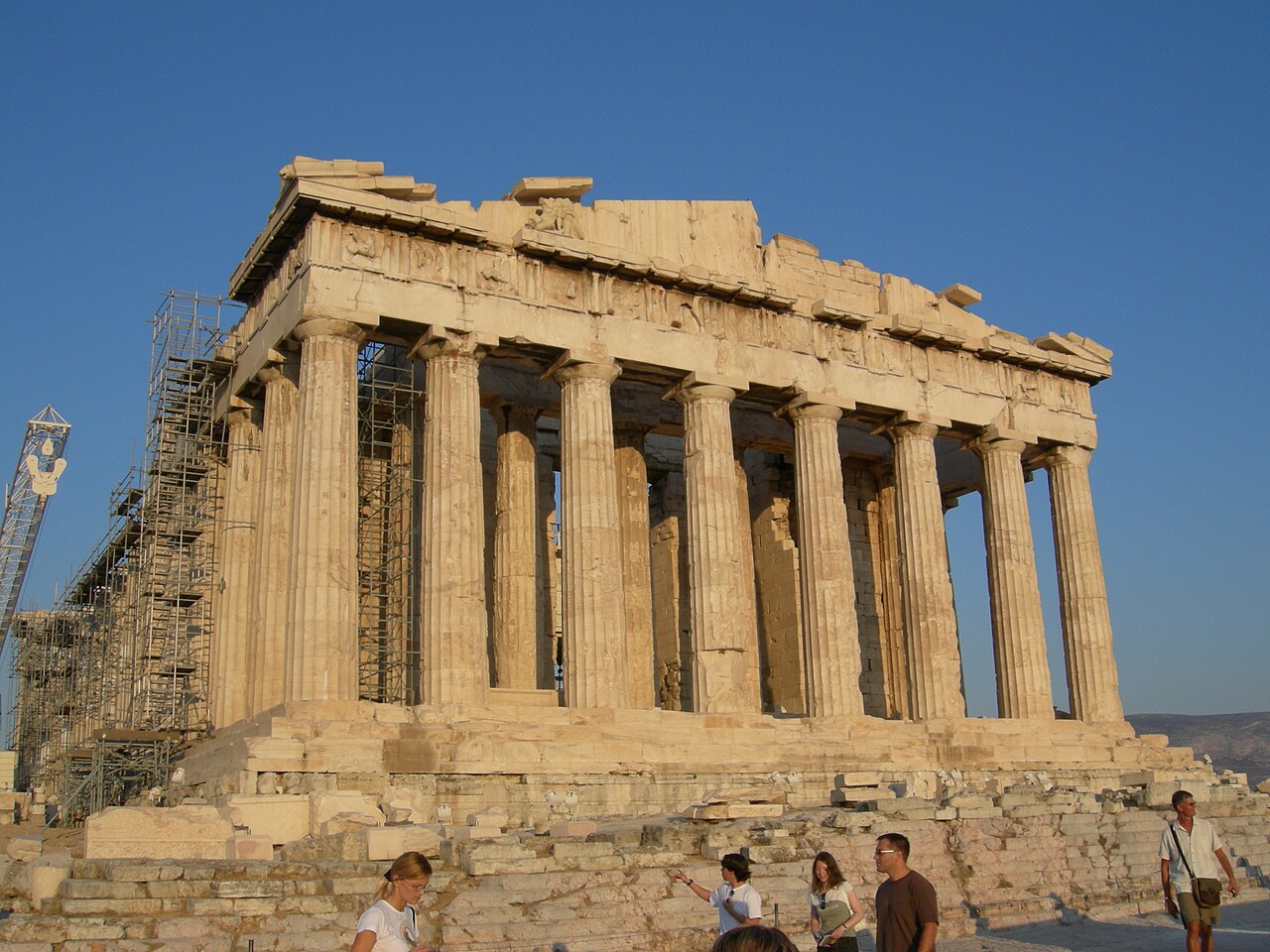
The olive tree became a symbol of Athens, while the great temple known as the Parthenon was later built in Athena’s honour upon the Acropolis.
Early Athens was ruled by kings, but political power gradually passed into the hands of aristocratic families.
Over time, social conflict and political reform transformed Athens into a democracy in which male citizens participated directly in government.
The Origins of Sparta
Sparta developed from several settlements in the Eurotas valley. Its citizens belonged to the wider Dorian cultural tradition of ancient Greece.
Spartan society credited many of its laws and institutions to the legendary lawgiver Lycurgus.
It is uncertain whether Lycurgus was a historical individual, but the Spartans believed that he had created the system that shaped their state.
According to tradition, Lycurgus established strict rules governing education, military service, property, public meals, political authority and personal behaviour.
These laws were intended to prevent luxury, selfishness and political disorder.
The Spartan system developed partly through conquest. Sparta defeated neighbouring communities and gradually gained control of Laconia and Messenia.
The conquered population supplied agricultural labour, allowing Spartan male citizens to devote much of their time to military training and public duties.
Athenian Government Before Democracy
Before the development of democracy, Athens was controlled by aristocratic families whose wealth came largely from land.
Powerful officials known as archons governed the city. A council called the Areopagus, composed mainly of former officials from noble families, also exercised considerable influence.
Economic inequality created serious tensions. Poor farmers often borrowed money from wealthy landowners and could lose their land or personal freedom when they failed to repay their debts.
Written laws were introduced by Draco during the seventh century before Christ.
Draco became famous for the severity of his legal code. The modern word draconian is still used to describe laws or punishments considered excessively harsh.
Although written laws made legal decisions more public, they did not resolve the deeper social problems affecting Athens.
The Reforms of Solon
In the early sixth century before Christ, the Athenian statesman Solon was given authority to reform the city.
Solon cancelled many debts and prohibited the practice of enslaving Athenian citizens for debt.
He reorganised citizens into property classes rather than allowing birth alone to determine political participation.
Wealthy citizens continued to hold the highest offices, but a wider section of the population gained access to political institutions.
Solon also strengthened the role of the courts and allowed citizens to appeal against decisions made by officials.
His reforms did not create a complete democracy, but they weakened aristocratic control and established important foundations for later change.
Solon attempted to balance the demands of rich and poor. Neither side was completely satisfied, but his laws helped prevent the city from collapsing into civil conflict.
Peisistratus and the Tyrants
After Solon’s reforms, political conflict continued. The leader Peisistratus eventually seized power and ruled Athens as a tyrant.
In ancient Greece, the word tyrant originally referred to a ruler who gained power outside the traditional constitutional system. It did not always imply extreme cruelty.
Peisistratus maintained many of Solon’s laws and encouraged agriculture, religion, public festivals and building projects.
He also strengthened the power of Athens and reduced the influence of certain aristocratic rivals.
After his death, his sons Hippias and Hipparchus continued the tyranny.
Hipparchus was assassinated, and Hippias became increasingly suspicious and oppressive.
Hippias was eventually expelled, opening the way for another major period of political reform.
Cleisthenes and the Birth of Athenian Democracy
Cleisthenes introduced reforms around 508 before Christ that are often regarded as the beginning of Athenian democracy.
He reorganised the citizen population into new political groups designed to weaken the power of traditional aristocratic families.
Citizens were placed into local districts known as demes. Political identity became connected to residence rather than only to family background.
Cleisthenes created a Council of Five Hundred, which prepared business for the citizen Assembly and supervised aspects of government.
Membership in the council was distributed among the political tribes of Athens.
Many public positions were eventually filled by lot, a method intended to give ordinary citizens an opportunity to participate and to prevent powerful families from controlling every office.
The reforms established the principle that citizens should share responsibility for governing the city.
Athenian Democracy
Athenian democracy was a direct democracy. Citizens did not elect representatives to make every decision for them.
Instead, eligible citizens could attend the Assembly, debate proposals and vote on laws, war, peace, alliances and public spending.
The Assembly met on the hill known as the Pnyx. Thousands of citizens could gather there to hear speeches and make decisions.
The Council of Five Hundred prepared the Assembly’s agenda and managed the daily work of government.
Large citizen juries decided legal cases. Jurors were usually selected by lot and received payment, allowing poorer citizens to participate.
Public speaking became extremely important. A citizen who could persuade the Assembly or a jury possessed considerable political influence.
Athenian democracy encouraged broad participation among citizens, but citizenship was limited.
Women, enslaved people and foreign residents were excluded from the Assembly and most political institutions.
Only free adult men born to Athenian citizen families possessed full political rights.
Ostracism in Athens
Athens developed a procedure known as ostracism to protect the city from individuals believed to be dangerously powerful.
Citizens could vote to exile a political figure for ten years.
They wrote the person’s name upon pieces of broken pottery known as ostraka.
The exiled person usually kept his property and was not treated as a criminal.
Ostracism was intended to prevent the rise of another tyrant and reduce political conflict before it became violent.
However, the system could also be used as a weapon against political rivals.
Several important Athenian leaders experienced ostracism, demonstrating both the openness and instability of democratic politics.
The Spartan Political System
Sparta did not develop a democracy like Athens. Its political structure combined elements of monarchy, oligarchy and limited popular participation.
The city had two kings at the same time. The kings came from two separate royal families.
They served as military commanders, religious leaders and representatives of the state.
The dual kingship prevented a single royal family from holding complete authority, although it could also create rivalry between the kings.
A council of elders known as the Gerousia played an important role in government.
The Gerousia included the two kings and twenty-eight men over the age of sixty.
It prepared proposals, advised the kings and served as a high court in serious cases.
Five officials known as ephors were elected each year. They supervised education, administration and the behaviour of citizens.
The ephors could even challenge or prosecute a king.
A citizen Assembly also existed, but its powers were more limited than those of the Athenian Assembly.
Spartan citizens could accept or reject proposals, but open debate was restricted.
The Two Kings of Sparta
The presence of two kings was one of Sparta’s most unusual institutions.
Each king belonged to a hereditary royal house. One came from the Agiad family and the other from the Eurypontid family.
During war, one king might lead the army while the other remained in Sparta.
The kings performed important sacrifices and maintained connections between the state and the gods.
The system offered continuity and religious authority, but the kings were not absolute rulers.
The Gerousia and ephors limited their power.
Spartan history includes several examples of conflict between kings, generals and ephors.
This balance of institutions helped prevent any one person from completely dominating the state.
Spartan Citizens
Full Spartan citizens were known as Spartiates or Equals.
They were adult men who had completed the state education system, served in the army and belonged to a common dining group.
Spartiates were expected to dedicate themselves to warfare and public duty.
They were supported by land worked by the helot population.
In theory, Spartan citizens shared a common lifestyle and avoided extreme displays of wealth.
They ate together, trained together and served in the same military formations.
In practice, economic inequality developed over time. Some citizens lost the resources required to maintain membership in the common dining groups.
As the number of full citizens declined, Sparta found it increasingly difficult to maintain its traditional military system.
The Perioikoi
The perioikoi were free inhabitants of communities surrounding Sparta.
Their name means those who live around.
They did not possess full Spartan citizenship and could not participate fully in Spartan government.
However, they were not enslaved and managed many of their own local affairs.
The perioikoi worked as farmers, merchants, sailors and craftsmen.
Because Spartan citizens were discouraged from many commercial and manufacturing activities, the perioikoi played an essential role in the economy.
They also served in the Spartan military, especially as heavily armed infantry and naval personnel.
Spartan society could not have functioned without their labour, skills and military support.
The Helots
The helots were an unfree population controlled by the Spartan state.
Many helots lived in Messenia, a region conquered by Sparta.
They worked agricultural land and provided a large share of their produce to Spartan citizens.
Unlike privately owned enslaved people in some other Greek states, helots were connected to the land and controlled collectively by the Spartan system.
They greatly outnumbered the full Spartan citizens.
This numerical imbalance created constant fear of rebellion.
Sparta used violence, intimidation and military supervision to maintain control.
Some ancient accounts describe an institution called the Krypteia, in which selected young Spartans secretly patrolled the countryside and killed helots considered dangerous.
The oppression of the helots was essential to the Spartan way of life.
Spartan citizens could devote themselves to military training because the helots produced their food.
Athenian Citizenship
Athenian citizenship involved both rights and responsibilities.
Male citizens could attend the Assembly, serve on juries, hold certain public offices and participate in religious festivals.
They were also expected to serve in the military, obey the laws and contribute to the welfare of the city.
Wealthy citizens could be required to fund public services, warships or dramatic performances.
Citizenship became more restricted during the fifth century before Christ.
A law associated with Pericles required both parents to be Athenian citizens for their children to receive citizenship.
The majority of people living in Athens did not possess full political rights.
Nevertheless, among those recognised as citizens, political participation was more extensive than in most other ancient societies.
Foreign Residents in Athens
Athens attracted large numbers of foreign residents known as metics.
Metics came from other Greek cities and from regions beyond the Greek world.
They worked as merchants, craftsmen, bankers, teachers and labourers.
They contributed greatly to the economy and cultural life of Athens.
However, metics could not vote in the Assembly or own land without special permission.
They paid particular taxes and were expected to serve in the military when required.
Athens therefore depended upon foreign residents while denying them full political participation.
This contradiction was characteristic of a city that valued civic freedom but defined citizenship narrowly.
Slavery in Athens
Enslaved people formed a substantial part of the population of Athens.
They worked in households, workshops, farms, mines and public services.
Some were captured in war, while others were purchased through Mediterranean slave markets.
Conditions varied greatly. A skilled household servant or public administrator might experience a different life from a labourer working in the dangerous silver mines at Laurion.
Athenian democracy depended partly upon enslaved labour.
The freedom of male citizens to attend political meetings, serve on juries and participate in cultural life was supported by the work of people who possessed no political or personal freedom.
This was one of the deepest contradictions within Athenian society.
Education in Athens
Athenian education aimed to prepare boys for citizenship and participation in public life.
Most formal education was privately organised rather than controlled directly by the state.
Boys from families that could afford schooling learned reading, writing, arithmetic, music and poetry.
They memorised and studied works attributed to Homer, which provided examples of heroic behaviour, leadership and morality.
Physical education was also important. Boys trained in running, wrestling, jumping and other athletic activities.
Older students from wealthy families might study rhetoric, philosophy or advanced political argument.
The ability to speak persuasively was especially valuable in the democratic Assembly and courts.
Education varied according to family wealth. Poorer boys might receive only limited schooling before beginning work.
Education in Sparta
Spartan education was organised by the state and focused heavily upon discipline, endurance and military preparation.
The system was known as the agoge.
Spartan boys entered the agoge at around the age of seven.
They were placed into groups and trained under strict supervision.
They learned obedience, physical fitness, fighting skills, endurance and loyalty to the state.
Food and clothing were deliberately limited to encourage toughness and resourcefulness.
Boys were expected to tolerate hunger, pain and hardship without complaint.
They also learned music, dancing and poetry, particularly songs celebrating courage and military honour.
The agoge was not simply a school. It was a long process intended to create disciplined soldiers and committed members of the Spartan community.
The Spartan Agoge
The agoge continued through several stages of a young Spartan’s life.
Older boys were given greater responsibilities and expected to supervise younger groups.
Competition was encouraged so that courage, discipline and leadership could be observed.
Spartan youths were sometimes encouraged to steal food, but they were punished if caught.
The lesson was not that stealing was acceptable but that a successful soldier should act secretly and avoid detection.
Physical punishments were common and were intended to teach endurance.
Young men eventually entered military service and joined common dining groups.
Completion of the agoge was essential for full citizenship.
Those who failed to meet the requirements could lose status within Spartan society.
Military Service in Athens
Athenian citizens were expected to defend their city.
Wealthier citizens could equip themselves as hoplites, heavily armed infantry soldiers who fought in close formations.
Poorer citizens often served as rowers in the navy.
The development of naval power increased the political importance of poorer citizens because the fleet depended upon their service.
Athens also trained young men for military duty during a period of preparation known as the ephebic system.
Athenian military organisation was less completely dominant over daily life than the Spartan system.
Citizens could also become farmers, merchants, artists, politicians, craftsmen, philosophers or sailors.
Nevertheless, warfare remained a regular and important part of Athenian citizenship.
Military Service in Sparta
Military service stood at the centre of Spartan male identity.
Spartan men remained connected to the army for much of their adult lives.
They trained continuously and were expected to place the survival of the state above personal comfort or family interests.
Spartan hoplites fought in the phalanx, a dense formation of soldiers carrying large shields and long spears.
Success depended upon unity. Each soldier’s shield protected both himself and part of the man standing beside him.
Discipline was therefore more important than individual displays of heroism.
A Spartan warrior was expected to remain in formation, obey orders and avoid bringing shame upon his companions.
The reputation of the Spartan army came not only from physical strength but from training, organisation and psychological confidence.
The Hoplite Phalanx
Both Athens and Sparta used hoplite soldiers.
A hoplite carried a large round shield, a spear, a short sword, armour and a helmet.
Hoplites fought in rows, with their shields overlapping to create a solid wall.
The phalanx advanced as a group and attempted to break the enemy formation.
A soldier who abandoned his position could endanger everyone around him.
Sparta became especially famous for maintaining order within the phalanx.
Years of shared training allowed Spartan soldiers to respond quickly to commands and move as a disciplined unit.
Athenians could also fight effectively on land, but their greatest military advantage eventually came from the navy.
The Athenian Navy
Athens built one of the most powerful navies in the ancient world.
Its principal warship was the trireme, a long and narrow vessel powered by rows of oarsmen.
A bronze ram at the front of the ship was used to strike and damage enemy vessels.
Triremes required skill, coordination and large numbers of trained rowers.
Themistocles, an important Athenian statesman, persuaded the city to use income from its silver mines to construct a major fleet.
This decision became crucial during the Persian Wars.
Naval power protected Athenian trade routes and allowed the city to control islands and coastal territories.
It also strengthened democracy because poorer citizens, who served as rowers, became essential to the security and power of Athens.
The Persian Wars
During the early fifth century before Christ, the Persian Empire attempted to conquer parts of the Greek world.
The threat forced many Greek city-states to cooperate despite their rivalries.
Athens and Sparta both played leading roles in the resistance.
Athens became famous for its victory at the Battle of Marathon in 490 before Christ.
A smaller Athenian force defeated a Persian army that had landed in Attica.
Ten years later, the Persian king Xerxes launched a much larger invasion.
Sparta led the Greek defence on land, while Athens provided much of the naval strength.
The war demonstrated that the different abilities of Athens and Sparta could complement one another when they faced a shared enemy.
The Battle of Thermopylae
In 480 before Christ, a Greek force led by King Leonidas of Sparta defended the narrow pass at Thermopylae.
Leonidas commanded three hundred Spartan citizens along with several thousand soldiers from other Greek communities.
The narrow terrain prevented the much larger Persian army from using its full numbers effectively.
For several days, the Greeks resisted the Persian advance.
A local man revealed a mountain path that allowed the Persians to move behind the defenders.
Leonidas dismissed much of the army but remained with the Spartans and other allied troops.
The final defenders were killed.
Thermopylae was a military defeat, but it became a powerful symbol of courage, sacrifice and resistance.
The event strengthened Sparta’s reputation as the leading military state of Greece.
The Battle of Salamis
During the same invasion, Athens was evacuated and occupied by Persian forces.
The Athenian leader Themistocles persuaded the Greek allies to fight the Persian fleet in the narrow waters near Salamis.
The restricted space limited the movement of the larger Persian navy.
Greek triremes attacked and defeated the Persian ships.
The victory at Salamis prevented Persia from controlling the sea and made it difficult to supply the invading army.
Athenian naval power was central to the success.
The battle demonstrated the strategic value of the fleet and increased the confidence and influence of Athens.
The following year, Greek forces led by Sparta defeated the remaining Persian army at Plataea.
The Rise of the Athenian Empire
After the Persian Wars, Athens formed an alliance commonly known as the Delian League.
Its original purpose was to continue the struggle against Persia and protect Greek communities around the Aegean Sea.
Member states contributed ships, soldiers or money.
The alliance treasury was initially kept on the sacred island of Delos.
Over time, Athens gained increasing control over the league.
Some states attempted to leave but were forced back into the alliance.
Athens moved the treasury from Delos to Athens and used part of its wealth for major building projects.
The Delian League gradually became an Athenian empire.
Athens presented itself as the defender of Greek freedom while limiting the independence of its allies.
The Peloponnesian League
Sparta led an alliance known as the Peloponnesian League.
Its members included powerful states such as Corinth and many communities of the Peloponnese.
The alliance was less centralised than the Athenian empire.
Member states generally maintained their own governments but agreed to support Sparta in major conflicts.
Sparta used the league to protect its influence and oppose rivals.
The alliance depended primarily upon land armies rather than naval strength.
As Athenian power expanded, members of the Peloponnesian League increasingly feared that Athens might dominate the entire Greek world.
The competition between the two alliances created the conditions for war.
The Age of Pericles
During the middle of the fifth century before Christ, the statesman Pericles became one of the most influential leaders in Athens.
He supported democratic participation and introduced payment for certain public duties, allowing poorer citizens to serve in government and the courts.
Pericles also encouraged the construction of temples and monuments on the Acropolis.
The most famous of these buildings was the Parthenon, dedicated to Athena.
Athens became a centre of drama, philosophy, sculpture, architecture and public debate.
This period is often described as the Golden Age of Athens.
However, the wealth supporting these achievements came partly from the Athenian empire and the payments of allied states.
The glory of democratic Athens was therefore connected to imperial power.
Art and Architecture in Athens
Athens became famous for its public buildings, temples, statues and monuments.
The Acropolis was rebuilt after its destruction during the Persian invasion.
The Parthenon was designed as a temple to Athena and as a symbol of Athenian achievement.
It contained a monumental statue of the goddess created under the direction of the sculptor Phidias.
Other buildings on the Acropolis included the Erechtheion, the Temple of Athena Nike and monumental gateways known as the Propylaea.
Athenian architecture emphasised balance, proportion and harmony.
These buildings communicated religious devotion, civic pride and imperial confidence.
Their ruins continue to influence architecture throughout the world.
Theatre in Athens
Theatre became one of Athens’ greatest cultural achievements.
Plays were performed during religious festivals honouring Dionysus, god of wine and theatre.
Tragedies explored war, family conflict, justice, divine power and human suffering.
Important tragic playwrights included Aeschylus, Sophocles and Euripides.
Comedies mocked politicians, intellectuals and social customs.
Aristophanes became the most famous writer of Athenian comedy.
Theatre was both entertainment and civic education.
Large audiences watched stories that raised difficult questions about leadership, morality and the consequences of war.
Sparta did not produce a comparable theatrical tradition during the classical period.
Philosophy in Athens
Athens became closely associated with philosophy and intellectual discussion.
Socrates questioned citizens about justice, courage, knowledge and virtue.
He did not write books but influenced many followers through conversation and argument.
Plato, one of his students, founded a philosophical school known as the Academy.
Plato wrote dialogues exploring politics, ethics, education, knowledge and the nature of reality.
Aristotle later studied at the Academy and founded his own school, the Lyceum.
He wrote about logic, politics, biology, poetry, ethics and many other subjects.
Athenian democracy created a culture of debate, but philosophers could also criticise democracy and question popular decisions.
Culture in Sparta
Sparta is often presented as a city without art or culture, but this picture is misleading.
Early Sparta produced poetry, music, dance and finely made objects.
The poet Tyrtaeus wrote verses celebrating courage, discipline and loyalty in battle.
Music and choral performances played important roles in Spartan religious festivals.
Young people learned songs that reinforced community values and honoured the gods.
Sparta later became less famous for artistic production than Athens, partly because its society placed greater emphasis upon military discipline and tradition.
Spartans also discouraged excessive luxury and elaborate displays of wealth.
Their cultural values emphasised simplicity, order and communal identity.
Spartan Speech
Spartans became famous for speaking briefly and directly.
The word laconic comes from Laconia, the region in which Sparta was located.
A laconic reply uses very few words.
Ancient writers preserved many short sayings attributed to Spartan leaders and citizens.
These sayings praised courage, self-control and contempt for danger.
Some may have been exaggerated or invented by later authors, but they reflect the reputation Sparta developed throughout the Greek world.
Spartan speech was expected to demonstrate discipline.
A person who spoke clearly and briefly appeared to possess control over both words and emotions.
Women in Athens
Athenian women did not possess political citizenship and could not vote in the Assembly or serve on juries.
The lives of women varied according to wealth, status and family circumstances.
Women from wealthy citizen families were often expected to manage the household, supervise servants, produce textiles and raise children.
Marriage was usually arranged by male relatives.
Women generally married younger than men and moved into their husband’s household.
Public religious life provided important roles for women.
Women served as priestesses, participated in festivals and performed ceremonies essential to the city’s relationship with the gods.
Poorer women might work outside the home as sellers, nurses, labourers or craft workers.
Women in Sparta
Spartan women had greater economic and social freedom than women in many other Greek city-states.
Girls received physical training because Spartans believed that healthy women would produce strong children.
They participated in running, wrestling and other exercises.
Spartan women could own and inherit property.
Because men spent much of their time training or serving in the army, women often managed households and estates.
They were known for speaking openly and were expected to support the military values of the state.
However, Spartan women did not possess the same political rights as male citizens.
Their relative freedom existed within a society organised around warfare and the production of future soldiers.
Marriage and Family in Athens
Marriage in Athens was closely connected to citizenship, inheritance and the continuation of the household.
Families arranged marriages to create alliances and produce legitimate children.
The father or male guardian of a bride usually negotiated the marriage.
A dowry accompanied the bride and provided financial security within the marriage.
Men often married in their late twenties or thirties, while women commonly married in their teens.
The household was led by the adult male citizen, but women played central roles in managing domestic life.
Legitimate sons were especially important because they inherited property and continued the family’s civic identity.
Marriage and Family in Sparta
Spartan marriage was strongly influenced by the state’s concern with population and military strength.
Men were expected to marry and produce children who would continue the citizen body.
Even after marriage, younger Spartan men often continued living and eating with their military groups.
Spartan women managed substantial household responsibilities during their husbands’ absences.
Physical health and childbirth were treated as matters of public importance.
Ancient writers sometimes described unusual Spartan marriage customs, though some accounts may reflect the fascination or prejudice of outsiders.
The central purpose of marriage was understood to be the production of healthy citizens and the continuation of the state.
Religion in Athens
Religion was present throughout Athenian public and private life.
Athena was the city’s principal protective goddess.
The Panathenaic Festival celebrated her with processions, sacrifices, athletic contests and musical performances.
Athenians also worshipped Zeus, Poseidon, Demeter, Dionysus, Apollo, Artemis and many other gods.
Religious festivals provided opportunities for public gatherings and strengthened civic identity.
Important political decisions were accompanied by sacrifices, prayers and consultation of divine signs.
Religion was not separated from government or citizenship.
Serving the gods was considered essential to the safety and success of the city.
Religion in Sparta
Spartans were deeply religious and carefully observed sacrifices, festivals and divine signs.
Military campaigns could be delayed if religious ceremonies had not been completed or omens were unfavourable.
Apollo was especially important in Spartan religion.
The festivals of the Carneia and Hyacinthia involved music, ritual and community participation.
Artemis Orthia was another significant deity associated with Spartan youth and initiation.
The kings held important religious duties and performed sacrifices on behalf of the state.
Spartan military discipline did not replace religion. It was closely connected to it.
Obedience to divine law was considered as important as obedience to military command.
Economic Life in Athens
Athens possessed a diverse economy based on agriculture, trade, craftsmanship, mining and maritime activity.
Farmers produced olives, grapes, grain and other crops, although Attica could not grow enough grain to feed the entire population.
Athens therefore imported large quantities of food, especially grain from regions around the Black Sea.
The port of Piraeus became one of the busiest commercial centres in the Mediterranean.
Pottery, olive oil, metal goods and manufactured products were exported.
Silver mines at Laurion provided major income for the state.
Foreign merchants and resident craftsmen contributed greatly to economic growth.
Athenian naval power protected the trade routes upon which the city depended.
Economic Life in Sparta
Sparta’s economy depended heavily upon agriculture.
Helots worked the land and supplied food to Spartan citizens.
The perioikoi handled much of the trade, manufacturing and craftsmanship.
Spartan tradition discouraged citizens from engaging in commerce or pursuing luxury.
Iron bars were reportedly used as a form of money, though the exact nature and extent of this practice remain uncertain.
The purpose was said to be the discouragement of greed and foreign trade.
Sparta attempted to maintain a self-sufficient and conservative society.
However, wealth inequality increased over time, and land became concentrated in fewer hands.
This contributed to the decline in the number of full Spartan citizens.
Athens as an Open Society
Athens was relatively open to trade, visitors and foreign ideas.
Its harbour brought merchants, sailors and migrants from across the Mediterranean.
This movement encouraged cultural exchange and economic growth.
Public debate allowed new ideas to be presented and challenged.
Teachers known as Sophists travelled to Athens and offered instruction in rhetoric, argument and public speaking.
Such openness could produce creativity, but it also caused anxiety.
Traditionalists feared that foreign influence, wealth and intellectual questioning might weaken established values.
Athenian history repeatedly shows tension between innovation and tradition.
Sparta as a Closed Society
Sparta attempted to limit foreign influence and preserve its traditional way of life.
Foreigners could be expelled, and Spartan citizens were discouraged from travelling unnecessarily.
Trade and luxury were viewed with suspicion because they might encourage individual ambition or weaken discipline.
Sparta valued stability more than experimentation.
Its institutions changed slowly and were supported by powerful traditions.
This conservatism helped maintain social order for a long period.
However, it also made adaptation difficult when Sparta faced new military, economic and political challenges.
The strength of the Spartan system was closely connected to its rigidity, which eventually became a weakness.
The Causes of the Peloponnesian War
After the Persian Wars, the power of Athens grew rapidly.
Its navy dominated the Aegean, and its alliance became an empire.
Sparta and its allies increasingly feared Athenian expansion.
Conflicts involving Corinth, Corcyra, Potidaea and Megara increased tensions between the two alliance systems.
The historian Thucydides argued that the deeper cause of the war was the growth of Athenian power and the fear this created in Sparta.
Neither side necessarily planned a conflict lasting decades.
However, competition, alliances, pride and mutual suspicion made compromise increasingly difficult.
The Peloponnesian War began in 431 before Christ.
The Athenian Strategy
At the beginning of the Peloponnesian War, Pericles advised the Athenians to avoid major land battles against the superior Spartan army.
The population of Attica moved behind the defensive walls of Athens.
Long Walls connected the city to the port of Piraeus, allowing supplies to arrive by sea.
The Athenian navy attacked the coasts of the Peloponnese and protected the empire.
The strategy depended upon patience, naval superiority and continued access to imported food.
It accepted the destruction of farms and homes outside the walls because the city itself could remain supplied.
The plan was logical but placed a huge population within a crowded urban space.
This created the conditions for a devastating epidemic.
The Plague of Athens
A severe plague struck Athens during the early years of the Peloponnesian War.
The crowded conditions within the city allowed disease to spread rapidly.
Thousands of people died, including Pericles.
The historian Thucydides survived the illness and described its symptoms and social effects.
The plague weakened military strength and damaged public confidence.
Normal customs surrounding burial, religion and law began to break down.
People who expected to die sometimes ignored social rules or spent their wealth recklessly.
The death of Pericles also removed an experienced leader capable of restraining more aggressive political decisions.
Athenian strategy became less consistent after his death.
The Spartan Strategy
Sparta relied upon its powerful army and invaded Attica repeatedly.
Spartan forces destroyed crops, damaged farms and attempted to force Athens into a land battle.
However, Athens remained protected behind its walls and supplied by sea.
Sparta initially possessed limited naval power, making it difficult to defeat Athens completely.
The war therefore continued without a quick victory for either side.
Sparta also attempted to encourage revolts among Athenian allies.
Later in the war, Spartan leaders became more willing to operate beyond the Peloponnese and develop naval forces.
This ability to adapt eventually became crucial to victory.
The Peace of Nicias
After years of fighting, Athens and Sparta agreed to a peace treaty in 421 before Christ.
The agreement was associated with the Athenian general Nicias.
It was intended to last for fifty years.
In reality, many allies rejected the settlement, and tensions continued.
Neither side fully returned captured territories or prisoners as required.
Smaller conflicts and shifting alliances prevented a stable peace.
The treaty represented an interruption in the war rather than a permanent conclusion.
Athens soon made a disastrous decision that transformed the conflict.
The Sicilian Expedition
In 415 before Christ, Athens launched a major military expedition against Syracuse in Sicily.
The campaign was promoted as an opportunity to gain wealth, allies and strategic influence.
The politician and general Alcibiades strongly supported the expedition.
Nicias opposed it but was appointed as one of its commanders.
Shortly after the fleet departed, Alcibiades was recalled to face accusations of religious offences.
He escaped and eventually advised Sparta against Athens.
The Athenian campaign in Sicily suffered from poor leadership, delays and determined resistance.
Sparta sent assistance to Syracuse.
The expedition ended in complete disaster. The Athenian fleet was destroyed, and thousands of soldiers were killed or captured.
The Final Years of the Peloponnesian War
Despite the Sicilian disaster, Athens continued fighting.
It rebuilt part of its fleet and resisted revolts within the empire.
Sparta received financial support from Persia and used it to construct a stronger navy.
The Spartan commander Lysander developed relationships with Persian leaders and improved the effectiveness of the fleet.
In 405 before Christ, Lysander destroyed the main Athenian fleet at Aegospotami.
Athens could no longer import sufficient food or protect its empire.
Spartan forces surrounded the city.
Facing starvation, Athens surrendered in 404 before Christ.
The Long Walls were demolished, the fleet was reduced and the Athenian empire collapsed.
Spartan Victory
Sparta emerged from the Peloponnesian War as the leading power in Greece.
It had defeated the Athenian empire and demonstrated an ability to fight both on land and at sea.
Sparta installed governments friendly to its interests in several cities.
In Athens, a narrow oligarchic government known as the Thirty was established.
The Thirty ruled harshly, executing opponents and confiscating property.
The regime was overthrown after a short period, and democracy was restored.
Spartan leadership soon created resentment among former allies.
Many Greeks discovered that Spartan dominance could be as controlling as the Athenian empire had been.
Victory did not bring lasting stability to the Greek world.
The Decline of Spartan Power
Sparta’s dominance lasted only a few decades.
Its attempts to control other Greek states led to new alliances against it.
Corinth, Thebes and even former enemies cooperated to resist Spartan influence.
Sparta also faced internal weaknesses, particularly the declining number of full citizens.
In 371 before Christ, the Theban army defeated Sparta at the Battle of Leuctra.
The Theban general Epaminondas used innovative tactics to break the Spartan line.
The defeat destroyed the belief that the Spartan army was unbeatable.
Thebes then invaded the Peloponnese and helped free Messenia from Spartan control.
Without Messenian land and helot labour, the foundations of Spartan power were permanently weakened.
The Later History of Athens
Athens recovered partially after the Peloponnesian War and restored its democracy.
It rebuilt its walls and developed another naval alliance.
However, it never regained the same level of imperial dominance it had possessed during the fifth century before Christ.
Athens remained an important cultural, commercial and intellectual centre.
Philosophers continued to teach there, and its schools attracted students from across the Mediterranean.
During the fourth century before Christ, the rise of Macedon under Philip the Second threatened the independence of the Greek city-states.
Athens and Thebes were defeated by Macedon at the Battle of Chaeronea in 338 before Christ.
The era in which Athens and Sparta could determine the future of the Greek world was coming to an end.
Athens and Individual Achievement
Athenian society encouraged competition among citizens.
Politicians competed for influence in the Assembly.
Playwrights competed for prizes at religious festivals.
Athletes competed in games, and speakers competed in the courts.
Artists, architects and philosophers sought recognition for their work.
This competitive culture encouraged innovation and extraordinary achievement.
However, it could also produce jealousy, factionalism and unstable political leadership.
Successful generals and politicians could quickly lose public support, face prosecution or be sent into exile.
Sparta and Collective Discipline
Sparta placed greater emphasis upon collective identity.
Citizens ate in common dining groups, trained together and fought in tightly organised formations.
Individual desires were expected to remain secondary to the needs of the state.
Spartan education attempted to create citizens who would obey laws and endure hardship without complaint.
This collective discipline produced military cohesion and political stability for long periods.
However, it discouraged individual freedom and made social change difficult.
People who did not fit the expected model could experience exclusion or loss of status.
The demands of unity were supported by the oppression of the helot population.
Freedom in Athens
Athenians often described their city as a place of freedom.
Male citizens could speak in the Assembly, criticise leaders and participate in legal decisions.
Public life allowed ambitious individuals to influence policy through argument and persuasion.
Compared with many ancient societies, Athenian citizens possessed remarkable political opportunities.
However, Athenian freedom was limited to a minority of the population.
Women, enslaved people and foreign residents lacked full political rights.
Athens also denied freedom to allied states that attempted to leave its empire.
The Athenian ideal of liberty therefore existed alongside exclusion and imperial control.
Freedom in Sparta
Spartan citizens considered themselves free because they were members of a ruling warrior community.
They were not controlled by a tyrant and possessed a recognised place within the political system.
Among themselves, the Spartiates valued equality, shared discipline and loyalty to the laws.
Yet individual freedom was restricted by constant supervision and compulsory military service.
The state influenced education, marriage, public meals and personal behaviour.
The freedom of Spartan citizens depended upon the unfreedom of the helots.
Sparta therefore offers another example of freedom existing for one group because another group was excluded and controlled.
Athenian Strengths
Athens possessed several major strengths.
Its location and harbour supported trade and naval power.
Its democratic institutions encouraged citizen participation and public debate.
The city attracted talented foreigners and allowed ideas to circulate.
Athens produced important developments in theatre, philosophy, history, architecture and art.
Its navy allowed it to resist Persia and build a powerful empire.
Athenian society could adapt rapidly and support ambitious projects.
However, these strengths could become weaknesses when political competition produced reckless decisions or when imperial ambition created resistance.
Spartan Strengths
Sparta’s greatest strength was its disciplined citizen army.
The agoge created soldiers trained from childhood to cooperate and endure hardship.
Its political system balanced several institutions and prevented rapid changes in leadership.
Spartan society valued duty, courage, simplicity and communal loyalty.
The city inspired respect and fear throughout Greece.
Its leadership was crucial during the Persian Wars, and its persistence eventually defeated Athens.
However, the system depended upon helot labour and a limited citizen population.
When the number of citizens declined and Messenia was lost, Sparta could no longer maintain its former power.
Athenian Weaknesses
Athenian democracy could be unstable.
Citizens could be influenced by persuasive speakers, fear, anger or unrealistic promises.
Political leaders sometimes pursued popularity rather than careful long-term strategy.
The decision to invade Sicily became the clearest example of destructive ambition.
Athens also created resentment by forcing allied states to remain within its empire.
Its dependence upon imported grain and naval routes made the city vulnerable if its fleet was defeated.
The concentration of people behind the city walls contributed to the devastation of the plague.
Democratic freedom did not prevent imperialism, slavery or social inequality.
Spartan Weaknesses
Sparta’s rigid social system limited its ability to change.
Its small citizen population made military losses especially damaging.
The state depended upon controlling a much larger helot population that could rebel.
Fear of helot revolt sometimes limited how long Spartan armies could operate away from home.
Economic inequality gradually reduced the number of citizens able to maintain their status.
Sparta was less experienced in naval warfare, diplomacy and overseas administration than Athens.
After winning the Peloponnesian War, it struggled to manage a wider empire.
The institutions that had made Sparta powerful within the Peloponnese were less effective when governing the Greek world.
Athens and Sparta Compared
Athens and Sparta organised society around different priorities.
Athens emphasised political participation, public debate, maritime power and cultural achievement.
Sparta emphasised military preparation, obedience, land warfare and social stability.
Athens encouraged citizens to distinguish themselves through speeches, art, politics and military leadership.
Sparta expected citizens to place the group above the individual.
Athens welcomed trade and foreign influence, while Sparta attempted to restrict them.
Athenian boys received a broad education determined largely by family resources.
Spartan boys entered a state-controlled system designed to produce soldiers.
Athenian women generally had fewer economic freedoms than Spartan women, although women in neither city possessed full political citizenship.
Similarities Between Athens and Sparta
Despite their differences, Athens and Sparta shared many features common to ancient Greek societies.
Both worshipped the Olympian gods and participated in major religious festivals.
Both used enslaved or unfree labour.
Both expected male citizens to serve in the military.
Both valued courage, honour and loyalty to the city.
Both excluded women from formal political power.
Both could act aggressively towards weaker states.
Both believed that their own institutions and way of life were superior.
The conflict between them was not a struggle between completely different civilisations but a rivalry within the shared Greek world.
The Historical Reputation of Athens
Athens has often been celebrated as the birthplace of democracy.
Its political institutions influenced later discussions of citizenship, voting and public debate.
Athenian philosophy, drama, history and architecture became central to later European education and culture.
However, admiration for Athens can lead to an idealised picture.
Its democracy excluded most residents, and its empire used force against rebellious allies.
Athens could make disastrous decisions and commit acts of extreme violence.
Its importance lies not in being a perfect democracy but in developing influential ideas about political participation and civic responsibility.
The Historical Reputation of Sparta
Sparta became a symbol of discipline, courage and military sacrifice.
Its defence at Thermopylae inspired later generations.
The word Spartan is still used to describe a lifestyle that is simple, strict and without luxury.
Some political thinkers admired Sparta’s stability and commitment to public duty.
Others criticised its lack of personal freedom, dependence upon violence and oppression of the helots.
Ancient writers often exaggerated Spartan customs because the city appeared unusual and secretive.
Modern popular culture sometimes focuses entirely upon Spartan warriors while ignoring the labour and suffering that supported them.
Democracy and Oligarchy
The rivalry between Athens and Sparta was also a rivalry between political systems.
Athens often supported democratic governments in allied cities.
Sparta generally preferred oligarchies controlled by smaller groups of wealthy or powerful citizens.
Political conflict within Greek cities could therefore become connected to the wider struggle between Athens and Sparta.
Democratic groups might seek Athenian assistance, while oligarchic groups appealed to Sparta.
This made the Peloponnesian War more than a military contest between two states.
It became a series of civil conflicts, revolutions and political interventions throughout the Greek world.
Both Athens and Sparta claimed to protect freedom while supporting governments useful to their own interests.
The Importance of Civic Identity
Citizens of Athens and Sparta identified strongly with their city-state.
They did not primarily think of themselves as members of a united Greek nation.
An Athenian was expected to place Athens at the centre of political loyalty.
A Spartan was trained to serve Sparta throughout his life.
This intense civic identity encouraged courage and public service.
It also made cooperation between Greek states difficult.
Athens and Sparta could unite against Persia, but they soon returned to competition.
The inability of the city-states to maintain lasting unity eventually made it easier for Macedon to dominate Greece.
The Lessons of Their Rivalry
The rivalry between Athens and Sparta demonstrates that military strength and cultural achievement do not guarantee lasting power.
Athens built an empire through naval dominance but created enemies through coercion.
Sparta defeated Athens but struggled to manage the wider Greek world.
Both cities became weakened by prolonged warfare.
The Peloponnesian War consumed lives, wealth and trust throughout Greece.
The conflict also shows how fear can turn competition into disaster.
Sparta feared the growth of Athenian power, while Athens feared the loss of its empire and influence.
Neither side could secure a permanent victory because domination created new resistance.
The Legacy of Athens and Sparta
Athens and Sparta continue to represent contrasting ideas about society and government.
Athens is associated with democracy, creativity, debate and individual achievement.
Sparta is associated with discipline, military service, sacrifice and collective duty.
These images remain influential in education, politics, literature, films and popular culture.
However, the historical societies were more complex than their modern reputations.
Athens was both democratic and imperial.
Sparta promoted equality among citizens while ruling over an oppressed population.
Understanding these contradictions allows both cities to be studied as real societies rather than simple symbols.
Conclusion
Athens and Sparta were two of the greatest city-states of ancient Greece.
They shared a common language, religion and cultural heritage, but they developed very different systems of government and social organisation.
Athens created a direct democracy in which male citizens debated and voted upon public decisions.
Its maritime economy and naval power supported trade, empire and cultural exchange.
The city became famous for philosophy, theatre, architecture, history and political thought.
Sparta created a disciplined military society governed by kings, elders, ephors and a citizen Assembly.
Its full male citizens were trained from childhood for warfare and supported by the labour of the helots and perioikoi.
Sparta became famous for courage, endurance and obedience to the state.
The two cities cooperated during the Persian Wars but later became rivals for leadership of Greece.
Their competition produced the Peloponnesian War, which ended with the defeat of Athens but ultimately weakened both powers.
Athens and Sparta offer two contrasting visions of civic life.
Athens placed greater value upon public debate, political participation and creative achievement.
Sparta placed greater value upon order, discipline and collective military strength.
Neither society was entirely free, equal or just.
Both depended upon excluded and unfree populations, and both used violence to defend their interests.
Their achievements and failures continue to shape how people think about democracy, military power, education, citizenship and the relationship between the individual and the state.
The enduring importance of Athens and Sparta lies not only in their differences but in the questions their histories continue to raise about freedom, responsibility, power and the organisation of society.