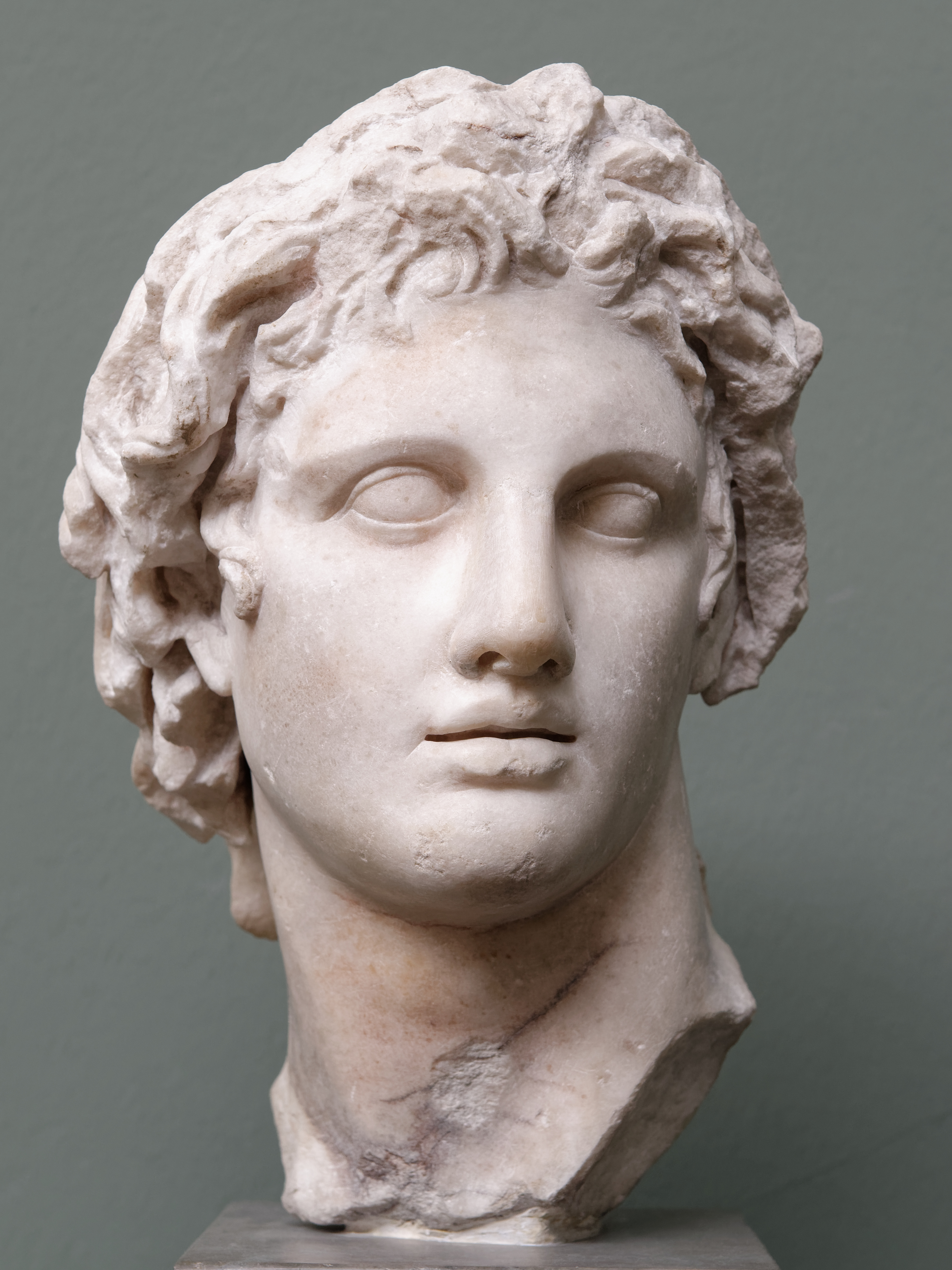
In 326 before Christ, Alexander the Great stood with his army beside the Hyphasis River in north-western India. He had crossed mountains, deserts and some of the greatest rivers known to the ancient world. He had defeated the Persian Empire, conquered Central Asia, entered the Punjab and overcome King Porus in a brutal battle fought during a thunderstorm.
The Conqueror at the Limits of the Known World
Alexander wanted to continue eastwards. He believed that further victories would carry him towards the outer Ocean that ancient geographers imagined surrounding the inhabited world. Beyond the river, however, lay unfamiliar kingdoms, powerful armies, broad plains and a seemingly endless succession of new campaigns.
For the first time, Alexander’s soldiers refused to follow him.
The confrontation at the Hyphasis was not a conventional military defeat. No enemy king had broken Alexander’s army, captured his camp or forced him to negotiate. Instead, the limit was created by the exhaustion and determination of his own men.
They had followed him for approximately eight years and travelled thousands of miles from Macedonia. Many had survived battles, sieges, wounds, disease, extreme weather and dangerous marches. They had gained treasure and glory, but they had also watched friends die in lands increasingly distant from home.
At the Hyphasis, Alexander reached the edge of his soldiers’ obedience, the edge of Greek geographical knowledge and perhaps the edge of his own ability to distinguish ambition from necessity.
His experience there provides one of the most revealing episodes in the history of ancient conquest. It shows that even the most successful commander could not advance forever and that the desire for unlimited glory eventually collided with the physical and emotional limits of ordinary human beings.
The Rise of Alexander
Alexander was born in 356 before Christ in Pella, the royal capital of Macedonia. He was the son of King Philip the Second and Queen Olympias.
Philip transformed Macedonia into the strongest military power in Greece. He reorganised the army, strengthened the cavalry and developed the Macedonian phalanx into a highly effective fighting formation.
Macedonian infantry carried long pikes known as sarissas. These weapons allowed several rows of soldiers to present spear points towards an approaching enemy.
The phalanx was most effective when supported by cavalry, light infantry, archers and specialised troops. Alexander inherited not only a kingdom but also a flexible military system created through years of reform.
As a young prince, Alexander received an education associated with the philosopher Aristotle. He studied literature, medicine, ethics, politics and the natural world.
Alexander developed a deep admiration for Homer’s Iliad. He identified especially with Achilles, the warrior who preferred a brief life of everlasting fame to a long life without glory.
This heroic ideal shaped Alexander’s understanding of kingship and conquest. He did not want merely to govern securely. He wanted to perform deeds that would be remembered for all time.
Philip’s Legacy
Philip defeated an alliance led by Athens and Thebes at the Battle of Chaeronea in 338 before Christ.
His victory established Macedonian leadership over most of mainland Greece.
Philip then prepared an invasion of the Persian Empire. He presented the campaign partly as revenge for the Persian invasions of Greece during the previous century.
Before the expedition could begin, Philip was assassinated in 336 before Christ.
Alexander became king at approximately twenty years of age.
His position was dangerous. Rival claimants threatened the throne, northern tribes challenged Macedonian authority and several Greek cities hoped to recover their independence.
Alexander acted quickly. He secured Macedonia, campaigned in the north and destroyed Thebes after the city rebelled.
The destruction of Thebes sent a terrifying message to the rest of Greece. Resistance to the new king could bring complete disaster.
With his authority established, Alexander prepared to cross into Asia and continue the invasion planned by his father.
The Invasion of the Persian Empire
In 334 before Christ, Alexander crossed the Hellespont into Asia Minor with a combined Macedonian and Greek army.
He visited the traditional site of Troy and honoured the heroes of the Trojan War.
By presenting himself beside the tomb of Achilles, Alexander connected his campaign with the heroic world of Greek epic.
His first major victory came at the Granicus River, where his forces defeated Persian commanders in western Asia Minor.
Alexander then advanced along the coast, capturing cities and reducing Persian naval bases.
In 333 before Christ, he confronted King Darius the Third at the Battle of Issus.
Although the Persian army greatly outnumbered the Macedonians according to ancient accounts, the narrow battlefield limited its advantage.
Alexander attacked the Persian centre, and Darius fled.
The Persian king’s family, including his mother, wife and children, fell into Alexander’s hands.
Alexander treated them with respect and increasingly behaved not merely as an invader but as a rival claimant to the Persian throne.
From the Mediterranean to Egypt
After Issus, Alexander moved south along the eastern Mediterranean coast.
Most cities surrendered, but Tyre resisted. The island city possessed strong walls and a powerful defensive position.
Alexander constructed a causeway from the mainland and used siege engines, ships and repeated assaults to capture the city.
The siege lasted for months and ended with severe punishment for the defenders.
Alexander then continued through the eastern Mediterranean and entered Egypt.
Egypt had been controlled by Persia, and Alexander was welcomed by many inhabitants as a liberator.
He founded the city of Alexandria near the Mediterranean coast. It later became one of the greatest centres of trade and learning in the ancient world.
Alexander also travelled through the desert to the oracle of Zeus-Ammon at Siwa.
The exact message he received remains uncertain, but the visit strengthened his connection with divine kingship.
From this period onwards, Alexander’s political identity became increasingly larger than that of a traditional Macedonian ruler.
The Defeat of Darius
In 331 before Christ, Alexander confronted Darius again near Gaugamela in northern Mesopotamia.
Darius selected a broad plain where the Persian cavalry and chariots could move freely.
Alexander used careful positioning, disciplined infantry and a decisive cavalry attack to break the Persian centre.
Darius fled once again, and the Persian army collapsed.
The victory opened the way to Babylon, Susa and Persepolis.
Alexander entered the ceremonial heartlands of the Persian Empire and took possession of enormous royal treasuries.
At Persepolis, the royal palace complex was burned. Ancient sources offer different explanations, including deliberate revenge for the Persian destruction of Greek temples or an impulsive act during a celebration.
The destruction symbolised the end of the old Persian royal order, but Alexander increasingly adopted elements of that order for himself.
Darius was later killed by Bessus, one of his own commanders.
Alexander honoured the dead king and presented himself as his legitimate successor.
Beyond the Persian Empire
The death of Darius did not end Alexander’s campaigns.
Bessus declared himself king and continued resistance in the eastern territories.
Alexander pursued him into Central Asia, entering regions corresponding broadly to modern Afghanistan, Uzbekistan and Tajikistan.
The fighting in Bactria and Sogdiana differed from the great battles against Darius.
Local leaders used raids, ambushes and fortified mountain positions. Alexander could capture cities, but resistance often reappeared elsewhere.
The campaigns became prolonged and brutal.
Alexander founded settlements, placed garrisons in strategic locations and attempted to secure roads and river crossings.
He also married Roxane, the daughter of a local nobleman, creating a political and personal connection with the eastern aristocracy.
His willingness to include Persians and other Asian peoples within his administration caused tension among some Macedonian companions.
Conflict Within Alexander’s Court
As Alexander moved farther from Macedonia, his court became increasingly influenced by Persian customs.
He wore elements of Persian royal clothing and appointed Persian officials alongside Macedonians.
He also experimented with a court ritual often described by Greek writers as proskynesis.
Among Persians, different forms of bowing expressed social rank. Greeks and Macedonians, however, associated full prostration with the worship of gods.
Many Macedonians feared that Alexander wanted to be treated as divine.
These cultural tensions contributed to conflict between the king and some of his oldest companions.
During a drunken argument, Alexander killed Cleitus the Black, an officer who had saved his life at the Granicus.
Alexander immediately regretted the act, but the death showed how isolated and dangerous the king’s position had become.
The campaign was transforming both Alexander and the community that followed him.
The Road to India
After years of warfare in Central Asia, Alexander turned towards the Indian subcontinent.
For the Macedonians and Greeks, India represented a distant land at the eastern limit of familiar geography.
Knowledge of the region came from travellers, traders, Persian records and stories that mixed observation with legend.
Some ancient geographers imagined that the Ocean surrounding the earth lay not far beyond India.
Alexander may have believed that by reaching this Ocean he could complete the conquest of Asia and establish the boundaries of his empire at the limits of the world.
India also contained territories that had once been connected with the Persian Empire.
Alexander could therefore present part of the campaign as the recovery of former Persian possessions now belonging to him as the successor of Darius.
Yet his ambitions extended beyond any clearly defined inherited frontier.
Crossing the Hindu Kush
Alexander’s army crossed the Hindu Kush mountains and descended towards the Indus region.
The journey required troops, animals and supplies to move through difficult highland routes.
Some local rulers submitted and provided assistance, while others resisted.
Alexander divided his forces so that different columns could secure routes and reduce strongholds.
The army encountered communities defended by mountain fortresses and steep positions.
One of the most famous operations was the siege of Aornos, a massive rocky stronghold near the Indus.
Ancient tradition claimed that even the mythical Heracles had failed to capture it.
Alexander’s conquest of the site therefore served both a military and symbolic purpose.
By succeeding where a hero was said to have failed, Alexander could present himself as surpassing the achievements of mythology.
Taxila and King Ambhi
Alexander entered the kingdom of Taxila, whose ruler is commonly identified in Greek sources as Taxiles and often associated with King Ambhi.
The ruler submitted without battle and offered Alexander gifts, troops and supplies.
This alliance demonstrates that Alexander’s entry into India was not a simple conflict between foreign invaders and a united local population.
The region contained several competing kingdoms and political communities.
Some rulers viewed Alexander as a threat, while others saw him as a useful ally against local rivals.
Taxila became an important base for Alexander’s operations.
From there, he prepared to confront King Porus, who ruled territory beyond the Hydaspes River.
King Porus
Porus controlled a kingdom between major rivers of the Punjab.
Unlike the ruler of Taxila, he refused to submit.
He positioned his army on the eastern bank of the Hydaspes River, known today as the Jhelum.
The river was swollen by seasonal rains, making a direct crossing extremely dangerous.
Porus possessed infantry, cavalry, chariots and war elephants.
The elephants were especially alarming to Macedonian soldiers and horses unfamiliar with confronting large numbers of them in battle.
Alexander could not simply cross in front of the waiting army.
He needed to deceive Porus about the location and timing of his attack.
The Crossing of the Hydaspes
Alexander repeatedly moved troops along the riverbank, creating noise and appearing to prepare crossings at several locations.
Porus was forced to follow these movements and remain alert.
After establishing this pattern, Alexander secretly led part of his army upstream during a stormy night.
The troops crossed near an island or bend in the river, although the difficult conditions caused confusion about the exact landing point.
Porus sent forces to oppose the crossing, but Alexander defeated them and established his army on the eastern bank.
The main Indian army then prepared for battle.
Alexander had successfully crossed a defended river, but he now faced one of the most difficult battles of his career.
The Battle of the Hydaspes
The Battle of the Hydaspes took place in 326 before Christ.
Porus placed his war elephants across the front of his infantry. Cavalry guarded the wings.
The elephants created gaps between one another but also formed a terrifying barrier against Macedonian horses.
Alexander used cavalry manoeuvres to pressure the Indian flanks.
His mounted forces attacked from different directions, forcing Porus to respond and weakening the coordination of his line.
The Macedonian infantry then advanced against the elephants and foot soldiers.
The battle became violent and confused.
Wounded elephants panicked and moved among both armies, crushing soldiers and disrupting formations.
Porus continued fighting despite wounds and heavy losses.
Eventually, his army was defeated, and he was brought before Alexander.
Alexander and Porus
According to a famous ancient tradition, Alexander asked Porus how he wished to be treated.
Porus replied that he wished to be treated like a king.
When Alexander asked whether he wanted anything more, Porus answered that everything was contained within that request.
Alexander admired his courage and restored him to his kingdom.
Porus may also have received additional territory.
The story reflects Alexander’s practice of ruling through defeated local kings when cooperation was more useful than destruction.
It also contributed to Porus’ reputation as a ruler who preserved dignity in defeat.
Whether the conversation occurred exactly as later writers described cannot be known.
Its survival reveals how strongly ancient audiences admired the meeting of two kings who recognised courage in one another.
Bucephalus
Alexander’s famous horse Bucephalus died around the time of the Hydaspes campaign.
Ancient accounts disagree over whether the horse died from wounds, exhaustion or old age.
Alexander had ridden Bucephalus since his youth.
A well-known story claimed that the young Alexander first mastered the horse after realising that it was frightened by its own shadow.
He turned Bucephalus towards the sun, mounted him and demonstrated a remarkable understanding of the animal.
Near the Hydaspes, Alexander founded a city named Bucephala in honour of the horse.
The death of Bucephalus carried emotional and symbolic importance.
The companion associated with Alexander’s rise and greatest victories had died at the far edge of the campaign.
Beyond the Hydaspes
After defeating Porus, Alexander did not turn back.
He continued eastwards through the Punjab.
Local communities submitted or resisted according to their interests and circumstances.
The army crossed more rivers and endured heavy monsoon rains.
The landscape was unfamiliar to the Macedonians. Rivers were broader, rainfall was intense and reports described powerful kingdoms farther east.
Alexander learned of the Ganges and the territories beyond it.
Ancient writers reported stories of enormous armies containing infantry, cavalry, chariots and thousands of elephants.
The accuracy of these numbers is uncertain, since ancient sources often exaggerated military strength.
Nevertheless, the reports increased the anxiety of soldiers who had already faced war elephants at the Hydaspes.
The Hyphasis River
Alexander eventually reached the Hyphasis River, known today as the Beas.
He intended to cross and continue towards the east.
From his perspective, the campaign remained unfinished.
He had defeated every major enemy placed before him, and the eastern Ocean seemed close within the geographical imagination of his world.
For the soldiers, the river represented something different.
It was another barrier leading to more rivers, more kingdoms and more battles.
They had already travelled far beyond the territories that Philip had planned to invade.
The Persian king had been defeated, the Persian capitals had been captured and the men had gained wealth beyond anything they had once imagined.
Yet every victory produced a new objective.
There was no clear point at which Alexander would declare that enough had been achieved.
The Soldiers Refuse
At the Hyphasis, the Macedonian soldiers refused to march farther east.
Ancient sources describe the event as a mutiny, although it was not a violent attempt to overthrow Alexander.
The men remained loyal to him as king and commander, but they rejected his order to continue the campaign.
They were exhausted by years of warfare, long marches and separation from their families.
Many were wounded or weakened by illness.
The monsoon rains, unfamiliar environment and reports of large armies beyond the river added to their fear.
The soldiers had also learned that distance itself was an enemy.
Every mile east made the journey home longer and the supply system more difficult to maintain.
Alexander had conquered territory faster than he could fully organise, garrison or integrate it.
The army understood that further conquest might create greater risks without providing a meaningful conclusion.
Alexander’s Speech
Alexander gathered his officers and attempted to persuade them to continue.
According to later accounts, he reviewed the victories they had achieved together.
He reminded them that they had crossed Asia Minor, defeated Darius, captured the Persian capitals, subdued Central Asia and entered India.
Alexander argued that only a limited distance remained before they reached the eastern Ocean.
He described conquest as necessary for the security of territories already taken.
Unconquered peoples beyond the frontier might encourage rebellion or threaten the empire.
He also reminded the soldiers that he had shared their hardships and wounds.
Alexander did not command from safety. He fought at the front, crossed the same rivers and endured the same storms.
To him, turning back at the moment when the limits of the world seemed close would make the entire achievement incomplete.
Coenus Answers the King
For a time, no officer wished to speak against Alexander.
Finally, Coenus addressed him on behalf of the army.
Coenus praised Alexander’s achievements and acknowledged the loyalty of the soldiers.
He then argued that the men had reached the limit of their endurance.
Many of the original Macedonians were dead. Others had been left behind in garrisons and newly founded settlements.
The survivors longed to see their parents, wives and children.
They wanted to enjoy the wealth and honour they had earned rather than die in another unknown land.
Coenus advised Alexander to return home, reorganise the empire and later raise a new generation of troops if further conquest remained necessary.
The speech allowed the soldiers’ refusal to be expressed respectfully without denying Alexander’s greatness.
The Silence After the Speech
Alexander reacted with anger and withdrew to his tent.
He waited for the army to change its mind.
For several days, the soldiers remained silent.
They did not attack their officers or attempt to abandon the camp.
They simply refused to cross the river.
The silence was more powerful than open rebellion because Alexander could not defeat it through courage, tactics or a cavalry charge.
His authority depended upon the willingness of his men to follow.
At the Hyphasis, that willingness ended.
Alexander had always led from the front, but no leader could continue alone into an unknown continent.
The army’s refusal exposed the practical limit hidden beneath absolute kingship.
The Sacrifices at the River
Alexander eventually announced that he would offer sacrifices and consult divine signs concerning the crossing.
The omens were declared unfavourable.
This allowed him to abandon the advance without openly admitting that his soldiers had defeated his will.
He ordered the construction of large altars marking the eastern limit of the expedition.
The monuments were intended to display the scale of Macedonian achievement and preserve the memory of how far the army had travelled.
Alexander then ordered the return journey.
The Hyphasis became the eastern terminus of his campaign in 326 before Christ.
The decision was celebrated by the soldiers, but Alexander accepted it reluctantly.
He had reached the edge, yet he had not reached the Ocean he imagined beyond it.
Was Alexander Defeated?
Alexander was not defeated in battle at the Hyphasis.
No eastern army forced him to retreat, and no local ruler imposed terms upon him.
Nevertheless, the event can be understood as a personal and strategic defeat.
Alexander failed to persuade or command his army to continue.
His vision of limitless conquest had become unacceptable to the men required to carry it out.
The refusal also revealed a contradiction within Alexander’s leadership.
He inspired extraordinary loyalty by sharing danger and promising glory.
Yet the same heroic ambition that inspired his soldiers eventually exhausted them.
A commander can ask followers to accept great risks when the objective appears clear.
At the Hyphasis, the men no longer understood what final objective remained beyond Alexander’s personal desire to continue.
The Edge of Greek Geography
Alexander’s eastern ambition was shaped by ancient geographical ideas.
Many Greeks imagined the inhabited land as a great mass surrounded by Ocean.
India was believed to lie near the eastern boundary of this world.
Alexander appears to have underestimated the size of the Indian subcontinent and the distance to the eastern sea.
The Ganges valley and territories beyond the Hyphasis were not the narrow final margin of Asia.
They contained vast populations, powerful states and extensive agricultural regions.
Alexander had reached an edge within Greek knowledge rather than the actual edge of the earth.
The difference between imagined geography and physical reality helps explain the crisis.
For Alexander, one more great advance might complete the map.
For the soldiers, every new report suggested that the world continued far beyond the next river.
The Desire to Surpass Heracles and Dionysus
Alexander frequently compared his achievements with those of mythological heroes.
Heracles had travelled across distant lands and performed impossible labours.
Dionysus was said in some Greek traditions to have campaigned in India.
Alexander used these stories to interpret and glorify his own movements.
He visited sacred places, founded cities and adopted symbols connecting him with heroic and divine figures.
The Indian campaign offered an opportunity to equal or surpass their legendary journeys.
This desire made turning back especially painful.
Alexander did not measure success only by the destruction of the Persian Empire.
He measured himself against heroes whose adventures had no ordinary political limits.
Myth could inspire conquest, but it could not feed an army, heal wounds or shorten the road home.
Preparing the Return
Although Alexander agreed to turn back, he did not simply retrace the route to Macedonia.
He planned a large movement southwards along the rivers of the Punjab towards the Indus and the sea.
Ships were constructed to carry part of the army and supplies.
Other forces marched along the riverbanks.
Alexander intended to conquer communities along the route, secure the Indus region and investigate the connection between the river system and the Ocean.
The return therefore became another campaign rather than a peaceful withdrawal.
The soldiers had prevented further movement east, but they had not ended Alexander’s determination to explore and conquer.
The Voyage Down the Hydaspes
Alexander assembled a fleet on the Hydaspes.
The vessels carried troops, horses, equipment and provisions.
The departure was marked by ceremonies and sacrifices.
As the fleet moved downstream, armies marched along both banks.
The river journey allowed Alexander to display power and establish control across a wide region.
Some communities submitted, while others prepared to resist.
The army encountered dangerous currents, unfamiliar channels and the meeting points of great rivers.
At one confluence, the water became so violent that ships collided or were damaged.
The journey demonstrated that rivers could serve as highways of conquest while also creating serious natural hazards.
The Mallian Campaign
During the movement south, Alexander fought against the Mallians and neighbouring peoples.
Ancient sources describe determined resistance.
Alexander divided his army and moved rapidly in an attempt to prevent his enemies from combining their forces.
Several settlements were captured, often with severe violence.
During the siege of a fortified Mallian town, Alexander became frustrated by the slowness of the assault.
He climbed a siege ladder and reached the top of the wall with only a small number of companions.
When the ladder broke under the weight of soldiers following him, Alexander was isolated.
Instead of waiting for rescue, he jumped down inside the city.
Alexander’s Near-Fatal Wound
Inside the walls, Alexander fought while surrounded by enemies.
Only a few companions stood beside him.
An arrow struck Alexander in the chest and penetrated deeply through his armour.
He collapsed and nearly died.
His soldiers, believing their king was trapped, forced their way into the city with desperate violence.
They killed large numbers of defenders after reaching him.
Alexander was carried away and treated by his physicians.
Rumours spread through the army that he had died.
When he recovered enough strength, Alexander showed himself to the soldiers so that they could see he remained alive.
The incident revealed both the courage and recklessness that defined his leadership.
He inspired his men by sharing danger, but his desire to be first into battle repeatedly endangered the entire empire.
The King as His Own Greatest Danger
Alexander’s army depended upon him personally.
He had not created a clear system for succession, and no other commander possessed equal authority.
If he had died in the Mallian town, the empire might have fragmented immediately.
His decision to leap inside the walls was therefore more than an individual act of bravery.
It risked the survival of every political and military achievement produced by the campaign.
Alexander often behaved as though personal exposure to danger proved his right to command.
This approach created powerful loyalty.
It also meant that the ruler of a vast empire continued fighting like a young warrior seeking recognition.
At the edge of the world, Alexander remained unable to separate heroic courage from strategic responsibility.
Reaching the Indus Delta
The army continued southwards and eventually reached the lower Indus.
Alexander explored channels leading towards the sea and encountered the powerful tides of the Indian Ocean.
The rise and fall of the water astonished soldiers familiar mainly with the Mediterranean, where tidal changes were less dramatic.
Alexander believed that he had reached the great Ocean surrounding the world.
He performed sacrifices and sailed beyond the river mouths.
Although he had not reached the eastern Ocean by crossing the Hyphasis, reaching the southern sea allowed him to claim another form of geographical completion.
He had connected his land conquests with maritime exploration.
Nearchus and the Ocean Voyage
Alexander appointed Nearchus to command a fleet from the Indus to the Persian Gulf.
The voyage was intended to explore the coastline, establish a sea route and connect India with the western parts of the empire.
The fleet faced shortages of food and water, difficult winds and unfamiliar coastal conditions.
Some communities along the coast were hostile, while others traded with the sailors.
Nearchus eventually reached the Persian Gulf and re-established contact with Alexander.
The voyage expanded Greek knowledge of the region and demonstrated the possibility of maritime communication between India and Mesopotamia.
For Alexander, exploration and empire remained closely connected.
The Gedrosian Desert
While Nearchus sailed, Alexander led a large part of the army through Gedrosia, a harsh region corresponding broadly to parts of southern Iran and Pakistan.
The march became one of the greatest disasters of the campaign.
The army faced extreme heat, limited water, deep sand and inadequate supplies.
Pack animals died, food disappeared and soldiers collapsed from thirst and exhaustion.
Sudden floods also destroyed people and equipment.
Ancient sources offer different explanations for Alexander’s decision to cross the desert.
He may have wanted to support the fleet, punish himself and the army, explore the route or surpass legendary rulers who were believed to have failed there.
Whatever his purpose, the decision imposed enormous suffering upon soldiers and camp followers.
The Cup of Water
A famous story from the desert describes soldiers finding a small quantity of water and presenting it to Alexander in a helmet.
The water was insufficient for the army but enough for the king.
Alexander thanked the men and poured it onto the ground without drinking.
He would not accept relief unavailable to his followers.
The army was encouraged by the gesture and continued marching.
Whether the incident occurred exactly as described is uncertain, but it expresses a central feature of Alexander’s leadership.
He demanded extreme sacrifices because he publicly shared hardship.
The gesture could inspire loyalty, yet it did not erase responsibility for choosing the deadly route.
Alexander’s willingness to suffer beside the army made him admirable, but it could also make unnecessary suffering appear heroic.
The Cost of the Return
The army eventually escaped the desert, but the losses were severe.
Many people had died without facing an enemy.
The Gedrosian march showed that nature could inflict damage beyond the power of any army to resist.
Alexander had crossed mountains, rivers and deserts throughout his career, often turning geographical obstacles into opportunities for glory.
In Gedrosia, that approach reached another limit.
The desert could not be intimidated, negotiated with or defeated in battle.
Survival depended upon water, supply and sound planning rather than courage alone.
The return from the edge therefore became almost as destructive as the advance towards it.
Alexander Returns to the Empire
When Alexander returned to the central regions of his empire, he discovered problems created during his long absence.
Some governors had abused their authority, raised private forces or treated their provinces as personal possessions.
Alexander punished several officials and attempted to restore control.
The difficulties revealed how hard it was to govern an empire stretching from the Balkans to the Indus.
Messages took months to travel, local conditions varied greatly and loyalty often depended upon personal relationships.
Alexander had been extraordinarily successful at winning territory.
He now faced the more complicated task of creating institutions capable of surviving without his constant presence.
The Susa Marriages
At Susa, Alexander organised a mass marriage ceremony between Macedonian officers and women from Persian noble families.
Alexander himself married Stateira, a daughter of Darius, while retaining his marriage to Roxane.
The marriages were intended to connect the Macedonian and Persian elites.
Alexander gave gifts and paid debts for his soldiers.
He appears to have imagined a ruling class combining Macedonian military power with Persian administrative and royal traditions.
Many Macedonians remained suspicious of this policy.
They feared that their privileged position was being weakened as Persians entered the army and court.
Alexander’s attempt to unite peoples within the empire produced resentment among those who had expected conquest to confirm Macedonian superiority.
The Persian Soldiers
Alexander trained thousands of young Persian men in Macedonian weapons and military methods.
These troops demonstrated that the king no longer depended entirely upon the original army that had crossed into Asia.
For Alexander, the integration of Persian soldiers strengthened the empire and provided replacements for ageing Macedonian veterans.
For the Macedonians, it appeared that the king was preparing to replace them.
The fear was especially painful because the veterans believed that their sacrifices had created the empire.
They had followed Alexander to the edge of the world, only to see former enemies receive positions beside them.
The Mutiny at Opis
In 324 before Christ, Alexander announced that older and disabled Macedonian soldiers would be sent home.
The decision should have fulfilled the desire expressed at the Hyphasis.
Instead, the soldiers interpreted it as a rejection.
They believed that Alexander preferred Persian troops and no longer valued the men who had won his victories.
A mutiny broke out at Opis.
The soldiers demanded that Alexander dismiss all of them and continue campaigning with his divine father and his Persian companions.
Alexander responded furiously.
He ordered the arrest of ringleaders and delivered a speech describing everything his father and he had done for the Macedonians.
He then withdrew and appointed Persians to symbolic positions of honour.
Reconciliation at Opis
The Macedonians quickly regretted the confrontation.
They gathered outside Alexander’s quarters and begged for forgiveness.
Alexander eventually appeared and reconciled with them.
A great banquet followed, bringing Macedonians and Persians together in a public display of unity.
The settlement showed that Alexander still possessed extraordinary emotional authority over his soldiers.
However, the second mutiny also revealed unresolved tension.
At the Hyphasis, the men had refused endless conquest.
At Opis, they feared exclusion from the empire they had created.
Alexander wanted a new imperial identity, while many Macedonians continued to understand the conquest as their own national achievement.
The Death of Hephaestion
Later in 324 before Christ, Hephaestion died at Ecbatana.
Hephaestion had been Alexander’s closest companion and one of the most powerful officers in the empire.
Alexander’s grief was extreme.
He ordered elaborate mourning ceremonies and planned a monumental funeral.
He also sought divine honours for his dead companion.
The loss isolated Alexander further.
Many family members, officers and childhood companions had died, been executed or fallen from favour.
The king who commanded a vast empire was increasingly surrounded by relationships shaped through rank, fear and political need.
New Plans at Babylon
Alexander returned to Babylon and began preparing new expeditions.
He planned operations in Arabia and considered further naval exploration.
Ancient sources also report broader plans involving the Mediterranean, although the scale and reliability of these accounts remain debated.
Alexander had not abandoned the desire for expansion after the Hyphasis.
Turning back from India had changed the direction of conquest rather than ending it.
Arabia offered new coastlines, trade routes and possibilities for exploration.
Babylon stood near the centre of the empire and could serve as a capital connecting east and west.
Yet Alexander had little time to carry out these plans.
The Death of Alexander
In 323 before Christ, Alexander became seriously ill in Babylon.
Ancient sources describe fever and a gradual loss of strength.
The exact cause of death remains unknown.
Proposals have included infectious disease, complications from previous wounds and other natural causes.
Stories of poisoning appeared in antiquity, but they are difficult to prove and may reflect later political suspicion.
Alexander died at approximately thirty-two years of age.
He had ruled for less than thirteen years.
At the time of his death, his empire stretched from Macedonia and Egypt to Central Asia and the Indus region.
No clear adult successor was ready to govern it.
The Question of Succession
Alexander’s half-brother Arrhidaeus had limited ability to rule independently.
Roxane was pregnant with Alexander’s child, the future Alexander the Fourth.
The generals therefore attempted to govern in the names of kings who could not exercise effective authority.
Alexander’s commanders soon divided into rival factions.
Wars broke out across the empire as generals competed for provinces, armies and legitimacy.
The royal family was gradually destroyed.
Roxane and Alexander the Fourth were eventually killed.
The empire did not survive as a single political unit.
It broke into several major kingdoms ruled by Macedonian dynasties.
An Empire Without an Edge
Alexander had spent his reign expanding frontiers, but he had not created an accepted final boundary.
Each conquered territory led towards another.
Asia Minor led to Syria, Syria to Egypt and Mesopotamia, Persia to Central Asia, and Central Asia to India.
The empire was defined by movement rather than completion.
This made Alexander extraordinarily effective as a conqueror but less successful at creating a stable succession.
His authority held different peoples and regions together because his military reputation appeared irresistible.
When he died, no institution possessed equal power.
The absence of a recognised edge was also the absence of a settled political purpose.
The Limits of Conquest
The confrontation at the Hyphasis reveals a basic truth about empire.
Territory can be conquered more quickly than it can be governed.
Every advance creates longer supply lines, new populations, unfamiliar landscapes and additional frontiers.
Victory does not remove danger. It changes its location.
Alexander argued that unconquered neighbours might threaten lands already taken.
Such reasoning could justify continuous expansion because every frontier had another people beyond it.
The soldiers recognised that this logic contained no natural stopping point.
Their refusal forced a boundary upon a campaign that Alexander could not limit for himself.
The Limits of Leadership
Alexander’s leadership rested upon courage, charisma, success and shared danger.
He knew many officers personally and understood how to inspire soldiers through speeches, rewards and symbolic actions.
He led cavalry charges and appeared at decisive points in battle.
His visible bravery distinguished him from rulers who remained far behind their armies.
Yet leadership based upon personal example has limits.
Alexander could share the exhaustion of a march, but he could not remove it.
He could display his wounds, but this did not heal the wounds of his soldiers.
He could promise greater glory, but glory no longer compensated men who feared that they would never return home.
At the Hyphasis, shared hardship stopped being enough.
The Limits of Heroic Ambition
Alexander understood himself partly through heroic mythology.
Achilles, Heracles and Dionysus offered models of extraordinary achievement.
These figures crossed boundaries, challenged impossible enemies and gained everlasting fame.
However, the world of heroic legend rarely addresses administration, supply, retirement or succession.
A hero is remembered for the scale of the challenge, not for the stability of the institutions left behind.
Alexander’s career demonstrates the danger of applying heroic values to imperial government.
The desire to surpass every predecessor can produce achievements beyond ordinary imagination.
It can also prevent a ruler from recognising when an objective has already been fulfilled.
The Soldiers’ Perspective
The history of Alexander is often told through the decisions of the king.
The Hyphasis forces attention towards the ordinary soldiers.
They had marched through heat, snow, rain and dust.
They had crossed the Hellespont, the Taurus Mountains, the deserts of Egypt, the highlands of Central Asia, the Hindu Kush and the rivers of India.
They had fought Persians, Greeks, Scythians, Sogdians and Indian kingdoms.
Many had received treasure, land or promotion, but they remained human beings with families and physical limits.
The refusal at the river was not necessarily cowardice.
It was a judgement that the cost of another campaign exceeded its purpose.
The soldiers had enabled Alexander to become great, and at the Hyphasis they reminded him that greatness depended upon their continued consent.
The Meaning of Home
For Alexander, the horizon offered glory.
For many soldiers, it represented greater separation from home.
Macedonia had become almost unimaginably distant.
Parents had aged, children had grown and wives had lived for years without knowing whether their husbands would return.
Some soldiers had established new relationships in Asia, while others had been ordered to remain in distant garrisons.
The army was no longer the same force that had crossed the Hellespont.
It had become a moving imperial society containing soldiers, families, servants, merchants, captives and officials.
The desire to return was therefore not simply homesickness.
It was an attempt to recover an identity that endless campaigning had begun to erase.
Alexander’s Achievement
Alexander’s conquests transformed the ancient world.
He destroyed the Achaemenid Persian Empire and created political connections across an enormous region.
Greek and Macedonian settlers established communities in Egypt and Asia.
Trade, migration, military service and royal patronage encouraged cultural exchange.
After Alexander’s death, kingdoms ruled by his successors supported cities, libraries, temples and artistic traditions combining Greek and local influences.
The period that followed is commonly called the Hellenistic age.
Alexander did not create this world alone, and cultural exchange did not move in only one direction.
Greek-speaking settlers encountered ancient civilisations with their own languages, religions and political traditions.
The resulting societies were diverse and constantly changing.
Alexander’s Destruction
The achievements of Alexander cannot be separated from the violence of conquest.
Cities that resisted could be destroyed, and populations could be killed or enslaved.
Military victories produced political transformation through force.
Alexander’s campaigns caused enormous suffering among both conquered peoples and his own followers.
Ancient writers admired his courage and strategic skill, but they also recorded anger, drunken violence, mass executions and reckless decisions.
His empire connected distant regions while being created through invasion.
The image of the heroic explorer must therefore be balanced against the experience of communities whose independence was destroyed.
Porus and the Alternative to Destruction
Alexander’s treatment of Porus illustrates another side of his imperial policy.
Rather than removing every defeated ruler, he could restore local kings who accepted his authority.
This allowed existing systems of government to continue under Macedonian supremacy.
Such arrangements reduced the number of foreign officials and soldiers required to control distant territories.
They also created risks because local rulers might later rebel or support Alexander’s rivals.
Alexander’s empire depended upon a mixture of garrisons, new cities, appointed governors, alliances and restored kings.
This flexibility made rapid conquest possible.
However, it also meant that different regions were connected to the king in different ways.
After his death, many of these personal arrangements weakened or disappeared.
The Historical Sources
No complete account written by an eyewitness to Alexander’s campaigns survives.
The principal narratives were composed centuries after his death.
Important surviving authors include Arrian, Plutarch, Diodorus, Curtius Rufus and Justin.
These writers used earlier works that are now lost, including accounts by people who accompanied the expedition.
Each surviving author had different interests and moral purposes.
Arrian admired Alexander’s military achievements and based much of his narrative upon sources he considered reliable.
Plutarch focused upon character and moral examples.
Curtius often emphasised drama and the corrupting effects of power.
Because the sources disagree, details such as army sizes, speeches, motives and casualty figures must be treated cautiously.
The Creation of a Legend
Alexander became legendary soon after his death.
Stories expanded his adventures beyond historical reality.
In later traditions, he explored the sky, descended beneath the sea, encountered strange peoples and searched for the source of immortality.
The collection of legends commonly known as the Alexander Romance appeared in many languages and cultures.
Alexander became Iskandar in Persian and Islamic traditions and appeared in stories from Europe, the Middle East and Asia.
These later versions emphasised his position as a ruler who travelled to the boundaries of human knowledge.
The historical campaign in India provided an ideal foundation for stories about the edge of the world.
The Edge as a Physical Place
For Alexander’s army, the edge was represented by mountains, rivers and oceans.
Each geographical barrier appeared to divide the known from the unknown.
The Hellespont separated Europe from Asia.
The Hindu Kush guarded the approaches to India.
The Hydaspes and Hyphasis marked difficult stages in the eastern advance.
The Indus led towards the Ocean.
Alexander repeatedly crossed these boundaries and treated geography as a challenge to authority.
Yet the Hyphasis showed that a river could become a frontier not because it was impossible to cross but because the army refused to cross it.
The Edge as a Human Limit
The most important boundary Alexander encountered was human endurance.
Soldiers can continue through fear when discipline and purpose remain strong.
They can survive extraordinary hardship when they believe that the end is approaching.
At the Hyphasis, the men no longer believed in an approaching conclusion.
The campaign appeared endless.
Their refusal transformed exhaustion into political power.
Alexander’s empire had reached the point where the wishes of the conqueror and the needs of the army could no longer be reconciled.
The edge was therefore not located only on a map.
It existed within the bodies, memories and decisions of the people who had carried Alexander across Asia.
The Edge of Identity
Alexander also stood between identities.
He was king of Macedonia, leader of the Greeks, pharaoh of Egypt, successor to the Persian kings and ruler of Asian territories.
Each title carried different expectations.
Macedonian soldiers expected a warrior king who respected traditional companions.
Persian nobles expected royal ceremony and recognition of their status.
Greek cities viewed Alexander as both leader and foreign master.
Egyptian traditions placed him within the sacred institution of pharaoh.
Alexander attempted to combine these roles into a universal monarchy.
The tensions at the Hyphasis and Opis showed that no single identity could satisfy every group within the empire.
The Edge Between Man and God
Alexander’s relationship with divinity became increasingly controversial.
Ancient kings often claimed divine ancestry or special favour from the gods.
Alexander was associated with Zeus-Ammon and encouraged comparisons with Heracles and Dionysus.
Some communities offered him divine honours.
It remains debated how literally Alexander understood his own divinity.
Political ritual, personal belief and heroic symbolism were closely connected.
To Macedonians, however, excessive claims could appear arrogant and foreign.
The king who crossed geographical boundaries also approached the boundary separating heroic humanity from godhood.
His death from illness at a young age revealed that conquest had not made him immortal.
The Edge of Success
Alexander’s career challenges the assumption that success naturally produces satisfaction.
Every victory expanded his ambitions.
The conquest of Asia Minor made the defeat of Darius possible.
The defeat of Darius opened Central Asia.
The conquest of Central Asia opened India.
The Hydaspes led towards the Hyphasis and the kingdoms beyond it.
Achievement became the reason for demanding another achievement.
There was no final victory large enough to end the pursuit of glory.
The Hyphasis forced Alexander to confront the possibility that unlimited success could become a form of failure.
What Might Have Happened Beyond the Hyphasis
Historians cannot know what would have happened if the army had agreed to continue.
Alexander might have won further victories through superior leadership, experienced troops and political alliances.
He would also have faced major difficulties.
The Gangetic plain contained large populations and states capable of raising substantial armies.
Additional war elephants would have presented serious tactical challenges.
Monsoon conditions, river crossings and long supply routes would have complicated every operation.
Even successful conquest would have required garrisons and administrators across an enormous distance.
The question is therefore not simply whether Alexander could have won another battle.
It is whether he could have conquered, organised and retained a much larger portion of the subcontinent.
The Decision to Turn Back
Turning back preserved the army and allowed Alexander to secure important parts of the Indus region.
It also prevented the campaign from becoming even more extended.
However, the return route brought severe new dangers, including the Mallian wound and the Gedrosian disaster.
Alexander did not respond to the army’s exhaustion by choosing the safest road home.
He continued seeking conquest, exploration and symbolic achievement.
The decision at the Hyphasis was therefore practical but incomplete.
It ended the eastward march without changing the ambition driving it.
Alexander as Explorer
Alexander’s expedition collected geographical, botanical and cultural information.
Surveyors measured routes, while specialists observed unfamiliar plants, animals and communities.
The voyages along the Indus and the coast expanded Mediterranean knowledge of the Indian Ocean.
Alexander wanted to understand how rivers and seas connected different regions of the world.
Exploration, however, occurred within a military campaign.
Knowledge supported conquest by identifying roads, resources, harbours and political conditions.
The explorer and conqueror could not be separated.
Alexander’s curiosity opened routes of communication while his armies imposed control.
Alexander as a World Ruler
Alexander increasingly imagined an empire extending beyond a single people.
His inclusion of Persian nobles, training of Asian soldiers and mixed marriages suggest a desire to create a broader ruling order.
Some historians interpret this as a vision of cultural unity.
Others emphasise practical necessity. An empire containing millions of Asian subjects could not be governed by a small Macedonian population alone.
Alexander’s policies probably combined idealism, ambition and administrative need.
He expected loyalty to himself to connect people of different backgrounds.
The weakness of this system became clear after his death.
Personal loyalty to one extraordinary king could not provide a permanent constitution for an empire.
The Legacy of the Hyphasis
The Hyphasis became famous because it marked the end of Alexander’s eastward advance.
It demonstrated that the army remained an active political force rather than a silent instrument.
The soldiers accepted Alexander’s kingship but placed a limit upon what he could demand.
The event also preserved the mystery of lands beyond the river within Greek imagination.
Alexander had reached India but had not crossed the entire subcontinent.
The unconquered east remained a space for geographical speculation and legendary storytelling.
Most importantly, the Hyphasis changed the meaning of Alexander’s greatness.
His greatest limit was not created by an enemy stronger than himself.
It was created by the people who had made his victories possible.
The Legacy of the Indian Campaign
Alexander’s invasion affected the political world of north-western India, although the long-term consequences remain debated.
Several local rulers were defeated, restored or replaced.
Macedonian garrisons and officials were established, but control weakened after Alexander’s death.
Within a few years, Chandragupta Maurya created a powerful empire in northern India.
The Seleucid ruler Seleucus later reached an agreement with Chandragupta involving territories, diplomacy and war elephants.
Greek-speaking kingdoms also developed in Central Asia and later expanded into parts of the Indian subcontinent.
Trade, diplomacy and artistic exchange connected the Hellenistic world with South Asia for centuries.
Alexander’s direct rule was brief, but the broader networks strengthened by his conquests continued to develop.
Alexander’s Final Boundary
Alexander died in Babylon rather than at the edge of India.
Yet the Hyphasis remained the clearest boundary of his career.
It was the place where movement stopped and ambition was forced to turn upon itself.
His monuments beside the river attempted to transform retreat into achievement.
They declared that the army had travelled farther than earlier conquerors and had reached a limit worthy of remembrance.
The true significance of the boundary lies not in the distance from Macedonia but in the decision made there.
Alexander learned that authority could compel men to cross much of the known world but could not compel them to abandon every hope of returning home.
Conclusion
Alexander at the edge is the story of a conqueror confronting a boundary he could not overcome through military genius.
By 326 before Christ, Alexander had destroyed the Persian Empire, campaigned through Central Asia, crossed the Hindu Kush and defeated King Porus at the Hydaspes.
He believed that the eastern Ocean and the completion of his conquest lay ahead.
His soldiers saw only more rain, rivers, elephants, battles and distance.
At the Hyphasis, they refused to continue.
Alexander argued, waited and consulted the gods, but the army did not change its decision.
He erected altars and ordered the return.
The retreat did not end the danger. Alexander nearly died during the Mallian campaign, while many followers perished in the Gedrosian Desert.
He returned to the centre of his empire and attempted to unite Macedonian and Persian elites, but his policies created further tension.
He died in Babylon before completing his new campaigns or establishing a secure succession.
Alexander’s achievement was extraordinary. He transformed the political geography of the ancient world and became a symbol of military ambition, exploration and imperial power.
His experience at the edge, however, reveals the limits hidden within that achievement.
No ruler can march without followers. No army can fight without rest, supplies and purpose. No empire can expand forever without confronting the difficulty of governing what has already been taken.
Alexander wanted to reach the limits of the world, but the world was larger than he imagined.
His soldiers understood that every horizon concealed another horizon.
The Hyphasis was therefore more than the place where Alexander turned back.
It was the place where unlimited ambition met human endurance and where the greatest conqueror of his age discovered that even victory has an edge.