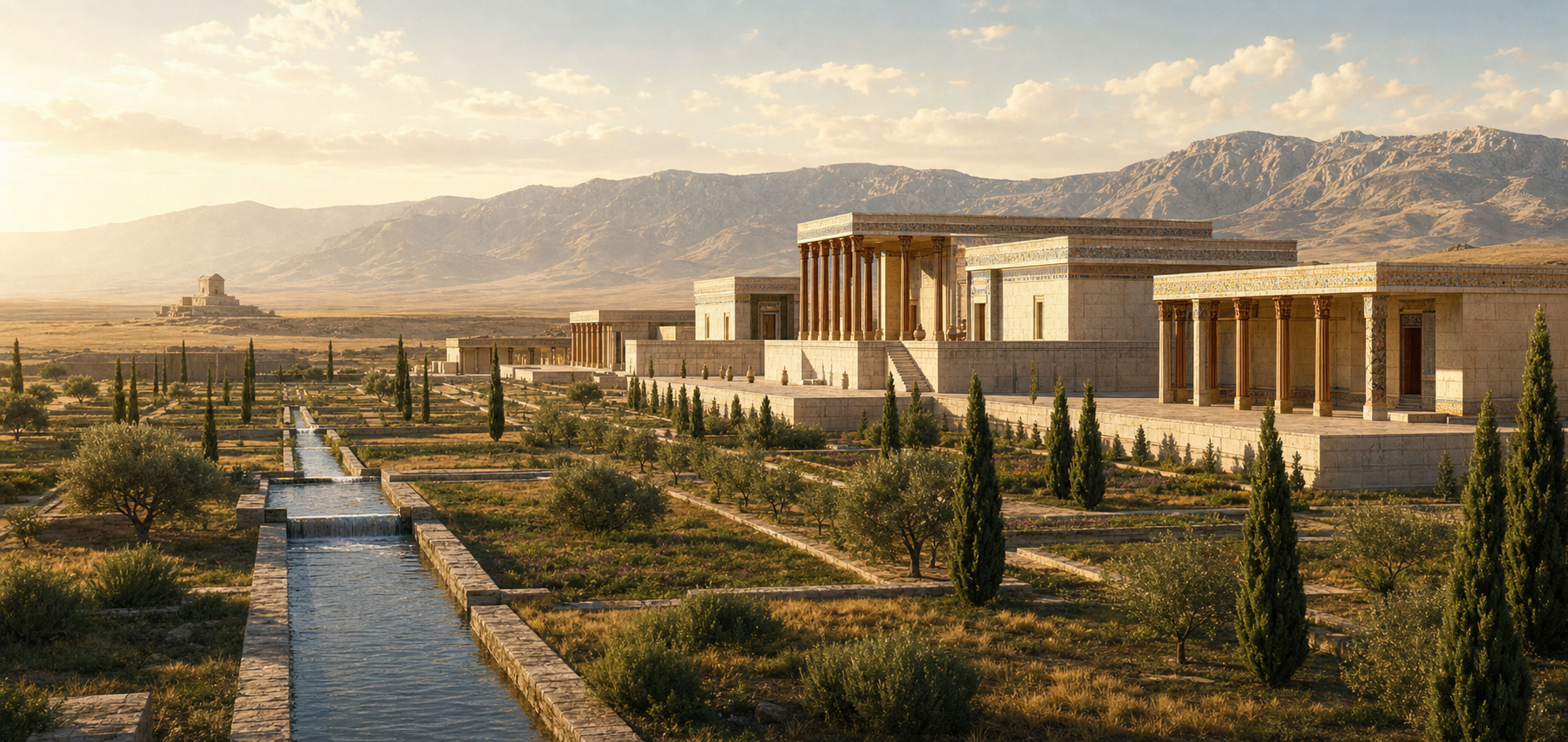
The occupation of Babylon and Persepolis marked two of the most symbolically significant moments in Alexander the Great’s conquest of the Persian Empire. Between 331 and 330 BCE, after the decisive victory at the Battle of Gaugamela, Alexander advanced into the imperial heartlands of the Achaemenid state. Babylon, one of the great cities of the ancient Near East, represented political legitimacy and administrative power. Persepolis, the ceremonial capital of the Persian kings, embodied dynastic authority, imperial memory, and the ideological centre of Achaemenid rule. Together, their occupation signalled the effective collapse of Persian sovereignty and the emergence of a new Macedonian-led order across western Asia.
Strategic Context After Gaugamela
Alexander’s victory at Gaugamela in 331 BCE broke the last major field army that King Darius III could assemble in defence of the empire’s core territories. Although Darius escaped, the defeat destroyed Persian capacity for coordinated resistance in Mesopotamia and opened the road to the wealthiest and most administratively developed regions of the empire.
For Alexander, the period after Gaugamela was not merely a continuation of conquest but a transition from campaigning to governing. The capture of major cities would provide resources to pay his army, secure supply lines, and present himself as the rightful successor to Persian kingship. His approach combined military speed with political calculation, seeking to absorb imperial structures rather than annihilate them.
The Entry into Babylon
Babylon was one of the most famous cities of the ancient world, renowned for its monumental architecture, religious institutions, and administrative importance. As Alexander approached, Babylon did not resist. Instead, its leaders received him with ceremony and, according to ancient accounts, opened the gates to his forces. The surrender reflected both pragmatic calculation and the broader recognition that Persian military authority had been fatally weakened.
Alexander entered Babylon as a conqueror, yet he also presented himself as a legitimate ruler. Rather than allowing wholesale destruction, he sought to preserve the city’s functioning as a vital centre of government. Babylon’s peaceful submission allowed him to secure immense stores of wealth and supplies without the costly delay of a siege.
He also showed respect to Babylonian religious traditions, an important act of political theatre in an empire whose legitimacy was often linked to divine favour. Such gestures served a wider strategy: Alexander aimed to be seen not simply as a foreign invader, but as a king capable of ruling diverse peoples through a blend of force and accommodation.
Administration and the Question of Continuity
The occupation of Babylon illustrates a key feature of Alexander’s imperial project. He did not dismantle Persian administration entirely. Instead, he frequently retained local officials or installed Macedonian and Greek overseers alongside existing bureaucratic structures. The Achaemenid Empire was highly centralised and relied upon satraps, local elites, and an extensive system of taxation and record keeping. Alexander’s success depended in part upon his willingness to use these structures to maintain order and revenue.
In Babylon, he began to shape his rule by distributing authority carefully. This dual approach, combining Macedonian military dominance with elements of Persian governance, allowed him to stabilise conquered territories rapidly. It also helped to reduce the risk of rebellion by reassuring local elites that cooperation could preserve their status.
The Advance to Susa and the Imperial Treasuries
After securing Babylon, Alexander moved towards other key centres. Although the focus of this narrative is Babylon and Persepolis, the road between them included Susa, another major imperial city and treasury. The capture of these treasuries was crucial. Conquest required money, and the Persian Empire possessed immense accumulated wealth in bullion, tribute, and luxury goods.
By gaining access to these resources, Alexander ensured the continued loyalty of his troops through pay and rewards. He also acquired the financial means to fund further campaigns, maintain garrisons, and support the establishment of new cities. The seizure of the imperial treasuries thus converted military victory into the material foundation of empire.
The March into the Persian Heartland
From Mesopotamia, Alexander advanced into the uplands and mountain passes leading to Persis, the homeland of the Achaemenid dynasty. This was a region of immense symbolic importance. It was here that the Persian kings traced their origins, and it was here that Persepolis stood as the ceremonial centre of the empire.
The march was not without resistance. Mountain peoples could threaten supply routes, and Persian commanders sought to delay Alexander by using difficult terrain. One of the most notable obstacles was the Persian Gate, where defenders attempted to block passage through a narrow mountain pass. Once these barriers were overcome, the route to Persepolis lay open.
Persepolis as Ceremonial Capital
Persepolis was not the everyday administrative capital of the empire in the way Babylon could be, but it was the ideological heart of Achaemenid kingship. Built by Darius I and expanded by later rulers, it functioned as a monumental stage for royal ceremony, tribute, and imperial display. Its palaces and terraces were designed to communicate the power of the Great King and the unity of the empire under Persian rule.
To occupy Persepolis therefore carried meanings beyond strategic gain. It was a statement that the old dynasty had been defeated in its own homeland. By entering Persepolis, Alexander symbolically placed himself at the centre of a world empire and presented himself as the inheritor of Persian sovereignty.
The Occupation of Persepolis
When Alexander took Persepolis in 330 BCE, he gained control of another enormous treasury. The wealth stored there represented not only economic power but also centuries of imperial accumulation. The seizure of these resources further strengthened Alexander’s ability to sustain his army and project power across vast distances.
The occupation also brought challenges. Conquest could easily descend into looting and violence, particularly when soldiers felt entitled to reward after prolonged campaigning. Alexander’s policies varied in different contexts, sometimes permitting plunder as a means of satisfying the army, while at other times seeking to restrain destruction in order to preserve economic and political stability.
In the case of Persepolis, ancient sources emphasise both the capture of immense wealth and the later burning of parts of the palace complex. The burning has been interpreted in multiple ways. Some traditions present it as an act of revenge for the Persian sack of Athens in 480 BCE, a symbolic reversal of an earlier humiliation. Other interpretations view it as a calculated political act intended to demonstrate that Achaemenid legitimacy had ended. It has also been suggested that the destruction may have resulted from a moment of celebration and excess rather than a carefully planned policy. Whatever the precise motive, the burning of Persepolis became one of the most controversial acts associated with Alexander’s conquest.
Symbolism and the Politics of Victory
The occupation of Babylon and Persepolis highlights the dual nature of Alexander’s imperial identity. In Babylon, he acted in ways that suggested continuity and accommodation, preserving administration and respecting religious traditions. In Persepolis, the symbolism of conquest was sharper, culminating in an act of destruction that many ancient writers treated as a decisive break with the Achaemenid past.
These contrasting approaches were not necessarily contradictory. Alexander’s overall aim was to secure legitimacy in multiple contexts. In some regions, legitimacy required continuity and cooperation with local elites. In others, legitimacy was reinforced by dramatic gestures that signalled the end of a defeated regime. Babylon offered a functioning imperial centre that Alexander could use. Persepolis offered the dynastic heart of Persian kingship, where conquest needed to be unmistakable.
Consequences for Darius III and the Persian Resistance
The loss of Babylon and Persepolis had devastating consequences for Darius III. Not only did he lose key cities and treasuries, but he also lost the symbolic and administrative foundation of his kingship. Without these centres, rallying support became increasingly difficult.
As Alexander moved through the Persian heartland, Darius fled eastwards, attempting to gather forces among the satraps of the eastern provinces. Yet the collapse of the imperial core encouraged desertion and betrayal. The occupation of the great cities thus accelerated the disintegration of Persian authority and reshaped the political landscape of Asia.
Economic Implications of the Imperial Treasuries
The transfer of Persian wealth into Macedonian hands had wider consequences. The redistribution of bullion could stimulate economies, fund new military ventures, and support the foundation of cities and garrisons. Alexander’s ability to pay his troops and reward loyalty depended upon these resources. At the same time, the movement of such wealth could disrupt local economies and alter existing networks of power.
Babylon and Persepolis were not merely symbolic prizes but vital financial centres. Their occupation turned Alexander from an invading commander into a ruler with access to one of the greatest accumulations of wealth in the ancient world.
Cultural Encounters and Imperial Integration
The occupation of these cities also intensified cultural exchange. Babylon was a centre of ancient scholarship, religious tradition, and cosmopolitan life. Persepolis represented Persian imperial art and ceremonial architecture. Alexander’s presence and the subsequent movement of soldiers, administrators, and merchants contributed to the early shaping of the Hellenistic world, in which Greek and local traditions interacted across a broad geographic space.
Alexander’s later policies of adopting aspects of Persian dress and ceremony, and encouraging integration between Macedonian elites and local aristocracies, were rooted in the realities of ruling such diverse centres. Babylon in particular would become central to his later plans and, ultimately, the site of his death.
Babylon and Persepolis in Historical Memory
In ancient historical writing, Babylon often appears as a city of imperial continuity, wealth, and strategic importance. Persepolis appears as the theatrical heart of Persian kingship, associated with both splendour and destruction. Together, they became symbols in competing narratives about Alexander: as liberator, as successor king, and as conqueror who brought the Achaemenid dynasty to an end.
Archaeological remains and later traditions have continued to shape perceptions of these events. The ruins of Persepolis remain among the most striking monuments of ancient Iran, while Babylon’s name endures as a symbol of urban grandeur and cultural depth.
Conclusion
The occupation of Babylon and Persepolis was central to Alexander the Great’s transformation from victorious commander to imperial ruler. Babylon offered administrative power, religious prestige, and a gateway to the empire’s wealth. Persepolis offered dynastic symbolism and access to immense treasure, while also becoming the site of a controversial act of destruction that signalled the end of Achaemenid ceremonial authority.
Together, these occupations marked the collapse of Persian sovereignty in its own heartlands and laid the material and ideological foundations for the Hellenistic age. They illustrate the complex balance Alexander struck between continuity and rupture, between pragmatic governance and symbolic dominance, as he reshaped the ancient world through conquest and rule.