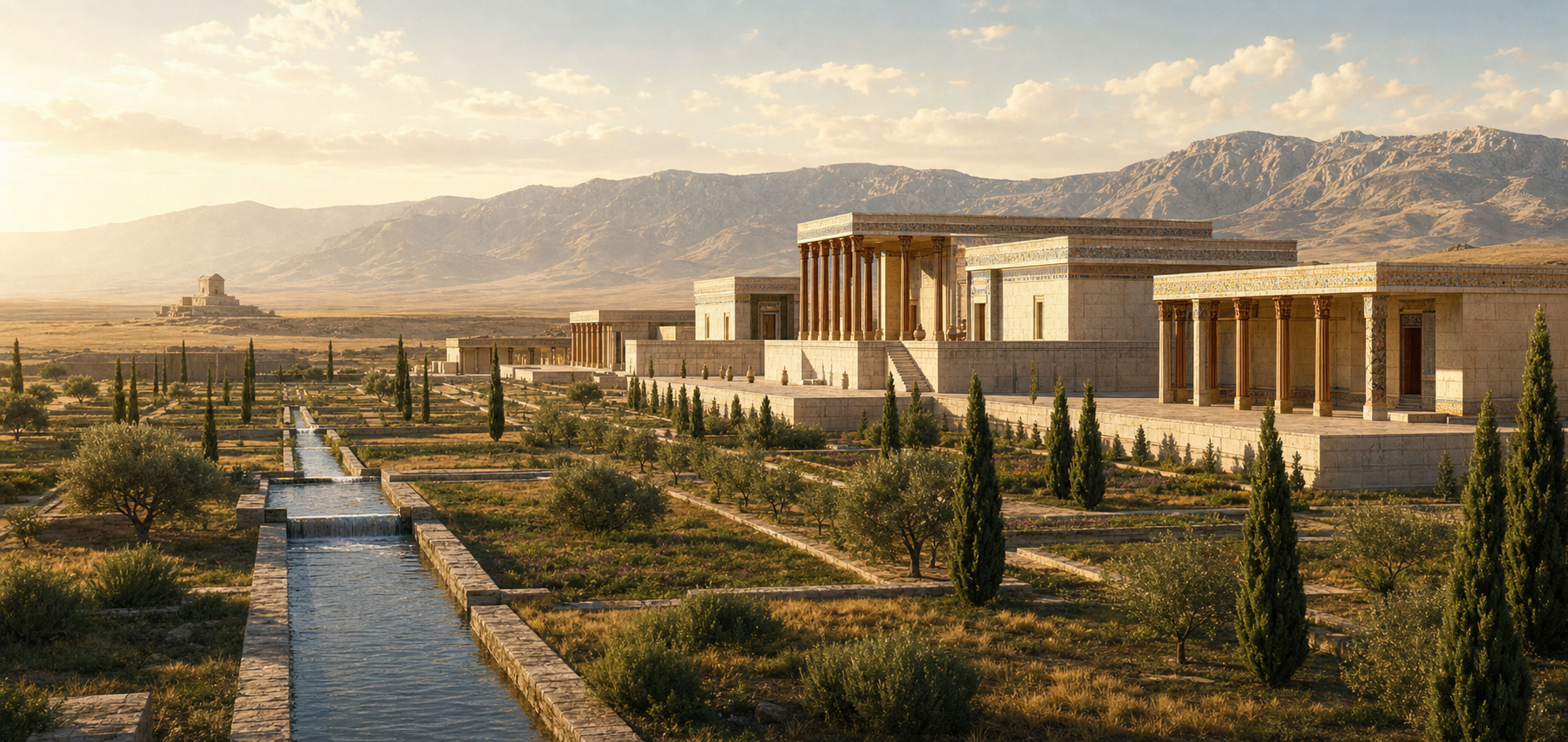
Knossos was the largest and most influential centre of the Minoan civilisation on the island of Crete. Flourishing during the Bronze Age, it stood as one of the earliest great urban centres in Europe. Although it predates the classical Greek city-states by many centuries, Knossos occupies a foundational place in the history of the Aegean world and later Greek cultural memory. Its grand palace complex, advanced architecture, vibrant art, and enduring myths have made it one of the most celebrated archaeological sites in the Mediterranean.
Geographic Setting
Knossos was located in a fertile valley near the northern coast of Crete, close to what is now Heraklion. The site benefited from arable land suitable for grain, olives, and vines, as well as proximity to the sea, which enabled maritime trade across the Aegean and eastern Mediterranean. The surrounding hills provided natural protection while still allowing communication with inland settlements.
Its position made it ideally suited to become a political and economic centre, linking Crete to mainland Greece, the Cyclades, Egypt, and the Near East.
Early Development
Settlement at Knossos began in the Neolithic period, but the site rose to prominence during the Early and Middle Bronze Age. By the second millennium BCE, Knossos had developed into the principal centre of Minoan civilisation. The term “Minoan” derives from the legendary King Minos, whose name became associated with the palace and the broader culture of Crete.
Knossos appears to have functioned as an administrative and ceremonial hub, coordinating agricultural production, craft activity, and trade across the island.
The Palace Complex
The palace of Knossos is the most remarkable feature of the site. Built around a large central courtyard, it consisted of multiple storeys, elaborate staircases, workshops, storerooms, and ceremonial chambers. The layout was intricate and highly sophisticated, incorporating light wells, ventilation systems, and advanced drainage.
Large storage jars, known as pithoi, were used to hold grain, oil, and wine, indicating organised redistribution of resources. The architectural complexity of the palace may have inspired the later Greek myth of the Labyrinth.
The palace was destroyed and rebuilt several times, likely due to earthquakes or other natural disasters. Each reconstruction demonstrates resilience and continued prosperity.
Art and Aesthetic Achievement
Knossos was renowned for its artistic production. Frescoes adorned the walls of the palace, depicting scenes of nature, marine life, ceremonial gatherings, and athletic activities such as bull-leaping. The figures are characterised by fluid movement, vivid colours, and a sense of vitality.
Craftsmen produced fine pottery, jewellery, carved seals, and metalwork. Marine motifs, such as dolphins and octopuses, were common, reflecting the island’s close relationship with the sea.
The art of Knossos reveals a society that valued beauty, ritual, and harmony with the natural world.
Writing and Administration
Knossos played a crucial role in the development of early writing systems in the Aegean. Two scripts, known as Linear A and Linear B, were used at the site. Linear A remains undeciphered, but Linear B was later adapted for early Greek and used by the Mycenaeans.
Clay tablets discovered at Knossos record inventories and administrative matters, indicating a highly organised bureaucracy. These records suggest that the palace oversaw agricultural production, trade, and craft activity.
Mythological Associations
In later Greek mythology, Knossos was the realm of King Minos. According to legend, Minos ordered the construction of a labyrinth to imprison the Minotaur, a creature half man and half bull. The hero Theseus eventually slew the Minotaur with the aid of Ariadne, Minos’ daughter.
While these stories are not historical accounts, they reflect the enduring fascination of later Greeks with Crete’s ancient past. The scale and complexity of the palace may have inspired tales of a maze-like structure.
Decline and Mycenaean Control
By the mid-second millennium BCE, Knossos experienced decline. Natural disasters, including earthquakes or the volcanic eruption of Thera, may have contributed to weakening the Minoan system. Eventually, the site came under the control of Mycenaean Greeks from the mainland.
The use of Linear B tablets indicates that Mycenaean administrators governed the palace during its later phase. This transition marks a shift from predominantly Minoan culture to a more recognisably Greek political structure.
By the end of the Bronze Age, Knossos had lost its pre-eminence, though settlement continued in the surrounding area.
Archaeological Rediscovery
Knossos was excavated in the early twentieth century by Sir Arthur Evans. His work uncovered extensive remains of the palace complex and revealed the existence of a previously unknown civilisation. Evans’ reconstructions, though sometimes debated, helped to bring the splendour of Minoan Crete to public attention.
The discoveries at Knossos transformed understanding of prehistoric Europe and demonstrated that advanced urban culture existed in the Aegean long before classical Greece.
Legacy
Knossos represents one of the earliest and most sophisticated civilisations in European history. Its architectural innovation, artistic vitality, and administrative organisation influenced later cultures in the Aegean.
The myths associated with Knossos ensured its place in Greek imagination, while archaeological evidence has confirmed its importance as a centre of Bronze Age civilisation. The site stands as a testament to the creativity and complexity of early Mediterranean societies.
Conclusion
Knossos was the heart of Minoan Crete and a beacon of early urban achievement. Through its palace complex, artistic excellence, maritime trade, and administrative sophistication, it shaped the development of the Aegean world.
Though its political dominance faded long before the rise of classical Greece, Knossos remains integral to the story of ancient civilisation. Its ruins continue to offer insight into the origins of European culture and the enduring power of myth and memory.