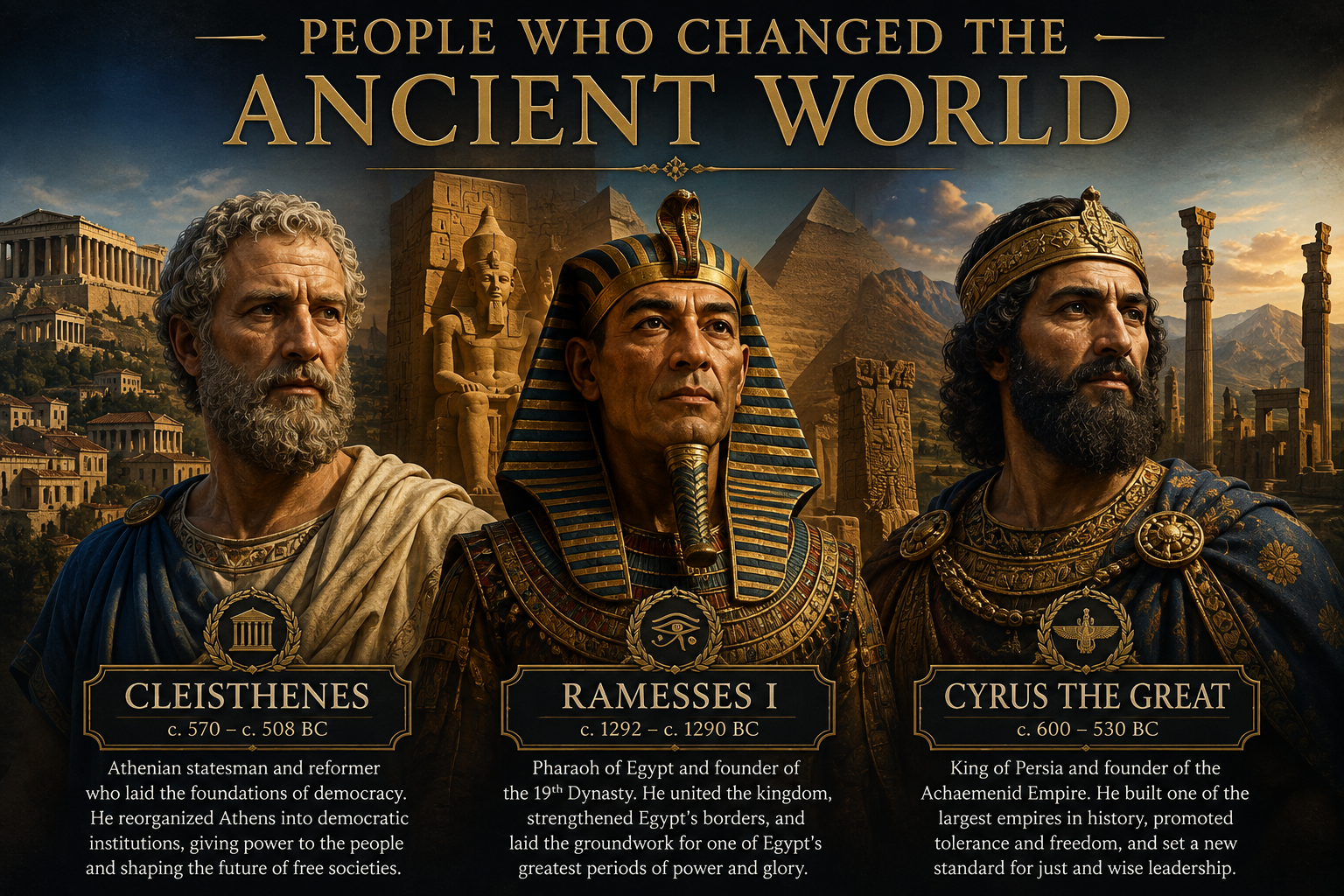
Ramesses II was one of the most powerful, ambitious and celebrated pharaohs of ancient Egypt. He ruled for more than six decades during the Nineteenth Dynasty and became famous for his military campaigns, monumental building programme, diplomatic achievements and extraordinary efforts to shape how future generations would remember him.
Often called Ramesses the Great, he reigned during the thirteenth century BCE, traditionally dated to approximately 1279–1213 BCE. His reign belonged to Egypt's New Kingdom, an age when Egyptian power extended far beyond the Nile Valley into Nubia and the eastern Mediterranean world.
Ramesses fought against the Hittite Empire for control of Syria, commanded Egyptian forces at the famous Battle of Kadesh, constructed enormous temples including Abu Simbel and the Ramesseum, expanded existing monuments throughout Egypt and fathered a remarkably large royal family.
His reign was also an age of diplomacy. Years after the Battle of Kadesh, Egypt and the Hittite Empire concluded one of the earliest surviving international peace treaties. Ramesses later strengthened the relationship by marrying a Hittite princess.
By the time of his death, Ramesses had ruled longer than most Egyptians could remember. His image appeared on temples, statues and inscriptions from the Nile Delta to Nubia. Later Egyptians regarded him as one of the great rulers of their past, while modern archaeology has made him one of the most recognisable pharaohs in world history.
Egypt During the New Kingdom
Ramesses II ruled during the New Kingdom, a period traditionally dated from around 1550 to 1070 BCE.
The New Kingdom followed the expulsion of the Hyksos rulers from northern Egypt and the reunification of the country under rulers of the Eighteenth Dynasty.
Egypt Becomes an Imperial Power
New Kingdom pharaohs campaigned extensively beyond Egypt's traditional borders.
Egyptian armies advanced southward into Nubia and northward into the Levant.
The Wealth of Empire
Conquest brought tribute, resources, captives and prestige.
Gold from Nubia became particularly important to Egyptian royal wealth.
Thutmose III
Long before Ramesses II, Pharaoh Thutmose III had conducted numerous campaigns into Syria and Palestine.
His victories established Egypt as one of the major international powers of the Late Bronze Age.
Amenhotep III
Under Amenhotep III, Egypt enjoyed extraordinary wealth and diplomatic prestige.
Foreign rulers exchanged gifts and royal correspondence with the Egyptian court.
Akhenaten
A major transformation occurred under Akhenaten, who promoted the worship of the Aten and established a new royal capital at Akhetaten.
His religious programme disrupted traditional relationships between the monarchy and established temples.
Tutankhamun
After Akhenaten's reign, Tutankhamun and his advisers restored many traditional religious practices.
The royal court abandoned Akhetaten and returned to older centres of power.
Horemheb
Horemheb, a military commander who eventually became pharaoh, attempted to restore political and administrative stability.
He had no surviving son to succeed him.
The Nineteenth Dynasty
Horemheb selected a military and administrative official named Ramesses as his successor.
This man became Ramesses I and founded the Nineteenth Dynasty.
Ramesses I
Ramesses I was already relatively old when he became pharaoh.
His reign was brief, probably lasting only around one or two years.
Seti I
Ramesses I was succeeded by his son Seti I.
Seti became an energetic military ruler who attempted to restore Egyptian influence in the Levant.
Ramesses II Is Born
Ramesses II was born during the early Nineteenth Dynasty, before his father Seti I became pharaoh.
His exact birth year is uncertain, although around 1303 BCE is often suggested.
A Royal Family With Military Roots
The family did not descend directly from the Eighteenth Dynasty's principal royal line.
Its rise was connected strongly with military and administrative service.
The Young Prince
Ramesses was prepared for kingship from an early age.
Royal inscriptions later portrayed him as participating in military and political life while still young.
Crown Prince
Seti I designated Ramesses as crown prince.
This publicly established him as the intended successor.
Was Ramesses Co-Ruler With Seti?
Older interpretations sometimes proposed a substantial period of co-regency between Seti I and Ramesses II.
The evidence remains debated, and many Egyptologists prefer to regard Ramesses principally as crown prince rather than full co-pharaoh during his father's reign.
Learning Kingship
As crown prince, Ramesses gained experience in administration, religious ceremony and military affairs.
Royal Education
Egyptian princes were expected to understand court ritual, religion, government and warfare.
Ramesses would later present himself as an ideal ruler competent in all these areas.
Seti I's Military Campaigns
Seti campaigned in the Levant against local rulers and against expanding Hittite influence.
These conflicts helped create the geopolitical situation Ramesses inherited.
The Hittite Empire
The Hittites ruled a powerful state centred in Anatolia.
Their capital was Hattusa in central Anatolia.
Egypt and Hatti
By the thirteenth century BCE, Egypt and the Hittite Empire were the principal rivals for influence over parts of Syria.
Amurru
The kingdom of Amurru occupied a strategically important region near the Syrian coast.
Its shifting allegiance became a repeated source of tension between Egypt and the Hittites.
Kadesh
The city of Kadesh stood near the Orontes River in Syria.
Its location made it strategically important for controlling routes through the region.
Seti Captures Kadesh
Seti I appears to have temporarily regained Kadesh during his campaigns.
The city later returned to the Hittite sphere of influence.
Ramesses Becomes Pharaoh
After Seti I's death, Ramesses II succeeded to the throne.
His reign is conventionally dated from around 1279 BCE.
A Young King
Ramesses was probably in his late teens or early twenties when he became pharaoh.
He would rule Egypt for approximately sixty-six years.
Royal Names
Egyptian kings possessed several official royal names and titles.
Ramesses's throne name was Usermaatre Setepenre.
Usermaatre Setepenre
The name can be understood approximately as Powerful is the Justice of Ra, Chosen of Ra.
It connected Ramesses directly with the sun god and the cosmic order represented by maat.
Ramesses
The birth name Ramesses means approximately Ra has fashioned him or Born of Ra.
The name emphasised the ruler's connection with the solar deity Ra.
Pharaoh and Divine Kingship
Egyptian kingship possessed deeply religious foundations.
The pharaoh was responsible for preserving maat, the divinely established order of the universe.
Maat
Maat represented truth, justice, balance and proper cosmic order.
The king's victories over enemies could therefore be represented symbolically as victories of order over chaos.
The King and the Gods
Ramesses appeared in temples offering sacrifices to deities and receiving divine approval.
Such scenes reinforced the claim that his authority was sanctioned by the gods.
Amun
Amun remained one of Egypt's most powerful deities during the Ramesside period.
His great temple complex at Karnak possessed enormous economic and religious importance.
Ra
The sun god Ra remained central to royal ideology.
Ramesses's own names repeatedly emphasised solar connections.
Ptah
Ptah, the great god of Memphis, was also important during Ramesses's reign.
Set
The god Set held particular significance for the royal family of the Nineteenth Dynasty.
Seti I's name itself means Man of Set.
The First Years of Ramesses
Ramesses moved quickly to establish his authority.
He commissioned monuments, organised royal ceremonies and continued Egyptian military activity.
A Building Pharaoh
From the beginning of his reign, Ramesses demonstrated extraordinary interest in monumental architecture.
His name would eventually appear on buildings throughout Egypt.
Completing His Father's Monuments
Ramesses completed some projects begun under Seti I.
These included important work at Abydos.
The Temple of Seti I at Abydos
Seti's mortuary temple at Abydos became one of the finest surviving monuments of the New Kingdom.
Its reliefs preserve exceptional artistic detail.
The Abydos King List
The temple contains a famous list of Egyptian kings.
The sequence omitted rulers considered illegitimate or problematic within later royal ideology.
Ramesses and Memory
Ramesses understood the political importance of monuments and historical memory.
He developed this principle on a scale rarely matched by earlier pharaohs.
Pi-Ramesses
Ramesses established a major royal residence in the eastern Nile Delta known as Pi-Ramesses.
The name means House or Domain of Ramesses.
A New Royal Capital
Pi-Ramesses became a major administrative and military centre.
Its eastern Delta location offered convenient access to routes leading toward Sinai and the Levant.
The Location of Pi-Ramesses
Archaeological research identifies the principal Ramesside city with the region around modern Qantir.
Nearby Tell el-Dab'a had earlier been the Hyksos capital Avaris.
A Military Centre
Pi-Ramesses contained facilities associated with chariots, horses and royal administration.
Its position suited the military priorities of the Nineteenth Dynasty.
A Cosmopolitan City
People and goods from different parts of the eastern Mediterranean passed through the Delta.
Ramesside Egypt was deeply connected with the wider Late Bronze Age world.
Ramesses and Nubia
Egypt maintained extensive control over Nubia to the south.
The region was strategically and economically essential.
Gold of Nubia
Nubian mines supplied large quantities of gold.
Gold supported temple construction, diplomacy and royal wealth.
Egyptian Administration in Nubia
Officials governed Egyptian-controlled territories and supervised the movement of resources northward.
The Viceroy of Kush
A senior official known conventionally as the King's Son of Kush administered much of Egyptian Nubia.
Temples in Nubia
Ramesses constructed monumental temples throughout Nubian territory.
These buildings demonstrated Egyptian political and religious authority.
Abu Simbel
The most famous of Ramesses's Nubian monuments are the rock-cut temples at Abu Simbel.
They were carved into cliffs near the Nile in Lower Nubia.
The Great Temple
The larger temple was dedicated principally to Ra-Horakhty, Amun, Ptah and the deified Ramesses himself.
The Colossal Statues
Four enormous seated statues of Ramesses dominate the temple facade.
Each originally stood approximately twenty metres high.
The King Made Monumental
The colossal scale was designed to communicate royal power to anyone travelling along the Nile.
The Interior of Abu Simbel
The temple contains halls supported by monumental figures of the king and walls covered with religious and military scenes.
The Battle of Kadesh at Abu Simbel
Reliefs celebrating Ramesses's campaign against the Hittites appear prominently within the temple.
Kadesh became one of the central themes of his royal image.
Solar Alignment
The temple was designed so sunlight penetrated deep into the sanctuary on particular days of the year.
The precise ancient intended dates and their significance remain subjects of discussion.
Ptah in Darkness
The sanctuary contains seated figures including Ptah, a god associated with the underworld as well as creation.
Ptah's position receives less direct solar illumination than the other figures.
The Smaller Temple
A second rock-cut temple at Abu Simbel was dedicated to the goddess Hathor and to Ramesses's Great Royal Wife Nefertari.
Nefertari
Nefertari was one of the most important women of Ramesses's reign.
She appears prominently in royal monuments and inscriptions.
Exceptional Representation
At the smaller Abu Simbel temple, statues of Nefertari appear at nearly the same monumental scale as those of Ramesses.
This was unusual within Egyptian royal imagery.
Hathor
Hathor was associated with love, music, motherhood, fertility and several sacred landscapes.
Nefertari was closely linked with the goddess in the temple.
The Modern Rescue of Abu Simbel
In the twentieth century, construction of the Aswan High Dam threatened to submerge the temples beneath the waters of Lake Nasser.
An International Archaeological Project
During the 1960s, an international campaign organised through UNESCO dismantled the temples into large blocks.
The Temples Are Moved
The blocks were reassembled on higher ground near their original location.
The operation became one of the greatest archaeological engineering projects of the twentieth century.
Ramesses's Monument Survives Again
More than three thousand years after its construction, the scale of Abu Simbel continued to inspire massive human effort.
Military Campaigns
Ramesses inherited an international world in which Egypt competed with the Hittite Empire for influence in Syria.
Military prestige was therefore a central concern during the early years of his reign.
The Sherden
Egyptian sources mention warriors called Sherden during Ramesses's reign.
They were associated with maritime raiding and later served within the Egyptian military.
Enemies Become Soldiers
Egyptian armies could incorporate foreign warriors after defeat or recruitment.
The presence of Sherden soldiers illustrates the international character of Late Bronze Age armies.
War in the Levant
Ramesses campaigned northward during the early years of his reign.
His greatest objective was restoring Egyptian influence over territories contested by the Hittites.
The Road to Kadesh
By the fifth year of his reign, Ramesses prepared a major campaign toward Kadesh.
Muwatalli II
The Hittite king at the time was Muwatalli II.
He assembled a powerful army and numerous allied contingents.
A Clash of Great Powers
The confrontation at Kadesh was therefore not simply a battle between two cities.
It represented a struggle between two of the most powerful states of the Late Bronze Age.
The Egyptian Army
Ramesses organised his forces into major divisions named after Egyptian gods.
The Division of Amun
The Amun division accompanied Ramesses during the initial approach toward Kadesh.
The Division of Ra
Another major force carried the name of Ra.
The Division of Ptah
A third division was named after Ptah.
The Division of Seth
A further division bore the name of Seth.
Chariot Warfare
Chariots were among the most prestigious weapons of Late Bronze Age armies.
They provided mobility for elite warriors and archers.
Egyptian Chariots
Egyptian chariots were relatively light and mobile.
They typically carried a driver and a warrior, often equipped with a composite bow.
The Composite Bow
Composite bows combined different materials to produce powerful weapons suitable for mounted or chariot warfare.
Infantry
Despite the fame of chariots, infantry formed the bulk of ancient armies.
Egyptian soldiers carried spears, shields, bows and close-combat weapons.
Ramesses Marches North
The Egyptian army advanced through the Levant toward Kadesh.
Ramesses believed the Hittite army was farther away than it actually was.
False Intelligence
According to Egyptian accounts, two local men deliberately gave Ramesses misleading information about Muwatalli's position.
Hittite Scouts Captured
Other captured individuals later revealed that the Hittite army was concealed close to Kadesh.
The Egyptian Army Is Dispersed
Ramesses had advanced with the Amun division while other Egyptian divisions remained separated along the route.
This created a dangerous tactical situation.
The Hittite Attack
Hittite chariots crossed the Orontes and struck the advancing Ra division.
The Ra Division Is Disrupted
The sudden assault created confusion and drove part of the Egyptian force toward Ramesses's camp.
Ramesses in Danger
The pharaoh found himself facing a serious battlefield crisis.
Egyptian royal inscriptions later transformed this moment into the central heroic episode of the battle.
The Poem of Pentaur
A lengthy literary account traditionally associated with the name Pentaur describes the Battle of Kadesh.
Versions were carved on several Egyptian temples.
The Bulletin
Another official narrative provides a more concise description of the campaign.
Reliefs and inscriptions together create one of the most detailed propagandistic records of any Bronze Age battle.
Ramesses Calls Upon Amun
The Egyptian narrative describes Ramesses appealing to Amun for help when surrounded by enemies.
The god responds by strengthening the king.
The Heroic Pharaoh
Ramesses is then portrayed attacking the Hittite forces almost single-handedly.
Royal inscriptions emphasise that other Egyptians had abandoned him.
Propaganda and History
The account should not be read as a literal battlefield transcript.
Its purpose was to present Ramesses as the ideal warrior king supported directly by the gods.
Egyptian Reinforcements
Additional Egyptian forces eventually arrived and helped stabilise the situation.
The Ne'arin
Egyptian inscriptions mention a force commonly called the Ne'arin arriving during the battle.
Their exact identity and origin remain debated.
Hittite Chariots
Hittite chariot forces had achieved dramatic initial success but became increasingly disorganised during fighting around the Egyptian camp.
Counterattack
Egyptian troops counterattacked and prevented the Hittites from destroying Ramesses's army.
Muwatalli's Position
The Hittite king appears to have remained with substantial reserves across or near the Orontes rather than committing every available force immediately.
The Battle Ends
Neither side achieved a complete destruction of the opposing army.
Ramesses eventually withdrew southward.
Who Won Kadesh?
Egyptian monuments portray the battle as an overwhelming victory for Ramesses.
The strategic outcome was far less decisive.
Egypt Did Not Capture Kadesh Permanently
Kadesh remained within the Hittite sphere after the campaign.
Egypt therefore failed to achieve its principal long-term strategic objective.
Ramesses Was Not Defeated Completely
At the same time, the Hittites had failed to destroy the Egyptian army or capture the pharaoh.
A Tactical Survival and Propaganda Victory
Ramesses transformed a dangerous and indecisive battlefield experience into one of the greatest royal victory narratives in Egyptian history.
Kadesh Everywhere
Scenes of the battle appeared on major temples including Karnak, Luxor, the Ramesseum and Abu Simbel.
The King Controls Memory
Most Egyptians encountering these monuments would see Ramesses as the triumphant hero of Kadesh.
History as Royal Ideology
The difference between strategic outcome and monumental presentation provides an important lesson about ancient historical sources.
Further Campaigns
Ramesses continued campaigning in the Levant after Kadesh.
Egyptian armies attempted to restore influence over territories that had shifted toward the Hittites.
Dapur
Royal scenes portray Ramesses attacking the fortified town of Dapur.
The location and precise historical context remain subjects of scholarly discussion.
Continued Rivalry
Neither Egypt nor Hatti could easily eliminate the other's influence in Syria.
A Changing International Situation
Eventually, political circumstances made diplomatic settlement more attractive than continuing conflict.
The Hittite Succession
Muwatalli II died after the Kadesh period.
Hittite politics then experienced significant dynastic tensions.
Hattusili III
Hattusili III eventually became Hittite king after overthrowing his nephew Urhi-Teshub, also known as Mursili III.
A New Diplomatic Relationship
Hattusili needed international recognition and stability.
Ramesses likewise had reasons to secure Egypt's northern frontier.
Assyria
The growing power of Assyria created an additional strategic concern for the Hittites.
Peace with Egypt became increasingly valuable.
The Egyptian-Hittite Peace Treaty
Around the twenty-first year of Ramesses's reign, Egypt and Hatti concluded a formal peace agreement.
The treaty is traditionally dated to around 1259 BCE.
One of the Earliest Surviving Peace Treaties
The agreement is frequently described as the world's first peace treaty.
It is more precise to call it one of the earliest surviving international peace treaties known in substantial textual form.
Egyptian Version
The Egyptian version was carved on temple walls in hieroglyphic inscriptions.
Hittite Version
Clay tablets preserving an Akkadian-language version were discovered at Hattusa.
Akkadian Diplomacy
Akkadian served widely as an international diplomatic language during the Late Bronze Age.
Two Great Kings
The treaty formally presented Ramesses and Hattusili as rulers entering a relationship of peace and brotherhood.
Permanent Peace
Each side promised not to attack the other.
Mutual Assistance
The agreement included provisions for assistance against external enemies and internal rebellion.
Extradition
The treaty also contained clauses concerning fugitives crossing between the two kingdoms.
Divine Witnesses
The gods of both states were invoked as witnesses to the agreement.
Diplomacy and Religion
As in many ancient treaties, political obligations were reinforced through religious sanctions.
A Diplomatic Triumph
For both states, the treaty allowed decades of conflict to give way to a more stable international relationship.
Marriage Diplomacy
The new relationship was later reinforced through royal marriage.
A Hittite Princess
A daughter of Hattusili III travelled to Egypt and married Ramesses.
Maathorneferure
The Hittite princess received the Egyptian name Maathorneferure.
She became one of Ramesses's royal wives.
An International Royal Marriage
The marriage represented far more than a personal relationship.
It symbolised the alliance between two great imperial houses.
Hittite-Egyptian Correspondence
Royal letters reveal diplomatic communication involving Ramesses, Hattusili and Hittite queen Puduhepa.
Puduhepa
Puduhepa was one of the most influential royal women of the Late Bronze Age.
She participated actively in diplomacy and treaty relationships.
Nefertari and Puduhepa
Correspondence associated with the two royal courts reflects diplomatic relationships extending beyond the kings themselves.
An International Bronze Age World
Egypt, Hatti, Babylon, Assyria and other states communicated through envoys, letters, marriages and gifts.
Great Kings
The most powerful rulers addressed one another using language of brotherhood.
This diplomatic terminology implied roughly equivalent status among recognised great powers.
Ramesses the Diplomat
The peace with Hatti demonstrates that Ramesses's reign cannot be understood only through warfare.
Diplomatic compromise achieved what decades of military campaigning had failed to accomplish.
Nefertari
Nefertari Meritmut was one of Ramesses's earliest and most prominent Great Royal Wives.
Beloved of Mut
Her name and titles associated her with the goddess Mut.
Royal Representation
Nefertari appeared beside Ramesses on numerous monuments.
Her unusually prominent representation indicates exceptional status.
Nefertari at Abu Simbel
The smaller Abu Simbel temple elevated Nefertari visually and religiously alongside Hathor.
Nefertari's Tomb
Nefertari was buried in tomb QV66 in the Valley of the Queens near Thebes.
One of Egypt's Most Beautiful Tombs
The tomb contains extraordinarily refined wall paintings depicting Nefertari's journey through the afterlife.
The Book of the Dead
Many scenes and texts relate to compositions commonly grouped under the modern term Book of the Dead.
Nefertari Before the Gods
The queen appears interacting with deities including Isis, Hathor and others.
Preservation
The tomb suffered deterioration after antiquity but has undergone major conservation efforts.
The Death of Nefertari
Nefertari appears to have died relatively early in Ramesses's exceptionally long reign.
The exact year remains uncertain.
Isetnofret
Another important royal wife was Isetnofret.
Several prominent royal children were her offspring.
The Royal Family
Ramesses II became famous for having an exceptionally large number of children.
Ancient monuments identify dozens of sons and daughters.
How Many Children?
Exact totals depend upon interpretation of inscriptions, but Ramesses appears to have fathered more than one hundred children.
Royal Processions
Temples sometimes depict long rows of royal princes and princesses.
Succession Problems of a Long Reign
Because Ramesses lived into old age, many of his intended heirs died before him.
Amunherkhepeshef
Amunherkhepeshef was one of Ramesses's eldest sons and held the position of crown prince for part of the reign.
Prince Ramesses
Another son named Ramesses later became crown prince.
He also died before his father.
Khaemwaset
Prince Khaemwaset became one of the most remarkable members of the royal family.
He was a son of Ramesses and Isetnofret.
Priest of Ptah
Khaemwaset became a high priest of Ptah at Memphis.
He combined religious authority with royal status.
Restorer of Ancient Monuments
Khaemwaset became famous for work associated with older monuments and royal tombs.
The First Archaeologist?
He is sometimes called the world's first archaeologist because inscriptions record his interest in identifying and restoring monuments of earlier kings.
The label is modern and should not imply he practised archaeology in the modern scientific sense.
Respect for Egypt's Past
Khaemwaset's activities demonstrate the importance ancient Egyptians themselves attached to monuments already centuries old.
Khaemwaset as Crown Prince
He eventually became crown prince but died before Ramesses.
Merneptah
Another son, Merneptah, ultimately survived to become Ramesses's successor.
An Elderly Heir
Because Ramesses ruled for so long, Merneptah was already an older man when he became pharaoh.
Bintanath
Ramesses's daughter Bintanath became a prominent royal woman and eventually held the title Great Royal Wife.
Royal Marriage Practices
Egyptian royal families sometimes practised marriages between close relatives.
These relationships were connected with dynastic ideology and the exceptional status of the royal household.
Meritamen
Another daughter, Meritamen, became an important royal wife after Nefertari's disappearance from the record.
Nebettawy
Nebettawy, another royal daughter, also held prominent titles.
A Vast Royal Household
The size of Ramesses's family reflected both his exceptionally long life and the political importance of royal marriage.
The Ramesseum
Ramesses constructed a monumental mortuary temple on the west bank of the Nile at Thebes.
Modern scholars call it the Ramesseum.
The House of Millions of Years
Egyptian royal mortuary temples maintained the cult and memory of deceased kings.
They also possessed substantial economic resources.
Ramesses's Colossal Statue
The Ramesseum once contained an enormous seated statue of Ramesses.
Fragments of the colossal figure remain at the site.
Ozymandias
The Greek form of part of Ramesses's throne name eventually inspired the name Ozymandias.
Percy Bysshe Shelley
The nineteenth-century poet Percy Bysshe Shelley used the name in his famous poem about the ruins of a once-powerful king's monument.
Ramesses and the Irony of Memory
Shelley's poem presents monumental pride as ultimately defeated by time.
Ironically, Ramesses's monuments have preserved his name more successfully than those of most ancient rulers.
The Ramesseum Reliefs
The temple contains representations of military victories, religious festivals and royal ceremony.
Kadesh Again
The Battle of Kadesh appears prominently.
Ramesses repeatedly used the same event to reinforce his identity as victorious warrior.
Karnak
The enormous temple complex at Karnak received additions and inscriptions during Ramesses's reign.
The Great Hypostyle Hall
One of Karnak's most famous features is the Great Hypostyle Hall.
Construction had begun before Ramesses, particularly under Seti I, and Ramesses completed and decorated substantial portions.
A Forest of Columns
The hall contains more than one hundred monumental columns.
The central columns rise dramatically above the surrounding rows.
Reliefs
Seti I's reliefs are often carved in raised relief, while Ramesses's later additions frequently use sunk relief.
Luxor Temple
Ramesses also added extensively to Luxor Temple.
The First Pylon
A monumental gateway built under Ramesses dominates the northern approach.
Colossi at Luxor
Large statues of the pharaoh stood before the temple.
Several survive today.
Obelisks
Ramesses erected obelisks before Luxor Temple.
Originally, a pair flanked the entrance.
The Luxor Obelisk in Paris
One of the pair was transported to France during the nineteenth century.
It now stands at the Place de la Concorde in Paris.
The Remaining Obelisk
The other remains at Luxor Temple.
Ramesses Across Egypt
The pharaoh's cartouches appear on monuments from earlier periods as well as structures built during his own reign.
Usurpation of Monuments
Ramesses sometimes added his names to statues or buildings created under previous rulers.
This practice is often described as usurpation.
Not Unique to Ramesses
Reusing and reinscribing monuments occurred under many Egyptian rulers.
Ramesses practised it on a particularly visible scale.
Royal Presence
The effect was to make Ramesses appear almost everywhere within Egypt's monumental landscape.
A Master of Image
Few ancient rulers manipulated monumental visibility as effectively as Ramesses.
Memphis
Ramesses also left important monuments at Memphis, one of Egypt's oldest capitals.
The Colossus of Ramesses
A famous colossal statue discovered near Memphis depicts the king on an enormous scale.
Royal Statues
Statues did more than represent physical appearance.
They created ritual presences through which royal authority and divine relationships could be expressed.
Idealised Appearance
Ramesses's official images usually show an eternally youthful and powerful king.
These should not be treated as photographic portraits of his actual appearance at different ages.
A King Who Grew Old
Ramesses lived far longer than most people of the ancient world.
His mummy demonstrates that the historical king eventually became elderly despite the permanent youth of his monuments.
The Sed Festival
Long-reigning pharaohs celebrated royal jubilees known as Sed festivals.
These ceremonies symbolically renewed the king's power.
Thirty Years of Kingship
The first Sed festival was traditionally associated with approximately thirty years of rule.
Later celebrations could occur at shorter intervals.
Ramesses Celebrates Many Jubilees
Because of his exceptional reign length, Ramesses celebrated numerous Sed festivals.
Royal Renewal
The festivals reinforced the concept that the aging human ruler remained divinely capable of preserving Egypt.
Religion Under Ramesses
Ramesses supported major cults throughout Egypt rather than elevating one deity at the expense of all others.
The Legacy of Akhenaten
The religious revolution associated with Akhenaten had been rejected before Ramesses's reign.
Traditional temple institutions were firmly restored.
Amun at Thebes
The priesthood and estates of Amun remained extremely wealthy.
Ra at Heliopolis
Solar religion continued to occupy a central position in royal theology.
Ptah at Memphis
Memphis remained an important religious and administrative centre.
Set in the Delta
The Nineteenth Dynasty maintained strong associations with the northeastern Delta and the god Set.
Religious Balance
Ramesses's royal names and monuments linked him with multiple major deities.
The Deified Ramesses
In some temples, especially in Nubia, Ramesses himself appears receiving worship alongside established gods.
Royal Divinity
Egyptian kings always possessed sacred qualities, but specific forms of royal cult could vary.
Abu Simbel and Divine Kingship
The sanctuary of the Great Temple at Abu Simbel dramatically places Ramesses among divine figures.
The Economy of Temples
Egyptian temples were not merely religious buildings.
They owned land, employed workers, stored agricultural produce and managed economic resources.
Royal Building Requires Resources
Ramesses's huge construction programme depended upon taxation, agricultural production, skilled labour and control of quarrying operations.
Stone Quarries
Egyptian expeditions extracted sandstone, limestone, granite and other materials from quarries throughout the Nile Valley and desert regions.
Aswan Granite
Granite from the Aswan region was particularly important for colossal statues and monumental architectural elements.
Transport on the Nile
The Nile served as Egypt's great transportation highway.
Large stone blocks could be moved by boat when river conditions allowed.
Skilled Workers
Stonecutters, sculptors, painters, scribes and other specialists produced royal monuments.
Deir el-Medina
A community of skilled workers lived at Deir el-Medina near the Valley of the Kings.
These workers constructed and decorated royal tombs.
Evidence for Daily Life
Thousands of written records from Deir el-Medina provide extraordinary information about families, wages, disputes, religion and working conditions.
Payment in Goods
Workers were commonly compensated through distributions of grain and other commodities rather than modern coinage.
Ramesses's Tomb
Ramesses II was buried in tomb KV7 in the Valley of the Kings.
The Valley of the Kings
New Kingdom rulers constructed hidden rock-cut tombs in valleys west of Thebes.
The location was intended partly to protect royal burials from robbery.
Tomb Robbery
Despite these precautions, most royal tombs were eventually robbed.
KV7
Ramesses's tomb suffered severe damage from flooding and ancient robbery.
It is much less visually preserved than the tomb of Nefertari.
The Tombs of Ramesses's Sons
Near Ramesses's own tomb lies KV5, an enormous tomb complex associated with many of his sons.
KV5
Modern excavation has revealed a vast network of chambers.
It is one of the largest known tombs in the Valley of the Kings.
A Monument to a Huge Dynasty
The scale of KV5 reflects the extraordinary size of Ramesses's royal family.
Administration
Ramesses ruled through an elaborate bureaucracy inherited from earlier pharaohs.
The Vizier
Viziers were among Egypt's highest officials.
They supervised administration, justice, taxation and royal projects.
Scribes
Scribes were essential to government.
They recorded taxes, supplies, military information and official correspondence.
Writing Systems
Hieroglyphs were used prominently on monumental inscriptions.
Hieratic script was widely used for administrative and literary writing on papyrus and ostraca.
The Power of Literacy
Literacy was limited compared with modern societies.
Professional scribes therefore occupied valuable positions within administration.
Ramesses's Monumental Inscriptions
Written texts allowed the king's official version of events to be repeated throughout the country.
Royal Propaganda
The term propaganda is modern, but it usefully describes the deliberate political messaging found in Ramesses's monuments.
The King Is Always Victorious
Egyptian royal art rarely emphasised defeat or royal weakness.
The king was depicted defeating enemies and preserving divine order.
Smiting Scenes
One of Egypt's oldest royal images shows the king raising a weapon over defeated enemies.
Ramesses continued this ancient visual tradition.
Enemies as Chaos
Foreign enemies could be represented symbolically as forces threatening maat.
Victory Is Cosmic
The king's military success therefore possessed both political and religious meaning.
Reality Was More Complicated
Foreign peoples were also traders, diplomats, soldiers and immigrants within Egyptian society.
Official royal imagery simplified these complex relationships.
Late Bronze Age Trade
Ramesside Egypt participated in international networks linking Africa, the Levant, Cyprus, Anatolia and the Aegean.
Copper
Cyprus was an important source of copper in the eastern Mediterranean.
Tin
Tin was required with copper to produce bronze, though its supply routes could extend over great distances.
Bronze Weapons
Bronze remained central to military equipment during Ramesses's reign.
Iron
Iron was known but had not yet replaced bronze as the dominant metal for weapons and tools.
Some iron objects possessed great prestige.
International Gifts
Great kings exchanged luxury goods as diplomatic gifts.
Gold
Egypt's access to Nubian gold made it a particularly important partner in international diplomacy.
Horses
Horses and chariots were valuable components of elite military culture.
Chariot Training
Effective chariot warfare required skilled drivers, archers, horse management and logistical support.
The Egyptian Army
By Ramesses's reign, Egypt possessed a highly organised military tradition developed over centuries of New Kingdom expansion.
Divisions
Large army formations could be identified through the names of major deities.
Foreign Troops
Nubians, Sherden and other non-Egyptian soldiers could serve within Egyptian forces.
Mercenaries and Auxiliaries
Egyptian warfare increasingly incorporated troops with different regional fighting traditions.
Fortresses
Egypt maintained defensive sites along vulnerable routes, particularly toward the eastern Delta and Sinai.
The Ways of Horus
A chain of fortified stations connected Egypt with the southern Levant.
These helped support military movement and communication.
Water and Logistics
Campaigning across Sinai required careful control of water supplies.
Military success depended upon logistics as much as battlefield skill.
Kadesh as a Logistical Campaign
Moving several army divisions hundreds of kilometres north from Egypt was a major organisational achievement even before the battle began.
Ramesses's Personal Image as Warrior
Royal scenes portray the pharaoh standing in his chariot, drawing his bow and defeating enemies.
King and Chariot
The chariot became one of the great symbols of Ramesside warrior kingship.
Historical Ramesses and Monumental Ramesses
Ramesses probably participated directly in campaigns, but monumental images deliberately exaggerate the king's individual role.
No Pharaoh Fought Alone
Ancient armies depended upon thousands of soldiers, officers, charioteers and supply personnel.
The Purpose of Royal Art
The objective was not to provide an objective battle report.
It was to demonstrate that victory flowed from the divine king.
The Sed Festivals and Old Age
As Ramesses's reign extended beyond thirty, forty, fifty and sixty years, his longevity itself became a political achievement.
Generations Under One King
Many Egyptians were born, lived much of their lives and died knowing only Ramesses as pharaoh.
Institutional Continuity
Such a long reign provided substantial continuity in government.
The Problem of Aging Officials
At the same time, royal sons and officials could die before the pharaoh, repeatedly changing succession arrangements.
Ramesses's Age
He probably died in his late eighties or around ninety years old.
For the ancient world, this was an exceptional lifespan.
The Death of Ramesses
Ramesses II died around 1213 BCE after approximately sixty-six years on the throne.
A National Transition
His death must have represented an extraordinary moment for Egypt.
Few living people could remember another ruler.
Merneptah Becomes Pharaoh
Ramesses was succeeded by his son Merneptah.
An Older Successor
Merneptah was probably already around sixty years old when he became king because of his father's exceptional longevity.
Ramesses's Burial
The king was originally buried in KV7 in the Valley of the Kings.
Royal Tomb Robbery
During later periods of political and economic instability, royal tombs became increasingly vulnerable to robbery.
The Priests Protect the Mummy
Ramesses's mummy was eventually removed from its original tomb and reburied for protection.
Royal Mummy Caches
Priests during the Twenty-First Dynasty relocated several royal mummies into hidden caches.
Deir el-Bahri Cache
Ramesses's mummy eventually became associated with the royal cache discovered at Deir el-Bahri.
Modern Rediscovery
The cache was officially brought to archaeological attention during the nineteenth century.
It contained the remains of several famous New Kingdom rulers.
The Mummy of Ramesses II
Ramesses's preserved body has allowed modern specialists to study aspects of his age, health and physical characteristics.
An Elderly Pharaoh
The mummy confirms that Ramesses survived into advanced old age.
Physical Problems
Studies have identified severe dental wear and other age-related conditions.
The Pharaoh's Teeth
Ancient Egyptian diets often contained abrasive particles introduced during grain grinding.
Dental wear was therefore a significant problem even among elites.
Arthritis
Ramesses appears to have experienced degenerative changes consistent with advanced age.
Hair
The mummy retains hair that appears reddish or lightened by age and preservation processes.
Claims about his exact original hair colour should therefore be approached carefully.
Ramesses Travels to France
In 1976, the mummy was transported to France for conservation and scientific examination.
A Pharaoh With Modern Documents
Popular stories often claim that Ramesses received a modern passport for the journey.
The details of this story are frequently repeated in simplified form, though the exact administrative documentation is less dramatic than popular retellings suggest.
Conservation
Specialists treated the mummy after concerns about deterioration and fungal contamination.
Modern Science and Ancient Royalty
The examination demonstrated the unusual opportunities provided by the preservation of Egyptian mummies.
Ramesses's Mummy Today
The mummy remains one of Egypt's most famous royal human remains and is preserved within Egypt.
Ramesses and the Biblical Exodus
Ramesses II is frequently associated in popular culture with the biblical story of Moses and the Exodus.
The Book of Exodus
The biblical narrative describes Israelites being forced to labour for Pharaoh and later leaving Egypt under Moses.
The Store City of Raamses
The biblical text mentions a place called Raamses or Rameses.
This has encouraged attempts to connect the story with Pi-Ramesses and the Ramesside period.
Was Ramesses II the Pharaoh of the Exodus?
There is no surviving Egyptian evidence identifying Ramesses II as the pharaoh of the Exodus.
The biblical text itself does not name the pharaoh involved.
A Popular Identification
Modern films and novels frequently portray Ramesses II as Moses's opponent.
This has made the association culturally powerful despite the historical uncertainty.
Chronological Debate
Different interpretations of biblical chronology have proposed different Egyptian rulers and periods.
No proposed identification has achieved universal scholarly acceptance.
Egyptian Records and Defeat
The absence of an Egyptian account would not by itself prove that an event never happened, since royal inscriptions normally avoided recording humiliating defeats.
However, there is currently no direct Egyptian evidence for the biblical Exodus as described in the text.
Ramesses and Popular Culture
The identification remains one of the strongest reasons Ramesses is widely recognised outside specialist ancient history.
The Historical Ramesses Is Remarkable Without Moses
His documented reign already contains extraordinary military, architectural and diplomatic achievements.
Merneptah and Israel
An important inscription from the reign of Ramesses's successor Merneptah contains one of the earliest known references to a people called Israel.
The Merneptah Stele
The inscription describes a campaign in Canaan and dates to the late thirteenth century BCE.
Israel Already in Canaan
The stele indicates that a group identified as Israel existed in the southern Levant by Merneptah's reign.
Historical Importance
This provides a valuable chronological reference for studying the emergence of ancient Israel.
The Late Bronze Age World
Ramesses II lived near the end of one of the great international systems of ancient history.
Great Powers
Egypt, Hatti, Assyria and Babylonia interacted with kingdoms throughout the eastern Mediterranean.
Diplomatic Networks
Royal courts exchanged letters, gifts and marriage partners.
Trade Networks
Ships and caravans transported metals, timber, luxury goods and agricultural products across vast distances.
Ugarit
The Syrian city of Ugarit was an important commercial and diplomatic centre.
Its archives preserve valuable evidence for the international world surrounding Ramesses's age.
Cyprus
Cyprus played a major role in regional copper production.
Mycenaean Greece
Palatial societies flourished in the Aegean during much of Ramesses's lifetime.
A Connected Mediterranean
Goods and artistic influences moved between Egypt, the Levant, Cyprus and the Aegean.
The Bronze Age Collapse
Within decades after Ramesses's death, many parts of this international system experienced severe disruption.
Around 1200 BCE
Hittite central authority collapsed, several eastern Mediterranean cities were destroyed or abandoned and Mycenaean palace systems declined.
Egypt Survives
Egypt endured the wider crisis but faced serious pressures during the reigns of Ramesses's successors.
Merneptah's Wars
Merneptah confronted Libyan forces and groups traditionally associated with the wider movements called the Sea Peoples.
Ramesses III
Later, Ramesses III fought major battles against groups identified in Egyptian inscriptions as Sea Peoples.
Ramesses II Before the Collapse
Ramesses's long reign therefore represents the final generations of the great Late Bronze Age international order.
Was Ramesses's Reign a Golden Age?
Later tradition often portrays his reign as an age of unparalleled Egyptian power.
The reality requires nuance.
Egypt Was Powerful
It remained wealthy, controlled Nubia and exercised significant influence in the Levant.
Egypt Was Not Alone
The Hittite Empire and other great states possessed comparable regional importance.
Kadesh Shows Egyptian Limits
Ramesses could not simply impose Egyptian rule throughout Syria.
The Peace Treaty Shows Pragmatism
His eventual agreement with Hatti recognised a balance of power rather than complete Egyptian supremacy.
Royal Ideology Exaggerated Victory
Ramesses's inscriptions rarely communicate these limitations openly.
A Great King in a Multipolar World
Ramesses is best understood as one powerful ruler operating within an interconnected system of powerful states.
Why Ramesses Built So Much
Monuments served religious, economic and political purposes simultaneously.
Honouring the Gods
Temples were constructed as divine houses where rituals maintained relationships between Egypt and its gods.
Displaying Royal Legitimacy
Monuments publicly demonstrated that Ramesses possessed the resources and divine approval required of a great king.
Creating Eternal Memory
Egyptian beliefs placed enormous importance upon preserving names and images.
The Name and Survival
To have one's name remembered was connected symbolically with continued existence.
Ramesses Multiplies His Name
By placing his cartouches throughout Egypt, Ramesses created an extraordinary monumental presence.
Success
More than three millennia later, the strategy has worked.
Ramesses remains one of the best-known rulers of ancient Egypt.
Statues of Ramesses
His colossal statues repeatedly depict idealised strength and royal confidence.
Scale as Political Language
Enormous size communicated authority immediately, even to viewers unable to read inscriptions.
Monuments and Landscape
At Abu Simbel, monumental royal figures dominate the natural cliff itself.
Architecture as Kingship
The landscape became part of the king's political message.
Ramesses and Nubian Identity
Egyptian monuments in Nubia represented imperial authority but existed within regions possessing their own ancient cultural traditions.
Nubia Was Not Simply an Egyptian Province
Nubian societies had long histories before Egyptian conquest and retained distinctive identities.
Egyptianisation
Some Nubian elites adopted Egyptian language, religion and material culture while local traditions continued.
Cultural Interaction
Imperial regions therefore experienced cultural exchange rather than simple one-way replacement.
Future Nubian Kingdoms
Centuries later, rulers from Kush would conquer Egypt and become pharaohs of the Twenty-Fifth Dynasty.
Ramesses and Temple Economy
The enormous resources granted to religious institutions contributed to the wealth of major temples.
Amun's Growing Power
During later Ramesside periods, the temple establishment of Amun at Thebes became increasingly influential.
Long-Term Political Change
By the end of the New Kingdom, high priests of Amun would exercise considerable political authority in Upper Egypt.
Ramesses Did Not See the End of the New Kingdom
His reign remained one of strong central monarchy.
The deeper political difficulties of later Ramesside Egypt developed after his death.
The Name Ramesses Becomes Prestigious
Many later pharaohs adopted the name Ramesses.
The Ramesside Period
Historians use the term Ramesside Period for rulers of the Nineteenth and Twentieth Dynasties associated with this royal naming tradition.
Ramesses III
Ramesses III deliberately invoked the memory of Ramesses II and copied elements of his monumental programme.
Medinet Habu
Ramesses III's great mortuary temple at Medinet Habu reflects architectural and ideological traditions strongly associated with earlier Ramesside kingship.
Ramesses as a Model King
Later rulers sought legitimacy by associating themselves with the achievements of Ramesses II.
Ancient Egyptian Memory
Ramesses became an ancestor figure of extraordinary prestige.
Greek Knowledge of Egypt
Centuries later, Greek writers encountered Egyptian traditions concerning ancient kings.
Ozymandias
Greek versions of Ramesses's royal name contributed to later traditions surrounding a king called Ozymandias.
Diodorus Siculus
The Greek historian Diodorus described monumental Egyptian remains associated with a king he called Osymandyas.
Classical Memory
By the Greco-Roman period, Ramesses's monuments were already ancient relics of a distant past.
Egypt Under Rome
When Rome annexed Egypt in 30 BCE, some buildings created under Ramesses were already more than twelve centuries old.
Monuments Outlive Empires
The temples survived the fall of the New Kingdom, Persian conquest, Macedonian conquest and Roman rule.
European Rediscovery
During the eighteenth and nineteenth centuries, European travellers increasingly documented Egypt's monumental remains.
Napoleon's Expedition
The French expedition to Egypt beginning in 1798 stimulated intense European interest in Egyptian antiquities.
The Description de l'Égypte
Scholars accompanying the expedition recorded monuments, landscapes and natural history.
The Rosetta Stone
The discovery of the Rosetta Stone eventually helped scholars decipher Egyptian hieroglyphs.
Jean-François Champollion
Champollion's work in the early nineteenth century transformed the study of ancient Egyptian writing.
Ramesses Speaks Again
Once hieroglyphs could be read, Ramesses's monuments changed from silent images into historical documents.
The Battle of Kadesh Reconstructed
Scholars could compare the different versions of the Egyptian inscriptions and identify the king's elaborate military narrative.
Hittite Discoveries
Excavations at Hattusa later revealed archives from the Hittite side of the international world.
Two Sides of the Story
Historians could now compare Egyptian claims with Hittite political evidence.
The Peace Treaty Rediscovered
The survival of both Egyptian and Hittite versions demonstrated the sophistication of Late Bronze Age diplomacy.
A Copy at the United Nations
A modern replica of the Egyptian-Hittite treaty has been displayed at the United Nations headquarters.
It has become a modern symbol of ancient diplomacy.
Modern Egyptology
Ramesses remains central to research into royal ideology, warfare, architecture, diplomacy and everyday life during the New Kingdom.
Archaeology at Pi-Ramesses
Excavations in the eastern Delta have helped reconstruct the scale and function of Ramesses's royal city.
Chariot Workshops
Archaeological evidence from the region reflects the military importance of horses and chariots.
The Lost City
Pi-Ramesses eventually declined after branches of the Nile shifted and the area's waterways became less suitable.
Tanis
Many monuments from Pi-Ramesses were later transported to Tanis.
This initially caused confusion among archaeologists attempting to locate Ramesses's capital.
Moving Ancient Monuments
Egyptians themselves frequently relocated statues and stone blocks.
Finding an inscription at one site therefore does not always prove it was originally created there.
Archaeology Reconstructs the Landscape
Modern geological and archaeological research helped identify Qantir as the principal location of Pi-Ramesses.
Ramesses and Historical Evidence
His reign is exceptionally well documented by Egyptian standards.
Monumental Inscriptions
Temples preserve royal narratives and official ideology.
Administrative Texts
Papyri and ostraca provide evidence for ordinary government and daily life.
Foreign Archives
Hittite records provide valuable perspectives unavailable from Egyptian monuments alone.
Archaeology
Buildings, pottery, settlements and human remains provide evidence independent of royal inscriptions.
Reading Sources Critically
The enormous quantity of Ramesside propaganda makes critical comparison particularly important.
The King Claims Victory
A monumental inscription tells us what the king wanted people to believe.
It does not necessarily describe events neutrally.
Kadesh Is the Best Example
Ramesses portrayed a strategically indecisive campaign as an overwhelming personal triumph.
This Does Not Make the Source Useless
The inscriptions remain invaluable evidence for military organisation, royal ideology and how Ramesses wished history to remember him.
The Pharaoh as Author of Memory
Ramesses did not personally carve every inscription, but his regime created one of antiquity's most successful programmes of royal self-presentation.
Was Ramesses the Greatest Pharaoh?
The title Ramesses the Great is traditional rather than an objective historical ranking.
Other Powerful Pharaohs
Khufu built the Great Pyramid.
Thutmose III created a vast New Kingdom empire.
Amenhotep III presided over immense prosperity.
Hatshepsut commissioned extraordinary monuments and trade expeditions.
Ramesses's Distinction
His exceptional reign length, building programme and surviving inscriptions give him a uniquely visible place in Egyptian history.
Visibility Is Not Always Power
A ruler with more surviving monuments is not automatically more powerful than rulers whose buildings were destroyed or reused.
Ramesses Made Himself Difficult to Forget
His deliberate monumental programme partly explains his later reputation.
The Ruler Behind the Monuments
Despite the abundance of images, the private personality of Ramesses remains difficult to reconstruct.
Official Ramesses
Monuments present the ideal king: powerful, youthful, courageous, pious and beloved by the gods.
Historical Ramesses
The real ruler had to negotiate with foreign kings, respond to military setbacks, manage officials and confront the realities of old age.
A Successful Politician
Remaining on the throne for more than six decades required more than artistic propaganda.
His reign appears to have maintained substantial political stability.
A Successful Diplomat
The Hittite treaty ended a major geopolitical rivalry without requiring either empire to destroy the other.
A Successful Builder
Few rulers altered Egypt's monumental landscape on comparable scale.
A Successful Dynast
His numerous children extended royal connections through the court and religious institutions.
Limits of His Achievement
Ramesses did not permanently conquer the Hittite Empire.
Egyptian control over northern Syria remained limited.
Peace Rather Than Conquest
His greatest international achievement may therefore have been diplomatic rather than military.
Ramesses and Imperial Ideology
Egyptian monuments continued portraying foreign rulers as subordinate even when diplomacy recognised them as powerful equals.
Two Languages of Power
Domestic propaganda and international diplomacy could therefore communicate very different political realities.
At Home
Ramesses was the invincible king dominating foreign enemies.
Abroad
He addressed the Hittite king through the diplomatic conventions of relations between great powers.
Understanding Ancient Kingship
This contrast reveals the flexibility of royal political communication.
Everyday Egypt Under Ramesses
Most Egyptians were farmers living in villages along the Nile.
The Nile Flood
Agriculture depended heavily upon the annual Nile inundation and systems managing agricultural land and water.
Grain
Wheat and barley formed important parts of the economy.
Bread and Beer
Bread and beer were staple foods for many Egyptians.
Livestock
Cattle, sheep, goats and other animals contributed to agriculture and diet.
The Calendar
Egyptian agricultural life followed seasonal rhythms connected with inundation, planting and harvest.
Taxes
The state collected agricultural produce and labour obligations.
Corvée Labour
Egyptians could be required to perform labour for state projects.
Were Ramesses's Monuments Built by Slaves?
It is misleading to imagine all Egyptian monumental construction as the work of vast enslaved populations.
Projects relied upon organised labour forces including skilled workers and people performing state labour obligations.
Slavery Existed
Enslaved people and war captives certainly existed within Egyptian society.
However, ancient labour systems were more complex than the popular image of monuments built entirely by chained slaves.
Craft Specialists
The sophistication of temple carving and tomb painting required highly trained workers.
Women in Egyptian Society
Egyptian women possessed certain legal rights including the ability to own property, inherit and initiate legal transactions.
Royal Women
Women such as Nefertari could exercise substantial ceremonial and diplomatic importance.
Letters Between Queens
International royal correspondence demonstrates that elite women could participate in diplomatic relationships.
Children
Ramesses's enormous royal family appears extensively in monuments, giving unusual visibility to royal sons and daughters.
Education
Scribal education prepared a minority of boys, and perhaps some individuals from elite backgrounds more broadly, for administrative careers.
The Satire of the Trades
Egyptian scribal literature often praised the profession of writing while portraying manual occupations as difficult.
Scribes and Empire
Armies could conquer territory, but scribes made taxation, administration and diplomacy possible.
Ramesses's Long Peace
After the settlement with Hatti, the later decades of Ramesses's reign appear to have been comparatively stable internationally.
Building Instead of Campaigning
Royal attention increasingly focused on temples, ceremonies and maintaining imperial order.
The Peace Was Valuable to Hatti
The Hittite Empire faced strategic concerns elsewhere, particularly from Assyria.
The Peace Was Valuable to Egypt
Egypt gained a secure northern relationship without the costs of endless campaigning in Syria.
A Balance of Power
The treaty represented sophisticated recognition that neither side needed total victory to achieve security.
The Last Decades
Ramesses remained on the throne as many members of the generation that began his reign died.
A Living Ancestor
His longevity must have enhanced the perception that he possessed extraordinary divine favour.
The King Outlives His Heirs
Multiple crown princes died before him.
Succession eventually passed to Merneptah.
Death Around 1213 BCE
The end of Ramesses's reign closed one of the longest individual reigns in Egyptian history.
An Empire Still Standing
Egypt remained powerful when Ramesses died.
The kingdom had not yet experienced the deepest disruptions associated with the end of the Bronze Age.
Problems Ahead
His successors would face migration, external attacks, succession struggles and economic pressures.
The Nineteenth Dynasty Declines
After Merneptah, political instability eventually weakened the dynasty.
The Twentieth Dynasty
A new royal line emerged, whose rulers repeatedly adopted the name Ramesses.
Ramesses II Becomes a Standard
The repeated royal name reveals how deeply his reign had entered Egyptian political memory.
Ramesses the Great
His greatness did not depend upon one single achievement.
It emerged from the combination of longevity, military activity, diplomacy, family, monumental architecture and extraordinarily effective self-presentation.
The Warrior
Ramesses led armies into Syria and transformed Kadesh into a permanent monument to royal courage.
The Diplomat
He concluded a lasting peace with the Hittite Empire and reinforced it through marriage diplomacy.
The Builder
He constructed and expanded temples throughout Egypt and Nubia.
The Husband
His monuments preserve unusually prominent representations of Nefertari and other royal wives.
The Father
His enormous family became a visible component of royal ideology.
The Living God
At monuments such as Abu Simbel, Ramesses placed himself within the sacred landscape alongside Egypt's gods.
The Master of Memory
He filled Egypt with his names and images so effectively that later generations encountered him almost everywhere.
The Battle of Kadesh
Kadesh reveals both Ramesses's abilities and the limits of royal inscriptions.
The battle was dangerous, complex and strategically inconclusive.
The monuments transformed it into unquestioned victory.
The Peace Treaty
The later Egyptian-Hittite settlement reveals another side of Ramesses.
The ruler celebrated as destroyer of Hittite enemies was capable of recognising the practical value of peace with Hatti.
Abu Simbel
The colossal temples preserve the most spectacular physical expression of Ramesses's kingship.
Military victory, divine authority, royal family and imperial control are combined in one monumental landscape.
The Ramesseum
His mortuary temple ensured that rituals and inscriptions would preserve his name in the sacred landscape of Thebes.
Pi-Ramesses
His Delta capital reflected the practical requirements of governing an empire oriented toward the eastern Mediterranean.
Nefertari
The exceptional monuments devoted to his queen reveal that royal ideology could include powerful representations of women as well as the king.
Khaemwaset
His son's interest in ancient monuments demonstrates that Egyptians of Ramesses's own age already lived surrounded by a past extending more than a thousand years behind them.
A Pharaoh Surrounded by Antiquity
When Ramesses looked upon the pyramids of Giza, they were already more than a thousand years old.
Ancient Egypt Was Ancient Even to Ramesses
The Egyptian civilisation he inherited possessed traditions reaching back to the first dynasties around 3100 BCE.
Ramesses Adds Another Layer
His monuments became part of that accumulated historical landscape.
Three Thousand Years Later
Modern visitors continue to encounter those temples, statues and inscriptions.
The Survival of the Name
Ramesses's greatest monument may ultimately be the remarkable persistence of his identity across time.
Historical Ramesses Versus Legendary Ramesses
The historical ruler was neither the invincible conqueror described by every royal inscription nor simply the biblical villain presented by modern popular culture.
A More Complex King
He was a Bronze Age monarch governing a sophisticated state through armies, officials, priests, diplomacy and monumental ideology.
Military Reality
He experienced setbacks as well as victories.
Diplomatic Reality
He recognised other great powers when political circumstances required compromise.
Domestic Reality
His government depended upon thousands of administrators, farmers, labourers and craftsmen rarely named in royal inscriptions.
Royal Image
He nevertheless succeeded extraordinarily in placing himself at the centre of Egypt's public historical memory.
Why Ramesses II Matters
His reign provides one of the richest windows into the political world of the Late Bronze Age.
Through Ramesses We See Warfare
Kadesh reveals armies, chariots, intelligence failures, tactical confusion and royal propaganda.
Through Ramesses We See Diplomacy
The Hittite treaty reveals international law, royal correspondence and alliances between great powers.
Through Ramesses We See Religion
Temples reveal how divine kingship connected government with cosmic order.
Through Ramesses We See Architecture
Abu Simbel, Luxor and the Ramesseum reveal how rulers used stone to communicate political authority.
Through Ramesses We See Family
Nefertari, Khaemwaset, Merneptah and dozens of princes and princesses reveal the enormous scale of the royal household.
Through Ramesses We See Memory
His repeated inscriptions demonstrate how ancient governments created official versions of history.
The Pharaoh Who Refused to Disappear
Ramesses placed his name on such an enormous number of monuments that even centuries of political change could not erase him.
Ramesses II: c. 1303–1213 BCE
Ramesses II lived for approximately nine decades and ruled Egypt for around sixty-six years.
He inherited a kingdom that was one of the wealthiest and most powerful states of the Late Bronze Age.
He fought the Hittites, survived the crisis at Kadesh and converted the campaign into one of antiquity's greatest royal victory narratives.
He later abandoned permanent confrontation with Hatti in favour of diplomacy and concluded one of the earliest surviving international peace treaties.
He built on an immense scale, transforming temples at Luxor, Karnak, Abydos and elsewhere while constructing great new monuments such as the Ramesseum and the rock-cut temples of Abu Simbel.
He created Pi-Ramesses as a major royal centre in the eastern Delta, maintained Egyptian authority in Nubia and ruled over a country deeply connected with the international world of the eastern Mediterranean.
His Great Royal Wife Nefertari became one of the most celebrated queens of ancient Egypt, while his vast family included princes such as Khaemwaset and his eventual successor Merneptah.
Ramesses grew old while his statues remained eternally young. He survived many of his heirs, celebrated repeated royal jubilees and became the living embodiment of continuity for generations of Egyptians.
When he finally died around 1213 BCE, Egypt lost a ruler whose reign had lasted longer than the lifetimes of many of his subjects.
The Legacy of Ramesses II
Ramesses's political empire did not last forever.
The Hittite Empire eventually collapsed, the Late Bronze Age international system fragmented and Egypt itself gradually lost much of its imperial influence.
His monuments, however, survived.
Abu Simbel still presents enormous statues of the pharaoh gazing across the Nubian landscape.
Luxor still carries his inscriptions and colossi.
The Ramesseum still preserves fragments of his gigantic royal image.
His mummy still preserves the physical remains of the elderly ruler behind those idealised statues.
Ramesses the Great
The title Great is justified less by a claim that Ramesses won every war than by the extraordinary scale and longevity of his reign.
He understood military spectacle, diplomatic compromise, religious authority and monumental communication.
He inherited one of the world's oldest monarchies and reshaped its landscape in his own image.
More than three thousand years after his death, that image continues to dominate popular understanding of the Egyptian pharaoh.
Ramesses II did not simply rule ancient Egypt.
He constructed a memory of his reign intended for eternity, and few rulers in history have succeeded more completely.