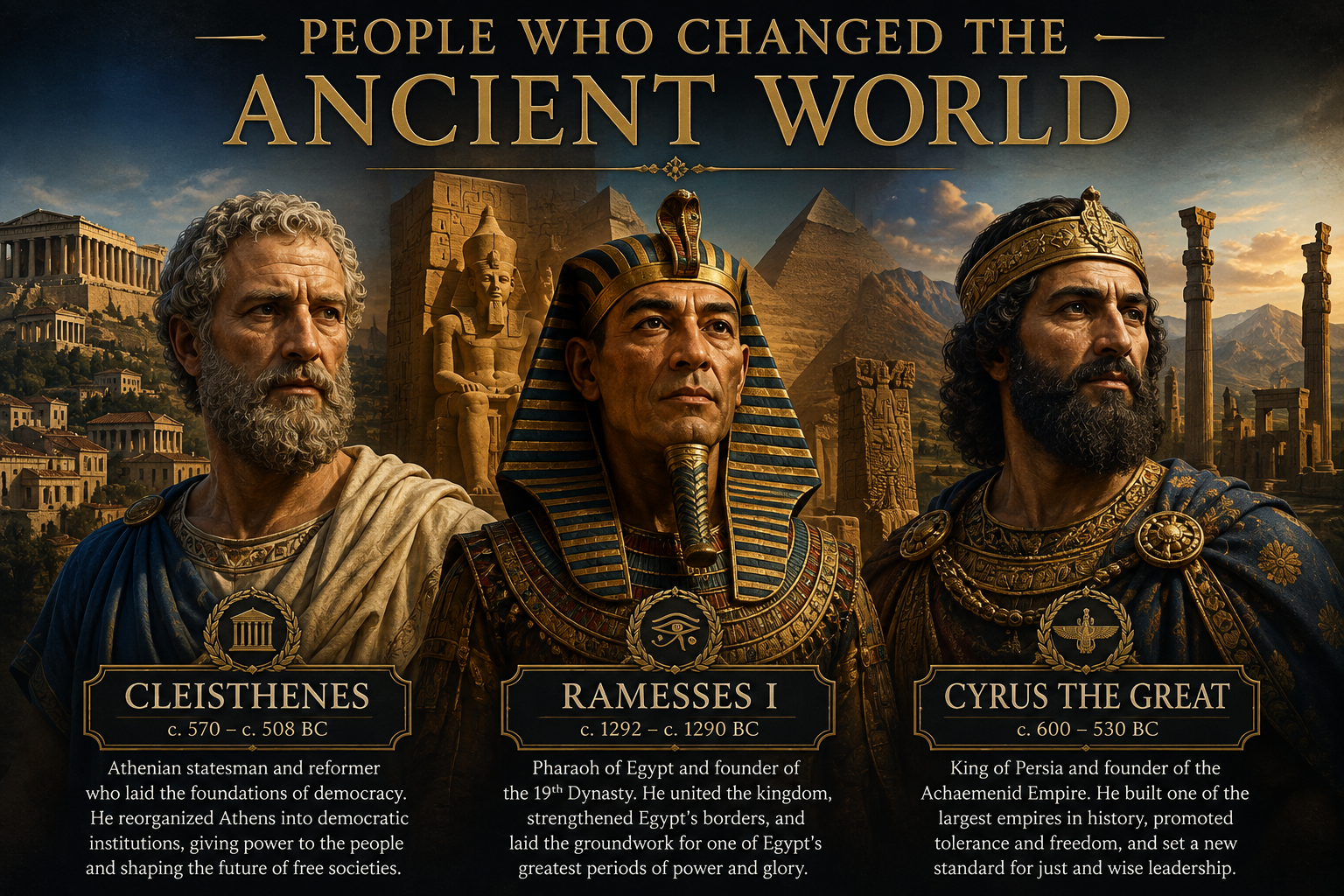
Cleisthenes was an Athenian statesman whose political reforms at the end of the sixth century BCE played a decisive role in the development of Athenian democracy. Working during a period of intense political rivalry following the overthrow of the Peisistratid tyranny, Cleisthenes reorganised the citizen body, weakened the influence of traditional aristocratic families and created institutions that gave a much larger number of Athenian citizens a direct role in government.
His reforms, introduced mainly around 508 and 507 BCE, did not create democracy in its later and fully developed fifth-century form. Nevertheless, they established much of the political framework upon which Classical Athenian democracy would later depend.
Cleisthenes reorganised Attica into new political units called demes, created ten new tribes that deliberately mixed citizens from different geographical regions, established a Council of Five Hundred and strengthened the role of the citizen assembly. These reforms helped transform political identity from one based heavily upon aristocratic families and local loyalties into one increasingly connected with citizenship in the Athenian polis.
Athens Before Cleisthenes
Athens had experienced major political and social changes long before Cleisthenes appeared.
During the seventh and sixth centuries BCE, aristocratic families competed intensely for political influence.
Political offices were dominated by wealthy citizens, while disputes over land, debt and social status produced repeated tensions.
Draco
One of the earliest famous Athenian lawgivers was Draco, traditionally associated with a written law code introduced in the late seventh century BCE.
Later tradition remembered his laws as exceptionally severe.
The modern word draconian derives from his name.
Written Law
The introduction of written laws was important because legal rules could no longer depend entirely upon the memory and interpretation of aristocratic judges.
Writing did not make Athenian society democratic, but it contributed to the development of more formal civic institutions.
Solon
Another crucial reformer was Solon, who became archon in the early sixth century BCE.
He attempted to reduce severe social and economic tensions within Athens.
Debt and Social Conflict
Many poorer Athenians had fallen into debt and some could lose their personal freedom because of financial obligations.
Solon's reforms abolished important forms of debt bondage among Athenians.
Solon's Political Reforms
Solon also reorganised political participation partly according to wealth rather than simply hereditary aristocratic birth.
His reforms allowed a broader range of citizens to participate in certain aspects of government.
Not Yet Democracy
Solon's Athens remained far from the democracy of the fifth century BCE.
Wealthy citizens continued to possess major political advantages.
The Rise of Peisistratus
Political rivalry continued after Solon's reforms.
During the middle of the sixth century BCE, the aristocrat Peisistratus eventually established himself as tyrant of Athens.
Tyranny in Ancient Greece
The Greek word tyrannos did not originally carry exactly the same meaning as the modern word tyrant.
It generally referred to a ruler who had gained sole political power outside the normal constitutional process.
Peisistratus
Peisistratus ruled Athens for much of the period between the 560s and his death in 527 BCE.
Although he controlled political power, he retained many existing Athenian institutions.
Athens Under Peisistratus
The city experienced significant economic and cultural development during the Peisistratid period.
Religious festivals were expanded and Athens became increasingly important within the Greek world.
Hippias and Hipparchus
After Peisistratus died, power passed to his sons Hippias and Hipparchus.
The Assassination of Hipparchus
In 514 BCE, Hipparchus was assassinated by Harmodius and Aristogeiton.
The Tyrannicides
Harmodius and Aristogeiton later became celebrated in democratic Athens as heroic tyrannicides.
The historical circumstances were more complicated than the later democratic legend suggested.
Hippias Remains in Power
The assassination of Hipparchus did not immediately end the tyranny.
Hippias continued ruling Athens.
A Harsher Regime
Ancient sources describe Hippias becoming increasingly suspicious and severe following his brother's death.
The Alcmaeonid Family
Cleisthenes belonged to one of the most important aristocratic families in Athens, the Alcmaeonids.
An Ancient Aristocratic Dynasty
The Alcmaeonids possessed considerable wealth and political connections.
They had been involved in Athenian politics for generations.
The Alcmaeonid Curse
The family carried a controversial religious reputation connected with an event that had occurred generations earlier.
Members of the family were blamed for sacrilege during the suppression of an attempted seizure of power by Cylon.
Cylon
Cylon was an Athenian aristocrat who attempted to establish himself as tyrant during the seventh century BCE.
His supporters sought sanctuary after the attempt failed.
Sacrilege
Some of Cylon's supporters were killed despite having taken refuge at sacred places.
The Alcmaeonid family became associated with responsibility for the killings.
A Political Weapon
The supposed curse attached to the family could later be used by political enemies against Alcmaeonid politicians.
Cleisthenes's Family
Cleisthenes was the son of Megacles, a member of the Alcmaeonid family.
His family possessed connections beyond Athens.
Cleisthenes of Sicyon
Cleisthenes was named after his maternal grandfather, Cleisthenes of Sicyon.
The elder Cleisthenes had ruled the city of Sicyon as a tyrant during the sixth century BCE.
An Aristocrat Who Reformed Democracy
Cleisthenes's aristocratic background is important.
The reforms associated with Athenian democracy did not emerge from someone outside the elite but from a politician deeply embedded within aristocratic competition.
Opposition to Hippias
The Alcmaeonids became important opponents of the Peisistratid tyranny.
They spent periods in exile and attempted to overthrow Hippias.
Spartan Intervention
The final overthrow of Hippias involved intervention by Sparta.
Cleomenes I
The Spartan king Cleomenes I played an important role in the events.
The Fall of the Tyranny
In 510 BCE, Spartan forces helped force Hippias from Athens.
Hippias Goes Into Exile
Hippias eventually sought support from the Persian Empire.
Years later, he accompanied the Persian expedition that landed at Marathon in 490 BCE.
Athens After Hippias
The removal of the tyrant did not immediately establish stable democratic government.
Instead, powerful aristocratic politicians competed to determine Athens's future.
Cleisthenes and Isagoras
The principal political struggle developed between Cleisthenes and another aristocrat named Isagoras.
Isagoras
Isagoras possessed strong aristocratic support and established a relationship with the Spartan king Cleomenes.
Cleisthenes Seeks Broader Support
Cleisthenes appears to have responded to his political difficulties by appealing to a broader body of Athenian citizens.
The Demos
The Greek word demos could refer to the people or citizen body.
It later became central to the concept of demokratia, rule or power of the people.
A Political Turning Point
Herodotus presents Cleisthenes as taking the people into partnership with himself.
This alliance with ordinary citizens transformed the political struggle.
Cleisthenes Proposes Reform
Cleisthenes introduced or proposed major changes to the organisation of the Athenian citizen body.
These reforms threatened traditional aristocratic networks.
Isagoras Calls Sparta
Isagoras sought assistance from Cleomenes of Sparta.
The Curse Returns
Cleomenes demanded that Cleisthenes and members of the supposedly accursed Alcmaeonid family leave Athens.
Cleisthenes Goes Into Exile
Cleisthenes temporarily withdrew from the city.
Isagoras Attempts to Control Athens
With Spartan support, Isagoras attempted to dissolve or dominate important political institutions.
The Council Resists
The Athenian Council resisted Isagoras's attempt to seize control.
The Citizens Rise
Athenian citizens surrounded Isagoras and his Spartan supporters on the Acropolis.
A Popular Political Intervention
The resistance was significant because the citizen body acted directly against an attempt to impose political authority with foreign military assistance.
Cleomenes Withdraws
After several days, the Spartans were allowed to leave Athens.
Isagoras Falls
Isagoras's attempt to dominate Athenian politics failed.
Cleisthenes Is Recalled
Cleisthenes and other exiles were invited back to Athens.
The Reforms Begin
Around 508 and 507 BCE, the political reforms associated with Cleisthenes were implemented.
The Purpose of the Reforms
The reforms redistributed political organisation in a way that reduced the influence of old aristocratic family networks.
A New Political Geography
Cleisthenes reorganised the citizen body according to residence rather than relying primarily upon older kinship structures.
The Demes
The foundation of the new system was the deme.
A deme was a local community within Attica.
Local Citizenship
Citizens became officially registered within their demes.
Deme Identity
A man's deme became an important part of his civic identity.
Citizens could be identified using their personal name together with their deme rather than relying only upon the name of their father.
Political Importance of the Demes
The demes possessed local assemblies, officials and administrative responsibilities.
Registration
Membership in a deme became crucial for recognition as an Athenian citizen.
Breaking Aristocratic Control
Because political registration was connected with locality, great aristocratic families had less ability to organise the entire political system exclusively through traditional kinship relationships.
Attica
Athens controlled a territory known as Attica.
This included the city of Athens itself, coastal regions, agricultural plains, mountain districts and numerous villages.
A Geographic Challenge
Different regions of Attica possessed their own local interests and political traditions.
Three Regional Zones
Cleisthenes divided Attica conceptually into three broad geographical regions.
These were the city region, the coastal region and the inland region.
Trittyes
Groups of demes were organised into units called trittyes.
The word can be understood approximately as thirds.
Thirty Trittyes
There were thirty trittyes in the Cleisthenic system.
Ten were associated with the urban region, ten with the coast and ten with the inland region.
The Ten Tribes
Cleisthenes then created ten new tribes.
Mixing the Population
Each tribe incorporated one trittys from the city, one from the coast and one from the inland region.
A Deliberate Political Design
The system forced citizens from geographically separated parts of Attica to cooperate within the same political tribe.
Weakening Regional Factions
Older political divisions based heavily upon local geography became more difficult to maintain.
A New Athenian Identity
The reforms encouraged citizens to think of themselves not only as inhabitants of individual districts but as members of a larger Athenian political community.
Tribal Names
The ten tribes were named after legendary Athenian heroes.
The Eponymous Heroes
According to tradition, the names were selected from a larger group of heroic candidates with divine consultation at Delphi.
Religious and Political Identity
Each tribe developed religious associations with its heroic founder.
The Monument of the Eponymous Heroes
In Classical Athens, statues of the tribal heroes stood in the Agora.
Official notices could be displayed there for citizens.
Political Information
The monument therefore combined religious symbolism with practical civic communication.
The Council of Five Hundred
One of Cleisthenes's most important reforms was the creation of a Council of Five Hundred.
Fifty From Each Tribe
Each of the ten tribes supplied fifty councillors.
The Boule
The Council was known as the boule.
It became one of the central institutions of Athenian democracy.
Preparing Business
The Council prepared matters for discussion by the wider citizen assembly.
Administration
It also supervised numerous aspects of public administration.
A Broader Political Class
Because hundreds of citizens served on the Council each year, political experience was distributed much more widely than under a narrow aristocratic system.
Selection
In the mature democracy, councillors were normally selected by lot from eligible citizens within the demes.
The precise development of all selection procedures immediately after Cleisthenes is not completely clear.
Rotation
Service was organised so that citizens from different tribes shared responsibility across the year.
Prytany
Each tribal group of fifty councillors served for part of the year as a presiding committee known as the prytany.
The Prytaneis
The fifty citizens serving as prytaneis dealt with daily governmental responsibilities during their period of service.
Government Becomes Participatory
The system allowed ordinary eligible citizens to participate directly in state administration.
The Assembly
The Athenian citizen assembly was known as the ekklesia.
Citizen Participation
Male citizens could attend the assembly and vote on major political questions.
Direct Democracy
Athens eventually developed a form of direct democracy.
Citizens did not simply elect permanent representatives to make all decisions for them.
Debate
Citizens could listen to speeches, participate in discussion and vote personally.
Decisions of War and Peace
The assembly could make decisions concerning military campaigns, diplomacy and other major state policies.
Cleisthenes Strengthens the Demos
His reforms helped create institutional conditions that made the assembly increasingly powerful.
Not Universal Democracy
Athenian democracy must not be confused with modern universal democracy.
Women
Women belonging to citizen families possessed important religious, familial and economic roles but did not vote in the assembly or hold ordinary political office.
Slaves
Enslaved people formed a substantial part of Athenian society and possessed no political citizenship.
Resident Foreigners
Foreign residents known as metics contributed significantly to the Athenian economy but did not normally possess citizen voting rights.
Adult Male Citizens
Political participation was therefore restricted principally to free adult male citizens.
A Radical Development for Its Time
Despite these exclusions, the ability of thousands of ordinary male citizens to participate directly in government represented an extraordinary political experiment within the ancient Mediterranean world.
Isonomia
Herodotus uses the concept of isonomia when discussing political equality in the context of early democracy.
Equality Under Political Order
The term is often translated as equality before the law or equality of political rights, although its precise ancient meaning is broader and debated.
Cleisthenes and Democracy
Ancient sources do not present Cleisthenes as writing a modern democratic constitution in a single act.
His changes reorganised the political community and shifted the balance of power toward wider citizen participation.
The Word Demokratia
The word demokratia became associated with the idea that political power belonged to the demos.
Its widespread political use may have developed after Cleisthenes's initial reforms.
Democracy Develops Over Time
The Athenian democratic system continued changing throughout the fifth century BCE.
Cleisthenes Laid Foundations
He created structures that later reformers could expand.
The Ten Tribes and the Army
The tribal organisation was not limited to civilian government.
It also shaped Athenian military organisation.
Tribal Military Units
Citizens could serve alongside members of their tribes in the army.
The Strategoi
Athens later elected ten generals known as strategoi, associated with the ten-tribe system.
Military and Political Integration
The tribal reforms therefore connected citizenship, administration and military service.
Marathon
Only about two decades after Cleisthenes's reforms, Athenians fought the Persian army at Marathon in 490 BCE.
A Citizen Army
The Athenian hoplite force was organised partly through the political structures created by the new tribal system.
Political Reform and Military Cohesion
The connection between military organisation and civic identity strengthened the sense that citizens were collectively responsible for the survival of Athens.
Ostracism
Cleisthenes is traditionally associated with the institution of ostracism.
What Was Ostracism?
Ostracism allowed citizens to vote to exile an individual from Athens for a period traditionally set at ten years.
Ostraka
Citizens wrote names on broken pieces of pottery known as ostraka.
No Loss of Property
A person ostracised from Athens normally retained his property and was not treated as a convicted criminal.
A Political Safety Mechanism
Ostracism may have been intended to prevent individual politicians from becoming dangerously dominant.
Cleisthenes and Ostracism
Aristotle's later account associates the introduction of ostracism with Cleisthenes.
However, the first known ostracism did not occur until around 487 BCE, approximately two decades after the reforms.
Uncertain Origins
It is therefore possible that the institution existed earlier but was not initially used, or that its later form developed after Cleisthenes.
Hipparchus Son of Charmus
The first person known to have been ostracised was Hipparchus son of Charmus.
Famous Ostracised Athenians
Later politicians including Themistocles, Aristides and Cimon experienced ostracism.
Protection Against Tyranny
The memory of the Peisistratid tyranny helped make Athenians suspicious of individuals who accumulated exceptional political influence.
Political Competition Without Civil War
Ostracism provided one method of removing a political rival temporarily without execution or confiscation of property.
Limits of the System
It could also be used as a weapon within political competition.
Cleisthenes and the Areopagus
The aristocratic council known as the Areopagus continued to exist after Cleisthenes's reforms.
An Older Institution
The Areopagus consisted largely of former archons and retained significant authority during the early democratic period.
Democracy Was Not Created Overnight
Older aristocratic institutions continued alongside newer participatory structures.
Later Reforms
During the fifth century BCE, politicians including Ephialtes and Pericles further reduced aristocratic control and expanded democratic participation.
Ephialtes
Around 462 and 461 BCE, Ephialtes introduced reforms that substantially reduced the political powers of the Areopagus.
Pericles
Pericles later became the most famous statesman of Classical democratic Athens.
His political world was built upon institutions whose foundations had been created generations earlier.
Cleisthenes and Solon
Athenian democracy cannot be attributed to one individual alone.
Solon's Contribution
Solon addressed debt, legal procedures and political participation.
Cleisthenes's Contribution
Cleisthenes fundamentally reorganised the citizen body and political geography of Attica.
Later Democratic Reformers
Ephialtes and others further transferred authority toward democratic institutions.
A Long Political Evolution
Athenian democracy therefore developed through generations of conflict, reform and experimentation.
Why the Tribal Reform Mattered
Cleisthenes's ten tribes represented one of the most ingenious aspects of his political programme.
Old Loyalties
Aristocratic families traditionally drew influence from local relationships, kinship and regional alliances.
New Loyalties
Citizens from the coast, city and interior now served together within artificial political tribes.
Political Engineering
Cleisthenes deliberately rearranged civic structures to change political behaviour.
Geography Becomes Government
The physical landscape of Attica was transformed into a new political map.
The Deme as Civic Home
Citizenship became rooted in membership of local communities integrated into the wider state.
Local and National Identity
A citizen could identify strongly with his deme while simultaneously participating in the political life of Athens.
Administrative Continuity
The deme system remained important throughout the Classical period.
The Council and Representation
The Council of Five Hundred ensured that citizens from across Attica participated in central government.
Not Modern Representation
The councillors were not representatives in the modern parliamentary sense.
They were citizens temporarily performing public duties.
Rotation of Office
One of the defining ideas of later Athenian democracy was that political responsibility should circulate among citizens rather than become a permanent profession.
Selection by Lot
Many public offices eventually came to be filled by lot.
Athenians often regarded random selection among eligible citizens as more democratic than election because elections could favour wealthy and famous individuals.
Generals Were Different
Military generals continued to be elected because command required experience and specialised ability.
Accountability
Athenian officials could be required to account for their conduct after serving in office.
The Principle of Citizen Government
The political system increasingly assumed that ordinary citizens were capable of governing and being governed in turn.
The Agora
The Athenian Agora became the heart of civic life.
Political institutions, religious buildings, law courts and commercial activities occupied the area.
A Public Political Landscape
Government became physically visible within spaces used by ordinary citizens.
The Pnyx
The citizen assembly later met prominently on the Pnyx hill overlooking Athens.
Thousands of Citizens
Large numbers of citizens could gather to hear speeches and vote.
Political Speech
The democratic system gave public speaking extraordinary importance.
Persuasion
Politicians could not rely entirely upon hereditary rank.
They increasingly needed to persuade large groups of citizens.
The Rise of Rhetoric
Public debate encouraged the development of sophisticated traditions of argument and rhetoric.
Democracy and Education
The political environment eventually contributed to the importance of teachers, philosophers and professional instructors in argument.
The Sophists
During the fifth century BCE, travelling teachers known as Sophists offered education in rhetoric and other subjects.
Much Later Than Cleisthenes
These developments occurred generations after his reforms but emerged within the political environment his institutions helped create.
The Persian Threat
Cleisthenes's reforms occurred at the same time that the Persian Empire was becoming increasingly involved in the Greek world.
The Achaemenid Empire
Under rulers including Cyrus the Great, Cambyses and Darius I, Persia had become the largest empire the ancient Near East had yet seen.
Ionian Greek Cities
Greek cities along the western coast of Asia Minor had fallen under Persian authority.
The Ionian Revolt
Beginning in 499 BCE, several Ionian cities rebelled against Persian rule.
Athenian Assistance
Athens sent limited military assistance to the rebels.
Darius Responds
Persian intervention eventually brought Athens into direct conflict with the Achaemenid Empire.
Marathon
In 490 BCE, a Persian expedition landed at Marathon.
Athenian forces defeated the invasion army.
Cleisthenes's Institutions at War
The citizens who fought at Marathon belonged to a political and military system significantly reshaped by Cleisthenes.
Themistocles
In the following generation, Themistocles became one of the most important leaders of democratic Athens.
Naval Democracy
Athens's later expansion of its navy brought poorer citizens serving as rowers into an increasingly important military role.
Salamis
At the Battle of Salamis in 480 BCE, the Athenian-led Greek fleet played a decisive role against Xerxes's Persian invasion.
The Democracy Survives
The political system created in Cleisthenes's generation survived the Persian Wars and became more radical afterward.
Cleisthenes Disappears From the Record
One of the great mysteries concerning Cleisthenes is that relatively little is known about his later life.
No Detailed Biography
Ancient sources do not provide a continuous biography comparable with those available for later figures such as Themistocles or Pericles.
His Death Is Uncertain
The date and circumstances of Cleisthenes's death are not securely known.
The Reforms Outlive the Reformer
Although Cleisthenes himself largely disappears from surviving narratives, the political structures associated with him continued shaping Athens for generations.
Herodotus
The historian Herodotus is one of the most important ancient sources for the political struggle involving Cleisthenes and Isagoras.
Herodotus and Democracy
Herodotus wrote later in the fifth century BCE, when democratic Athens was already a major power.
His account must therefore be read with awareness of later political developments.
Aristotle
The Constitution of the Athenians attributed to Aristotle's school provides another major source for Cleisthenes's reforms.
A Later Source
This work was produced much later than Cleisthenes's lifetime.
It preserves valuable constitutional traditions but must also be used critically.
Archaeology and Inscriptions
Material evidence and later inscriptions help historians reconstruct the organisation of demes, tribes and political institutions.
Incomplete Evidence
Many details of exactly how the reforms were introduced remain uncertain.
Was Cleisthenes a Democrat?
The answer depends partly upon what is meant by democrat.
An Aristocratic Politician
Cleisthenes was a member of an elite family competing against other aristocrats.
Political Necessity
His appeal to the people may initially have been motivated partly by his struggle against Isagoras.
Consequences Beyond Motive
Whatever his personal motives, the institutions he established gave ordinary citizens significantly greater political importance.
Intent Versus Outcome
A political reform can have consequences larger than the immediate goals of the person who introduced it.
The People Become Political Actors
The events surrounding Isagoras demonstrated that the citizen body could intervene directly in struggles over constitutional government.
Popular Sovereignty
Over time, the idea that the demos possessed legitimate political authority became fundamental to Athenian democracy.
Cleisthenes and Equality
His reforms did not create social or economic equality.
Wealthy families remained influential.
Aristocrats Continue to Lead
Many of the most powerful politicians of democratic Athens came from elite families.
Political Opportunity Expands
The important change was that elite politicians increasingly had to operate within institutions involving broad citizen participation.
The Citizen Assembly Could Reject Leaders
Aristocratic birth alone could no longer guarantee political control.
Democracy and Elite Leadership
Athenian democracy therefore combined broad male citizen participation with continued competition among wealthy and influential politicians.
The Importance of Citizenship
Cleisthenes's reforms helped make citizenship itself a powerful political identity.
The Polis
The Greek polis was more than a city in the modern sense.
It was a political community consisting of citizens, institutions, territory, religious traditions and shared identity.
Athens and Attica
The political community of Athens included people living far beyond the urban centre.
Demes Connect the Countryside
The Cleisthenic organisation integrated villages and rural communities into central government.
Representation Across Attica
Citizens from distant districts could serve on the Council and participate in the assembly.
A More Unified State
The reforms contributed to the political integration of Attica.
Democracy and War
The relationship between military service and citizenship became increasingly important.
Hoplites
Citizens wealthy enough to obtain heavy armour could serve as hoplite infantry.
Rowers
Later, poorer citizens served extensively as rowers in the Athenian fleet.
Military Contribution and Political Confidence
The importance of ordinary citizens to Athens's military success strengthened arguments for their political participation.
The Athenian Empire
During the fifth century BCE, democratic Athens became the centre of a large maritime alliance known as the Delian League.
From Alliance to Empire
Athens gradually transformed this alliance into an imperial system.
The Paradox of Athens
Athens practised democracy among its citizens while exercising coercive power over many allied communities.
Cleisthenes Could Not Foresee the Empire
The imperial Athens of Pericles developed decades after his reforms.
The Institutions Made Expansion Possible
Nevertheless, the political mobilisation created by democratic government became one source of Athenian strength.
Periclean Athens
By the middle of the fifth century BCE, Athens had developed into the democracy most familiar from Classical history.
Payment for Public Service
Some public roles eventually received payment, allowing poorer citizens greater ability to participate.
Popular Courts
Large citizen juries became important centres of democratic power.
Assembly Government
Major policies could be debated directly before thousands of citizens.
Cleisthenes's Foundation Remained
The ten tribes, demes and Council of Five Hundred continued forming the basic structural framework.
The Peloponnesian War
Athenian democracy survived severe tests during the war with Sparta beginning in 431 BCE.
Oligarchic Revolutions
The democratic system was temporarily overthrown in 411 BCE and again at the end of the war in 404 BCE.
The Thirty Tyrants
After Athens's defeat, an oligarchic government known as the Thirty ruled briefly.
Democracy Restored
Democratic government was restored in 403 BCE.
The Cleisthenic System Endures
The restoration demonstrates how deeply democratic political identity had become embedded within Athenian society.
Cleisthenes and Modern Democracy
Cleisthenes is often described as the father of democracy.
A Useful but Simplified Title
No single person invented democracy.
The Athenian system emerged from centuries of political change.
Earlier Foundations
Solon and earlier institutions contributed important precedents.
Cleisthenes's Distinctive Contribution
His reforms systematically reorganised citizenship and weakened older aristocratic political structures.
Later Expansion
Ephialtes, Pericles and generations of ordinary citizens developed the system further.
Ancient and Modern Democracy
Modern representative democracies differ substantially from Classical Athens.
Direct Versus Representative Government
Athenian citizens normally voted personally rather than choosing professional legislators to make every decision.
Limited Citizenship
Athens excluded women, slaves and foreigners from formal political participation.
Modern Universal Citizenship
Many modern democratic systems define citizenship much more broadly.
A Historical Influence
Despite these differences, Athens provided later political thinkers with one of history's most famous examples of citizen government.
Democracy Was Controversial
Not all ancient Greeks admired democratic government.
Plato
The philosopher Plato later criticised democracy and associated it with instability and excessive freedom.
Aristotle
Aristotle analysed democracy as one of several possible constitutional forms.
Sparta
Sparta possessed a very different political system combining kings, elders, magistrates and an assembly.
Greek Political Diversity
There was no single political model shared by all Greek city-states.
Athens's Experiment
The system that grew from Cleisthenes's reforms was therefore one distinctive solution to the problem of governing a polis.
The Revolution of 508 and 507 BCE
Some historians describe the events surrounding Cleisthenes as an Athenian revolution.
Why Revolution?
The citizen body's successful resistance to Isagoras and Spartan intervention changed the political balance dramatically.
Citizens Defend Their Political Role
The people were no longer simply passive followers of competing aristocrats.
A New Source of Legitimacy
Political authority increasingly required support from the citizen body.
The Demos Becomes Central
This development was perhaps even more important than any single constitutional rule.
Cleisthenes and Political Genius
The geographical restructuring of Attica demonstrated remarkable political imagination.
Changing Institutions to Change Society
Instead of merely replacing one leader with another, Cleisthenes altered the structures through which political competition operated.
Families Remained Important
Aristocratic families did not disappear.
But Their Environment Changed
They now competed within a political system organised through demes, tribes, Council and assembly.
Institutional Legacy
This structure proved durable enough to survive wars, political crises and constitutional upheavals.
Cleisthenes and Identity
One of his greatest achievements was redefining how citizens related to the state.
From Family to Deme
Official civic identity became tied more strongly to locality and citizenship.
From Region to Tribe
Artificial tribes mixed people from different parts of Attica.
From Tribe to Polis
These structures encouraged cooperation within the wider Athenian community.
The Individual Citizen
The reforms created more opportunities for individual citizens to enter public life.
Serving on the Council
A farmer from an Attic deme could potentially serve within the central administration of Athens.
Voting in the Assembly
He could personally vote on questions affecting the entire polis.
Serving in the Military
He could fight alongside fellow members of his tribe.
Participating in Religion
Civic festivals and tribal cults reinforced the political community through shared religious practice.
Politics as Citizenship
The boundary between political, military and religious identity was much less distinct than in many modern states.
The Importance of the Deme
The deme system became one of the most durable elements of Cleisthenes's reforms.
Local Records
Demes maintained citizen lists and handled aspects of local administration.
Local Officials
Deme communities selected their own officials.
Political Training
Participation in local government could provide citizens with experience before serving in central institutions.
A Democracy Built From Communities
Athens's democracy therefore depended not only upon mass meetings in the city but upon a network of local political units across Attica.
Cleisthenes and Historical Memory
Despite his importance, Cleisthenes never achieved the same popular fame as Pericles, Socrates, Alexander the Great or Leonidas.
A Reformer Rather Than a Conqueror
His achievements were institutional rather than based upon spectacular military victories.
Institutions Are Less Visible Than Monuments
A temple or battlefield can be easily imagined.
The reorganisation of citizenship is less dramatic visually but can have more enduring consequences.
The Architecture of Government
Cleisthenes effectively redesigned the political architecture of Athens.
A System That Outlived Him
The institutions associated with his reforms continued operating long after his own disappearance from recorded history.
The Father of Athenian Democracy
For this reason, Cleisthenes is frequently given the title father of Athenian democracy.
Not the Sole Founder
The phrase should not obscure the contributions of earlier reformers or the role of ordinary Athenians themselves.
The Citizens Matter
The resistance against Isagoras demonstrated that political transformation was not solely the achievement of Cleisthenes.
The citizens who defended the political order were active participants in its creation.
Democracy as a Collective Achievement
The institutions established around 508 and 507 BCE became meaningful because generations of citizens used them.
The Legacy of Cleisthenes
Cleisthenes changed Athens by reorganising the relationship between citizens, territory and political power.
His demes established local civic identities.
His ten tribes mixed citizens from different geographical regions.
His Council of Five Hundred widened participation in central administration.
His political alliance with the demos helped establish the principle that ordinary citizens possessed a legitimate role in determining the government of Athens.
A New Political Order
The democracy that followed remained deeply imperfect by modern standards.
Women, slaves and resident foreigners were excluded from formal political participation, while wealthy citizens continued to exercise substantial influence.
Nevertheless, the political system represented a remarkable departure from government dominated exclusively by kings, tyrants or narrow hereditary aristocracies.
Cleisthenes: Architect of Athenian Democracy
Cleisthenes did not invent every institution of Athenian democracy, nor did he create the fully developed democratic state associated with the age of Pericles.
His importance lies instead in restructuring the citizen body so fundamentally that later democracy became possible.
By weakening traditional regional and aristocratic networks, integrating Attica through new tribes and giving citizens a broader role in government, Cleisthenes transformed the political foundations of Athens.
His reforms helped create the society that would later defeat Persia at Marathon, build the great Athenian navy, establish a maritime empire and produce some of the most celebrated political, artistic and intellectual achievements of the Classical Greek world.
Cleisthenes largely disappears from history after his reforms, but the institutions he helped establish survived him for generations.
His greatest monument was not built from marble or bronze.
It was a political system in which citizens themselves became central to the government of their city.