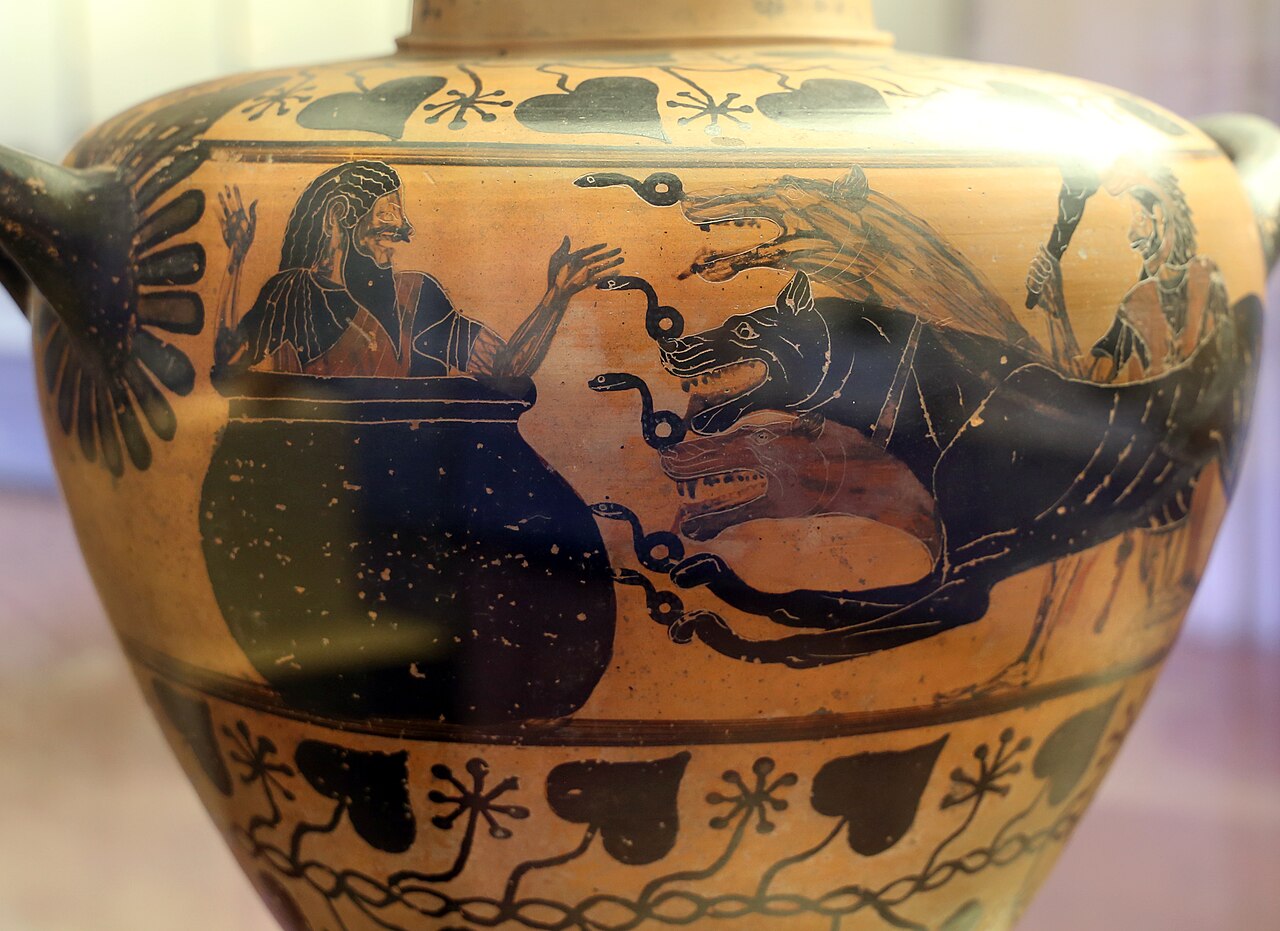
The twelfth and final labour of Heracles was the capture of Cerberus, the terrifying guardian of the Underworld. This was the most dangerous task assigned by King Eurystheus because it required Heracles to enter the kingdom of the dead and return alive.
The Capture of Cerberus
Cerberus was a monstrous dog commonly described as having three heads, a serpent for a tail and snakes growing from parts of his body. He guarded the entrance to the Underworld and prevented the dead from escaping.
King Eurystheus ordered Heracles to bring Cerberus from the realm of Hades to Mycenae. The hero was forbidden to use ordinary weapons against the creature.
Heracles had defeated lions, dragons, giants, kings and supernatural animals during the earlier labours. The final task placed him against death itself.
To succeed, he had to receive religious preparation, descend through an entrance to the Underworld, gain permission from Hades and overpower Cerberus with only his strength.
The capture of Cerberus completed the Twelve Labours and proved that Heracles could cross the boundary between life and death.
Heracles and the Twelve Labours
Heracles was the son of Zeus, king of the gods, and Alcmene, a mortal woman descended from the hero Perseus.
Hera, the wife of Zeus, hated Heracles because he was born from one of her husband’s relationships with a mortal.
She persecuted him throughout his life and eventually caused him to fall into a terrible state of madness.
During this madness, Heracles killed members of his own family.
When his sanity returned, he was overcome with grief, guilt and horror.
Heracles travelled to the Oracle of Apollo at Delphi and asked how he could be purified.
The oracle commanded him to serve King Eurystheus of Tiryns and Mycenae.
Eurystheus assigned Heracles a series of dangerous tasks that became known as the Labours of Heracles.
Why There Were Twelve Labours
Heracles had originally been required to complete ten labours.
Eurystheus refused to count the destruction of the Lernaean Hydra because Heracles had received help from his nephew Iolaus.
He also rejected the cleaning of the Augean Stables because Heracles had arranged to receive payment.
Two additional tasks were therefore added.
The first additional labour was the obtaining of the golden apples of the Hesperides.
The second was the descent into the Underworld and capture of Cerberus.
The First Eleven Labours
Before descending into the Underworld, Heracles had completed eleven extraordinary tasks.
He had killed the invulnerable Nemean Lion and taken its skin as armour.
He had destroyed the many-headed Lernaean Hydra with the assistance of Iolaus.
He had captured the sacred Ceryneian Hind alive after pursuing it for an entire year.
He had captured the Erymanthian Boar and carried it back to Eurystheus.
He had cleaned the Augean Stables in a single day by redirecting rivers through them.
He had driven away the Stymphalian Birds with a bronze rattle given to him by Athena.
He had captured the Cretan Bull alive.
He had seized the man-eating Mares of Diomedes.
He had obtained the belt of Hippolyta, queen of the Amazons.
He had captured the red cattle of Geryon at the western edge of the world.
He had also obtained the golden apples of the Hesperides after carrying the heavens for Atlas.
Only the twelfth labour remained.
The Command of Eurystheus
King Eurystheus ordered Heracles to descend into the Underworld and bring Cerberus back alive.
The command appeared impossible because no ordinary mortal could enter the realm of the dead and return.
Even if Heracles survived the journey, he would have to confront Hades, ruler of the Underworld, and obtain the guardian dog without angering the gods.
Eurystheus may have believed that this final task would ensure the death of Heracles.
The king had sent him to the edges of the world, but the final labour sent him beyond the world of the living.
The Underworld
The Greek Underworld was the realm of the dead and the kingdom of Hades.
It was imagined as a dark and distant place beneath the earth.
All mortals eventually travelled there after death, although their experiences differed according to their lives and the traditions followed by ancient storytellers.
The Underworld contained rivers, gates, fields, palaces and regions of punishment or reward.
It was not identical to the later idea of a place where every dead person was punished.
Most souls existed as shadows without the full strength and awareness of living human beings.
Hades
Hades was the son of Cronus and Rhea and the brother of Zeus and Poseidon.
After the defeat of the Titans, the three brothers divided control of the cosmos.
Zeus received the sky, Poseidon received the sea and Hades received the world of the dead.
Hades was not usually presented as evil.
He was a severe and unyielding ruler who maintained the laws separating the living from the dead.
His name also became a name for the Underworld itself.
Persephone
Persephone was the queen of the Underworld and the wife of Hades.
She was the daughter of Zeus and Demeter, goddess of agriculture and grain.
Hades carried Persephone into the Underworld, where she ate seeds from a pomegranate.
Because she had consumed food from the realm of the dead, she was required to spend part of each year there.
Her return to the world above was associated with the growth of crops, while her descent was connected with the decline of vegetation.
Cerberus
Cerberus was the monstrous dog that guarded the gates of the Underworld.
He allowed the souls of the dead to enter but prevented them from leaving.
He also stopped living intruders from entering the realm without permission.
Cerberus was loyal to Hades and formed an essential part of the order of the Underworld.
He was not a wandering monster attacking innocent communities.
He was a guardian carrying out a divine duty.
The Three Heads of Cerberus
Cerberus was most commonly described as having three heads.
Each head could watch, bite and threaten intruders independently.
The three heads made it almost impossible to approach the creature without being seen.
Some ancient writers gave Cerberus many more heads, while artists often preferred three because the form was easier to represent.
The number three became the most famous and enduring version.
The Serpent Tail
Cerberus possessed a serpent instead of an ordinary dog’s tail.
The snake could twist, strike and bite anyone attempting to approach from behind.
This meant that the creature was dangerous from every direction.
An enemy avoiding the three heads might still be attacked by the tail.
The Snakes of Cerberus
Some descriptions gave Cerberus snakes growing from his back, neck or body.
These serpents increased his monstrous appearance and connected him with the creatures of the earth and Underworld.
They also made grappling with him extremely dangerous.
The Family of Cerberus
Cerberus was usually described as a child of Typhon and Echidna.
Typhon was a gigantic enemy of Zeus, while Echidna was a creature who was partly woman and partly serpent.
Their offspring included many of the greatest monsters in Greek mythology.
Cerberus was related to the Lernaean Hydra, Orthrus, the Chimera and other creatures confronted by heroes.
Cerberus and Orthrus
Orthrus was the two-headed dog who guarded the cattle of Geryon during the tenth labour.
Cerberus was his more famous brother.
Heracles killed Orthrus while taking the cattle.
During the final labour, he had to overcome Cerberus without killing him.
The two encounters show Heracles facing related guardian dogs under very different conditions.
Cerberus as a Guardian
Cerberus protected the boundary between life and death.
If souls could escape freely, the order of the world would collapse.
If the living could enter without restriction, they might interfere with the dead or attempt to avoid mortality.
The guardian therefore represented a necessary limit rather than uncontrolled evil.
The Meaning of the Final Labour
The earlier labours had carried Heracles into caves, marshes, mountains, distant islands and the western edge of the earth.
The final labour took him beyond ordinary geography.
He had to enter the realm from which no mortal was expected to return.
The task represented the ultimate test of courage and divine favour.
The Need for Purification
Before entering the Underworld, Heracles needed religious preparation.
He had killed many creatures and human beings during his journeys.
Contact with death and blood could create ritual pollution within Greek religion.
The hero could not simply enter sacred mysteries or the realm of Hades without proper purification.
The Eleusinian Mysteries
Heracles travelled to Eleusis, a town near Athens famous for religious rites known as the Eleusinian Mysteries.
These mysteries honoured Demeter and Persephone.
They were associated with agriculture, death, rebirth and hope for a better existence after death.
Those initiated into the mysteries received sacred knowledge that was not revealed publicly.
The secrecy of the ceremonies was strictly respected in the ancient world.
Heracles Seeks Initiation
Heracles wished to be initiated into the Eleusinian Mysteries before descending into the Underworld.
Participation would prepare him spiritually and teach him how to approach the realm of Persephone.
However, initiation was normally limited to people meeting certain religious and cultural requirements.
Heracles was connected with Thebes rather than Athens, and he needed to be purified from bloodshed.
Adoption by Pylius
Some traditions said that Heracles was adopted by an Athenian named Pylius so that he could qualify for initiation.
This ritual adoption gave him the necessary connection with the community.
He was then purified and permitted to take part in the sacred ceremonies.
The Lesser Mysteries
A special form of preparation known as the Lesser Mysteries was sometimes associated with the initiation of Heracles.
These rites were held at Agrae near Athens.
They may have provided purification before participation in the Greater Mysteries at Eleusis.
The connection with Heracles showed that even the greatest hero needed religious preparation before confronting death.
Demeter and Persephone
The Eleusinian Mysteries centred upon the story of Demeter searching for her daughter Persephone.
Persephone’s annual movement between the Underworld and the world above made her a divine figure who crossed the boundary Heracles now intended to cross.
Initiation placed him under the protection of powers closely connected with death and return.
Religious Knowledge and Courage
Heracles possessed extraordinary physical courage, but courage alone was not enough.
He needed to understand sacred law and receive permission to approach the world of the dead.
The final labour joined religious knowledge with heroic strength.
The Entrance to the Underworld
Ancient traditions located entrances to the Underworld in several places.
Heracles was commonly said to descend through a cave or opening near Cape Taenarum in the southern Peloponnese.
Other accounts connected his descent with regions such as Heraclea Pontica.
The different locations allowed communities to associate their own landscapes with the journey of the hero.
Cape Taenarum
Cape Taenarum was the southernmost point of the Peloponnese.
Its caves and dramatic coastline made it a suitable location for an entrance to the Underworld.
A sanctuary of Poseidon existed in the region.
The remote and rocky landscape appeared to stand at the boundary between familiar land and the unknown depths beneath it.
Athena and Hermes
Athena and Hermes assisted Heracles during the descent.
Athena had supported him throughout many of the labours.
Hermes served as a guide of souls and could travel freely between Olympus, earth and the Underworld.
Their presence helped protect Heracles and showed that his journey had divine approval.
Hermes as Guide of Souls
Hermes was known as a conductor of souls to the Underworld.
After death, he guided human spirits towards the realm of Hades.
His familiarity with the roads of the dead made him the ideal guide for a living hero.
The Descent Begins
Heracles entered the dark passage leading beneath the earth.
The light of the living world disappeared behind him.
He passed through caves, shadows and regions untouched by sunlight.
The journey required him to continue despite uncertainty about what waited ahead.
The Rivers of the Underworld
The Underworld contained several rivers associated with different aspects of death and suffering.
These included the Styx, Acheron, Cocytus, Phlegethon and Lethe.
Ancient writers differed about their exact courses and relationships.
Together, they created a landscape separating the living world from the dead.
The River Styx
The Styx was the most famous river of the Underworld.
The gods swore binding oaths by its waters.
Breaking an oath sworn by the Styx brought severe punishment even upon a deity.
The river represented an unbreakable boundary and the seriousness of divine promises.
The River Acheron
Acheron was often called the river of sorrow or pain.
It was associated with the journey of souls into the Underworld.
Some traditions described Charon carrying the dead across Acheron rather than the Styx.
The River Cocytus
Cocytus was known as the river of lamentation.
Its name reflected the cries and grief associated with death.
The river contributed to the sorrowful atmosphere of the Underworld.
The River Phlegethon
Phlegethon was imagined as a river of fire.
Its burning waters flowed through the Underworld and were associated with punishment and destructive force.
The River Lethe
Lethe was the river of forgetfulness.
Souls who drank from it forgot aspects of their previous lives.
It represented the loss of memory separating the dead from their mortal existence.
Charon
Charon was the ferryman who carried souls across the river separating the living from the dead.
The dead were expected to pay him with a coin placed with the body during burial.
Those without proper funeral rites might be forced to wander near the riverbank.
Heracles Meets Charon
When Heracles reached the river, Charon initially refused to carry a living man.
Heracles used threats, strength or divine authority to persuade him.
In some traditions, Charon was later punished by Hades for allowing the hero to cross.
He was chained or imprisoned for a period because he had broken the normal rules of passage.
The Souls Fear Heracles
As Heracles entered the land of the dead, many souls fled in fear.
They remembered his strength or mistook him for a dangerous intruder.
Only a few spirits remained near him.
The living hero appeared more solid and powerful than the shadow-like dead.
Medusa’s Shadow
Heracles saw what appeared to be the Gorgon Medusa approaching him.
He prepared to draw his sword and defend himself.
Hermes explained that the figure was only an empty shade and could not harm him.
The encounter reminded Heracles that the rules of the Underworld differed from those of the living world.
The Dead as Shadows
Many souls in the Underworld lacked the physical strength they had possessed during life.
They appeared as images or shadows of their former selves.
Weapons that would harm a living body were often useless against them.
Heracles had to learn when combat was unnecessary.
Meleager
Heracles encountered the spirit of Meleager, one of the greatest heroes of an earlier generation.
Meleager had led the hunt for the Calydonian Boar.
He told Heracles about his sister Deianira.
Heracles promised to marry or protect her when he returned to the world of the living.
This meeting would later influence the final years of his mortal life.
Deianira
Deianira became the wife of Heracles after he completed the labours.
Her name became connected with the events leading to his death.
The centaur Nessus deceived her into believing that his poisoned blood was a love charm.
She later placed it upon a robe given to Heracles.
The Hydra poison within the blood caused unbearable suffering and led to the end of his mortal life.
The Connection Between Labour and Fate
The meeting with Meleager appears to offer Heracles a future marriage after his service ends.
However, the same relationship eventually contributes to his death.
The final labour therefore contains a hidden connection between his victory over death and his later mortal ending.
Theseus and Pirithous
Heracles also encountered Theseus and Pirithous imprisoned within the Underworld.
The two heroes had entered the realm of Hades with an extremely reckless plan.
They intended to abduct Persephone so that Pirithous could marry her.
Hades welcomed them with deceptive hospitality and invited them to sit.
The Chair of Forgetfulness
Theseus and Pirithous sat upon a magical seat often called the Chair of Forgetfulness.
Once seated, they became trapped and could not rise.
Serpents or bonds held them while their memories and strength faded.
The punishment reflected the arrogance of attempting to steal the queen of the Underworld.
Heracles Frees Theseus
Heracles seized Theseus and pulled him from the enchanted seat.
The effort was so great that part of Theseus remained attached to the stone in some humorous later traditions.
Theseus was freed and eventually returned to the world above.
Heracles Attempts to Free Pirithous
Heracles then attempted to rescue Pirithous.
The earth shook or the gods prevented the release.
Pirithous had intended to take Persephone for himself and was judged more guilty than Theseus.
Heracles was forced to leave him behind.
The Limits of Rescue
Heracles could free Theseus but not Pirithous.
The episode showed that even his strength could not overturn every divine punishment.
Some boundaries were maintained by the will of the gods rather than by physical chains alone.
Ascalaphus
Some traditions connected Heracles with the release of Ascalaphus.
Ascalaphus had revealed that Persephone ate pomegranate seeds in the Underworld.
Demeter punished him by trapping him beneath a heavy stone.
Heracles moved the stone and freed him.
Demeter or Persephone then transformed Ascalaphus into an owl in some versions.
The Herds of Hades
Heracles also encountered cattle belonging to Hades and tended by the herdsman Menoetes.
The hero may have attempted to sacrifice one of the animals to provide blood for the spirits.
Menoetes challenged him to a wrestling match.
Heracles Wrestles Menoetes
Heracles seized Menoetes and broke several of his ribs.
Persephone intervened and asked the hero to spare the herdsman.
Heracles released him.
The encounter demonstrated that the hero could control his violence when directly asked by a goddess.
Blood and the Dead
In Greek mythology, the spirits of the dead could sometimes recover awareness by drinking sacrificial blood.
The Odyssey describes Odysseus offering blood so that shades could speak clearly.
The possible sacrifice in the final labour connects the journey of Heracles with wider Greek beliefs about communication with the dead.
Approaching the Palace of Hades
Heracles continued deeper into the Underworld until he reached the palace of Hades and Persephone.
He did not attempt to steal Cerberus secretly.
Instead, he approached the rulers of the realm and requested permission.
This respectful action distinguished the labour from the reckless mission of Pirithous.
Heracles Speaks to Hades
Heracles explained that King Eurystheus had commanded him to bring Cerberus to the world above.
He did not wish to keep the dog permanently or damage the order of the Underworld.
He needed only to present the creature as proof that the final labour had been completed.
Permission from Hades
Hades agreed to allow Heracles to take Cerberus under strict conditions.
The hero had to overpower the creature without using his club, sword, bow or arrows.
He was also required to return Cerberus safely after presenting him to Eurystheus.
The conditions ensured that the guardian would not be killed or permanently removed.
An Alternative Conflict with Hades
Some ancient traditions described a more violent encounter.
Hades may have opposed Heracles and been wounded by one of his arrows.
The god then travelled to Olympus for healing.
Other accounts preferred a peaceful agreement.
The varying traditions reflect different ideas about whether a mortal hero could directly challenge the ruler of the dead.
Heracles Removes His Weapons
Heracles set aside his club, sword and bow before confronting Cerberus.
His Hydra-poisoned arrows would have killed or permanently injured the guardian.
The hero had to depend entirely upon his body, endurance and protective lion skin.
The Nemean Lion Skin
The skin obtained during the first labour protected Heracles during the final labour.
Its invulnerability guarded his body from the claws, teeth and snakes of Cerberus.
The first and twelfth labours were therefore directly connected.
The reward gained from the Nemean Lion helped Heracles survive the guardian of the Underworld.
The Search for Cerberus
Heracles found Cerberus near the gates of the Underworld.
The creature stood between the realm of the dead and the road leading upward.
Its three heads watched the approaching hero while the serpent tail twisted behind it.
The snakes upon its body rose and hissed.
Cerberus Attacks
Cerberus rushed towards Heracles with all three mouths open.
The heads attempted to bite his arms, shoulders and face.
The serpent tail struck from behind, while the snakes upon the creature’s body twisted around him.
Heracles moved close enough to prevent Cerberus from using the full force of a charge.
Heracles Grasps Cerberus
Heracles wrapped his powerful arms around the dog’s necks.
He may have seized the central head while trapping the others against his body.
The lion skin protected him from the creature’s teeth.
He tightened his grip as Cerberus struggled.
The Wrestling of Cerberus
The battle was a contest of endurance rather than a brief attack.
Cerberus twisted, clawed and bit while Heracles refused to release him.
The serpent tail struck repeatedly and may have bitten the hero.
Heracles continued applying pressure until the guardian weakened.
The Serpent Bites
Some accounts said that Heracles was bitten by the serpent tail or by snakes growing from Cerberus.
He endured the pain without loosening his grip.
The episode demonstrated his ability to continue despite injury.
Cerberus Is Subdued
Eventually, Cerberus stopped resisting.
Heracles placed chains, ropes or a strong collar around the creature.
He had captured the guardian alive without using a weapon.
The condition established by Hades had been fulfilled.
Why Cerberus Was Not Killed
Cerberus was essential to the order of the Underworld.
Killing him would allow souls to escape and living intruders to enter more easily.
The labour required only temporary control.
Heracles demonstrated superiority without destroying the guardian’s necessary role.
The Journey Out of the Underworld
Heracles began leading Cerberus towards the world of the living.
The dead watched as their guardian was taken from his post.
Hermes and Athena may have continued guiding the hero.
The upward journey reversed the ordinary movement of souls, which travelled downward and did not return.
Cerberus Sees Daylight
When Cerberus emerged into the light, the creature reacted violently.
He had spent his existence in the darkness of the Underworld.
The brightness of the sun caused pain, fear or rage.
Cerberus struggled, barked and produced foam from his mouths.
The Birth of Aconite
According to a later tradition, drops of Cerberus’ poisonous saliva fell upon the earth.
From these drops grew the deadly plant aconite.
Aconite was also known as wolfsbane or monkshood.
The plant’s poisonous nature was explained through its connection with the guardian of death.
Cerberus and Poison
The poisonous saliva of Cerberus connected him with death and the dangerous forces beneath the earth.
The appearance of aconite showed how the Underworld could leave a physical mark upon the living world.
Even a temporary journey above ground created lasting consequences.
The Road to Mycenae
Heracles led Cerberus across the land towards the court of Eurystheus.
The sight of the three-headed dog terrified everyone who saw them.
People fled from roads and settlements as the guardian of the dead passed through the living world.
Heracles maintained control throughout the journey.
Eurystheus Sees Cerberus
Heracles arrived at Mycenae and presented Cerberus to King Eurystheus.
The king was horrified by the creature.
According to familiar tradition, Eurystheus hid inside his large bronze storage jar.
The ruler who had ordered the impossible labour could not face the result.
The Bronze Jar Again
Eurystheus had previously hidden in the bronze jar when Heracles returned with the Erymanthian Boar.
His reaction to Cerberus completed the humorous contrast between the fearful king and the courageous hero.
Eurystheus possessed authority to command the labour but lacked the courage to approach the captured creature.
Eurystheus Begs for Removal
Eurystheus demanded that Heracles take Cerberus away immediately.
He had seen enough to accept that the final labour was complete.
The king no longer wished to possess or display the guardian.
His command had been fulfilled, and the dangerous proof could be returned.
The Completion of the Twelfth Labour
Heracles had entered the Underworld, gained permission from Hades, subdued Cerberus without weapons and brought him before Eurystheus.
No further task could be demanded.
The Twelve Labours were complete.
Heracles had fulfilled the conditions of his service and earned release from the authority of Eurystheus.
The Return of Cerberus
Heracles obeyed the agreement made with Hades and returned Cerberus to the Underworld.
The guardian resumed his place beside the gates.
The boundary between life and death was restored.
The labour ended without permanent damage to the divine order.
Different Versions of the Release
Some traditions said that Heracles simply released Cerberus after Eurystheus saw him.
The dog found his own way back to the Underworld.
Other accounts described Heracles personally leading him to the entrance and returning him to Hades.
Every version agrees that Cerberus did not remain permanently among the living.
Heracles Is Freed from Service
After completing the final labour, Heracles was released from his required service to Eurystheus.
The years of humiliation, danger and obedience had ended.
The hero had achieved the purification demanded by the oracle.
However, his life continued through many further adventures, wars, marriages and tragedies.
The Meaning of the Final Labour
The capture of Cerberus represents the ultimate victory over fear.
Heracles enters the place every mortal must eventually go and returns alive.
He does not destroy death, but he proves that he can cross its boundary under divine permission.
Heracles and Death
Heracles had caused death and experienced the deaths of family, friends and enemies throughout his life.
In the final labour, death becomes a landscape through which he must travel.
He confronts spirits, punishments and the guardian preventing escape.
The journey forces him to face the reality underlying all his earlier violence.
A Victory Over Death
Heracles does not become immortal during the labour.
He remains a living man who can still suffer and eventually die.
His return from the Underworld symbolically anticipates his later transformation.
After his mortal death, he will rise to Olympus and become a god.
The Final Labour as Rebirth
The descent and return can be interpreted as a symbolic death and rebirth.
Heracles enters the darkness beneath the world and emerges into sunlight.
He returns after completing the punishment connected with his past guilt.
The hero who comes back is no longer the servant who began the labours.
Descent into the Underworld
A heroic journey into the world of the dead is often called a descent into the Underworld.
Such journeys appear in many ancient myths and later works of literature.
The traveller usually seeks knowledge, rescues someone or proves exceptional courage.
Heracles descends to capture a guardian and complete his purification.
Other Visitors to the Underworld
Several other heroes and legendary figures entered the Underworld while still alive.
Orpheus descended in an attempt to recover his wife Eurydice.
Odysseus travelled to the edge of the dead to seek advice from the prophet Tiresias.
Aeneas entered the Underworld to learn about the future of Rome.
Theseus and Pirithous entered with the intention of abducting Persephone.
Heracles differed because he entered with divine preparation and eventually returned with Cerberus.
Heracles and Orpheus
Orpheus used music to charm Cerberus and gain passage into the Underworld.
Heracles used physical strength to subdue the dog.
The two heroes represent different ways of overcoming the guardian.
Art and music succeed in one story, while courage and wrestling succeed in the other.
Heracles and Odysseus
Odysseus approaches the dead through ritual, sacrifice and questioning.
Heracles physically enters the realm and wrestles its guardian.
Odysseus seeks knowledge, while Heracles seeks proof of completed service.
Both journeys reveal that intelligence and religious preparation are essential when approaching death.
Heracles and Theseus
Theseus enters the Underworld through reckless loyalty to Pirithous.
Heracles enters under divine and royal command.
Theseus becomes trapped, while Heracles frees him.
The contrast presents Heracles as a rescuer whose strength corrects the failure of another hero.
Heracles and Pirithous
Pirithous attempts to take Persephone as his wife.
His goal violates the authority of Hades and the sanctity of the Underworld.
Heracles respects that authority by requesting permission for Cerberus.
The different outcomes show the importance of motive and respect for divine law.
Permission and Theft
Heracles does not secretly steal Cerberus.
He receives permission under specific conditions.
This makes the labour a test rather than an act of permanent robbery.
His respectful approach allows the cosmic order to remain intact.
The Importance of Agreements
Hades allows Heracles to take Cerberus because the hero agrees to use no weapons and return the guardian.
Heracles keeps both conditions.
This contrasts with kings such as Augeas, Minos and Laomedon, who broke their promises.
The final labour shows Heracles behaving as an honourable participant in an agreement.
The Importance of Restraint
Heracles possesses weapons capable of killing Cerberus.
He leaves them behind and uses only the force necessary for capture.
Restraint becomes the proof of mastery.
The hero must control his strength rather than release it without limit.
The Importance of Religious Preparation
The Eleusinian initiation occurs before the physical struggle.
This sequence shows that spiritual preparation is as important as muscular strength.
Heracles must become ritually ready to enter the world of the dead.
The Importance of Guidance
Hermes guides Heracles through a realm unfamiliar to living people.
Athena provides divine support.
The hero does not succeed through isolation.
He accepts the assistance of gods whose knowledge exceeds his own.
The Importance of Courage
Every human being fears death, darkness and the unknown.
Heracles enters the Underworld voluntarily because his duty requires it.
His courage is not the absence of danger but the decision to continue despite it.
The Importance of Self-Control
Heracles encounters shades that cannot harm him, prisoners he cannot fully rescue and a guardian he must not kill.
He must judge each situation carefully.
Blind violence would violate the conditions of the labour.
The Importance of Mercy
Heracles frees Theseus and may release other sufferers during the journey.
He also spares Menoetes when Persephone intervenes.
These actions show that his final journey includes compassion as well as strength.
The Importance of Accepting Limits
Heracles cannot free Pirithous.
He cannot change the fate of every dead soul.
He cannot keep Cerberus permanently or abolish the Underworld.
The final labour teaches that true wisdom includes recognising limits that even a hero must respect.
The Importance of Returning What Is Borrowed
Cerberus is not a trophy for Heracles to keep.
The dog belongs to Hades and has an essential duty.
Returning him completes the agreement and restores balance.
The labour is successful because the hero proves control without claiming permanent possession.
Cerberus as a Symbol of Death
Cerberus stands at the entrance to the realm every mortal must eventually enter.
His terrifying form reflects the fear and finality of death.
By subduing him, Heracles symbolically overcomes that fear.
He does not eliminate mortality but shows that courage can face it directly.
Cerberus as a Symbol of Boundaries
The guardian separates the living from the dead.
Boundaries protect order even when they appear frightening.
Cerberus prevents dangerous movement in both directions.
His role suggests that some limits are necessary for the stability of the world.
Cerberus as a Symbol of Vigilance
The three heads allow Cerberus to watch several directions at once.
He never abandons his duty.
The creature represents constant vigilance and loyalty to an assigned role.
The Three Heads as Symbols
Later interpreters suggested that the three heads represented the past, present and future.
Others connected them with birth, life and death.
Some saw them as symbols of the three stages of human existence.
These interpretations are later symbolic readings rather than one fixed ancient explanation.
Cerberus and the Number Three
The number three appears frequently in mythology.
It may suggest completeness, balance or several connected forms of power.
Cerberus has three heads, Geryon has three bodies and several divine groups contain three members.
The number gives the guardian a form greater than that of an ordinary dog without making him impossible to imagine.
The Underworld as a Symbol
The Underworld represents death, memory, grief and the hidden consequences of human action.
Heracles encounters people connected with past and future events in his life.
The journey becomes a confrontation with his own history as well as a physical descent beneath the earth.
Darkness and Light
Heracles moves from the sunlight of the living world into darkness.
He then brings Cerberus into daylight before returning the dog below.
The movement between darkness and light reflects the crossing of boundaries between life and death.
The First and Final Labours
The first labour required Heracles to kill the Nemean Lion.
The final labour required him to capture Cerberus.
Both tasks involved close combat with powerful animals inside dark or enclosed places.
The lion skin gained at the beginning protected him at the end.
The Twelve Labours form a complete cycle through this connection.
The Hydra and Cerberus
The Hydra and Cerberus are both children of Typhon and Echidna in the most familiar tradition.
Heracles destroys the Hydra but preserves Cerberus.
The difference reflects their roles.
The Hydra spreads poison and danger beyond its lair, while Cerberus maintains the necessary order of the dead.
Orthrus and Cerberus
Orthrus guards the cattle of Geryon and is killed during the tenth labour.
Cerberus guards the Underworld and is captured without being harmed permanently.
The two related creatures demonstrate the different moral meanings of guardianship within the labours.
The Ceryneian Hind and Cerberus
Both creatures must be captured alive.
The hind is sacred to Artemis and escapes through speed.
Cerberus is sacred to the order of Hades and resists through monstrous strength.
Heracles shows restraint in both labours, although the methods are entirely different.
The Erymanthian Boar and Cerberus
The boar and Cerberus are both presented alive to Eurystheus.
The king reacts with fear and hides from the captured animals.
The repeated scene exposes the difference between commanding danger and facing it personally.
The Cretan Bull and Cerberus
Heracles wrestles both the Cretan Bull and Cerberus without killing them.
The bull threatens the world of the living, while Cerberus protects the realm of the dead.
Controlled physical strength is central to both victories.
The Golden Apples and Cerberus
The eleventh and twelfth labours bring Heracles closest to the divine world.
The golden apples belong to Hera and grow in a sacred garden.
Cerberus belongs to Hades and guards a cosmic boundary.
Both treasures or creatures must be returned after Eurystheus sees them.
Temporary possession proves success without permanently disturbing divine ownership.
The First Twelve Labours Compared
The Nemean Lion tests direct strength and courage.
The Lernaean Hydra tests cooperation and adaptation.
The Ceryneian Hind tests patience and restraint.
The Erymanthian Boar tests hunting skill and use of terrain.
The Augean Stables test engineering and creative thought.
The Stymphalian Birds test archery and specialised tools.
The Cretan Bull tests wrestling and controlled force.
The Mares of Diomedes test leadership and the defeat of cruelty.
The belt of Hippolyta tests diplomacy, trust and judgement.
The cattle of Geryon test endurance, navigation and responsibility.
The golden apples test knowledge, negotiation and cleverness.
The capture of Cerberus tests religious preparation, courage before death and complete mastery of physical strength.
Eurystheus and Heracles
Eurystheus begins the labours as the king with authority over Heracles.
Heracles appears as a servant seeking purification.
By the final labour, the moral difference between them is complete.
Eurystheus continues issuing commands from safety, while Heracles has travelled through the world and into the realm of death.
Authority Without Courage
Eurystheus can command the capture of Cerberus but cannot stand before the creature.
He hides when Heracles succeeds.
The scene shows that formal authority does not guarantee courage, wisdom or merit.
Service and Greatness
Heracles gains greatness while serving a weaker man.
The humiliation intended by Eurystheus becomes the path through which Heracles develops discipline, skill and fame.
The labours transform forced service into heroic achievement.
Purification Through Action
Heracles cannot undo the deaths caused during his madness.
He can devote himself to tasks that protect communities and restore order.
The labours turn guilt into service.
The final journey confirms that he has completed the path assigned by the oracle.
Was Heracles Fully Redeemed?
The completion of the labours brings purification and release, but Heracles remains capable of anger, violence and error.
His later life contains further conflicts and tragedies.
Greek mythology does not present redemption as the removal of every human weakness.
It presents it as a difficult process of responsibility, suffering and action.
Heracles After the Labours
After his service ended, Heracles continued travelling and performing heroic deeds.
He fought kings, assisted gods and entered new marriages.
He also experienced further betrayal, anger and loss.
The completion of the labours was a major turning point but not the end of his mortal story.
Heracles and Deianira
Heracles later married Deianira, the sister mentioned by Meleager in the Underworld.
He won her after wrestling the river god Achelous.
The marriage eventually became connected with the final tragedy of his mortal life.
Nessus
The centaur Nessus attempted to assault or abduct Deianira while carrying her across a river.
Heracles shot him with an arrow poisoned by the blood of the Hydra.
As Nessus died, he told Deianira that his blood could preserve the love of Heracles.
The claim was a final act of revenge.
The Poisoned Robe
Deianira later feared that Heracles loved another woman.
She placed the blood of Nessus upon a robe and sent it to her husband.
The Hydra poison within the blood burned into his body.
The robe could not be removed without tearing away his flesh.
The Death of Heracles
Unable to escape the pain, Heracles ordered a funeral pyre to be built upon Mount Oeta.
He climbed upon the pyre and asked someone to light it.
As the flames consumed his mortal body, Zeus raised his divine part to Olympus.
The Immortality of Heracles
Heracles became an immortal god and joined the Olympians.
He was reconciled with Hera and married her daughter Hebe, goddess of youth.
The hero who had entered the Underworld alive finally overcame mortality completely.
Cerberus and the Immortality of Heracles
The final labour foreshadows the divine fate of Heracles.
He enters death’s kingdom and returns before his mortal life is over.
Later, death cannot hold his divine nature.
The capture of Cerberus becomes an early sign of his eventual place among the gods.
Hera and Heracles Reconciled
Hera had opposed Heracles throughout his life.
After his transformation into a god, the hostility ended.
His marriage to Hebe symbolised acceptance into the divine family.
The suffering caused by Hera had unintentionally contributed to the achievements that made him worthy of immortality.
The Labours as a Complete Journey
The Twelve Labours begin with a hero struggling against a lion in a cave.
They end with the hero emerging from the Underworld carrying its guardian.
Between these events, Heracles crosses rivers, mountains, seas and the edges of the known world.
He develops from a warrior of overwhelming strength into a hero capable of patience, intelligence, negotiation and restraint.
From Violence to Control
The first labour is completed by killing the Nemean Lion.
The final labour is completed by subduing Cerberus without killing him.
This difference reflects the development of Heracles.
He has learned that true power includes the ability to preserve what could be destroyed.
From Isolation to Divine Support
Heracles often appears as a solitary hero, but the labours repeatedly require help.
Iolaus assists against the Hydra.
Athena provides guidance and tools.
Hermes guides the final descent.
Prometheus, Atlas and other figures contribute knowledge or action.
The cycle shows that even the strongest individual depends upon cooperation.
From Local Hero to Universal Hero
The first labours take place near Mycenae and within the Peloponnese.
Later tasks send Heracles to Crete, Thrace, the land of the Amazons and the western Ocean.
The final labour sends him beyond the world of living humans.
His fame expands with the geography of his adventures.
The Twelfth Labour in Ancient Art
The capture of Cerberus became a popular subject in Greek pottery, sculpture and later Roman art.
Artists usually showed Heracles holding the creature by a chain or grasping one of its heads.
Hermes and Athena sometimes appeared nearby.
Hades or Persephone could be shown observing the removal of the guardian.
Representing Cerberus
Ancient artists did not always give Cerberus the same number of heads.
Some early images showed only one or two, while later depictions increasingly preferred three.
Snakes might grow from his body or form his tail.
The artist needed to make the creature recognisable without making the image visually confusing.
Heracles in Underworld Art
Heracles was identified by the Nemean Lion skin, club or muscular body.
Even when the rules of the labour prevented him from using the club, artists might include it as a symbol of his identity.
His confident posture contrasted with the struggling guardian.
The Temple of Zeus at Olympia
The Twelve Labours were represented upon the metopes of the Temple of Zeus at Olympia.
The capture of Cerberus completed the sculpted sequence.
The images presented the labours as a journey of development, suffering and divine assistance.
Greek Literature and Cerberus
Greek poets and mythographers described the final labour with many variations.
Some emphasised the initiation at Eleusis.
Others focused upon the rescue of Theseus or the agreement with Hades.
The appearance and number of Cerberus’ heads also differed.
The central story remained the same.
Heracles entered the Underworld, captured the guardian and returned alive.
Homer and Cerberus
Early Greek poetry referred to Heracles bringing the hound of Hades from the Underworld.
The detailed name Cerberus became more familiar in later traditions.
The ancient reference shows that the final labour belonged to an early part of the Heracles legend.
Hesiod and the Family of Cerberus
Hesiod described Cerberus as a child of Typhon and Echidna.
He gave the creature many heads in poetic tradition.
Later storytellers and artists simplified the number to three.
Cerberus in Roman Tradition
The Romans called Heracles Hercules and adopted Cerberus into their mythology of the Underworld.
Roman poets described the guardian as a three-headed dog with snakes and poisonous breath.
The capture became one of the most recognisable achievements of Hercules.
Virgil and Cerberus
In Roman epic, the Sibyl accompanying Aeneas calms Cerberus with a drugged honey cake.
The creature eats the offering and falls asleep.
This method differs from the strength used by Heracles.
The two stories show that the guardian can be overcome through force, magic or clever preparation.
Cerberus and Orpheus
Orpheus charms Cerberus with music while seeking Eurydice.
The dog allows him to pass because of the beauty of the song.
Heracles, Orpheus and Aeneas each overcome Cerberus through a different ability.
Cerberus in Later Literature
Cerberus appears in medieval and later descriptions of Hell and the afterlife.
Writers transformed him according to their own religious and literary traditions.
He often remained a symbol of appetite, punishment and the guarded entrance to a place of suffering.
Cerberus in Modern Culture
Cerberus continues to appear in novels, films, television programmes, comics and games.
He is usually shown as an enormous black dog with three heads.
Modern versions may give him fire, poisonous breath or supernatural armour.
He may appear as an enemy, guardian or loyal companion of Hades.
The Name Cerberus
The origin of the name Cerberus remains uncertain.
Several theories have connected it with words from Greek or other ancient languages.
No single explanation is universally accepted.
The name has become so closely associated with a guard dog that it is sometimes used for security systems, animals and fictional guardians.
Cerberus as a Security Symbol
Modern organisations and fictional stories use the name Cerberus for systems designed to guard entrances or sensitive information.
The association comes from the creature’s constant vigilance and refusal to allow escape.
The Scientific and Cultural Use of Cerberus
The name Cerberus has been used for animals, plants, astronomical features and fictional machines.
Such uses reflect the enduring power of the three-headed guardian as a symbol of defence and danger.
The Twelfth Labour as a Lesson in Preparation
Heracles does not rush into the Underworld without guidance.
He seeks purification and initiation first.
The story teaches that the greatest challenges require preparation beyond physical training.
The Twelfth Labour as a Lesson in Respect
Heracles asks Hades for permission rather than stealing Cerberus.
He recognises the authority of the Underworld and accepts its conditions.
Respect makes possible what reckless intrusion would prevent.
The Twelfth Labour as a Lesson in Keeping Promises
Heracles agrees to use no weapons and return Cerberus.
He fulfils both promises.
His honour contrasts with the dishonest rulers encountered during earlier labours.
The Twelfth Labour as a Lesson in Controlled Power
Heracles could use Hydra-poisoned arrows or a crushing blow against the dog.
He instead controls Cerberus with his arms.
The labour proves that disciplined strength is greater than destruction.
The Twelfth Labour as a Lesson in Facing Fear
The Underworld represents the greatest fear shared by mortals.
Heracles enters it directly.
The labour suggests that fear loses part of its power when confronted with preparation, purpose and courage.
The Twelfth Labour as a Lesson in Boundaries
Heracles crosses the boundary of death but does not abolish it.
He returns Cerberus and restores the guardian to his post.
The story values temporary crossing without permanent destruction of necessary limits.
The Twelfth Labour as a Lesson in Humility
Even Heracles needs initiation, guidance and permission.
His strength does not place him above religious law or divine authority.
Humility allows him to succeed where arrogance traps Pirithous.
The Twelfth Labour as a Lesson in Mercy
Heracles uses the journey to free Theseus and relieve suffering where permitted.
He spares Menoetes after Persephone intervenes.
His conduct reveals a hero increasingly capable of compassion.
The Twelfth Labour as a Lesson in Accepting Limits
Heracles cannot save Pirithous or free every soul.
He cannot take Cerberus permanently.
The final labour demonstrates that greatness includes understanding what must remain beyond personal control.
The Twelfth Labour as a Lesson in Completion
Heracles does not stop after capturing Cerberus.
He presents the creature, returns it and restores the agreement.
Completion includes dealing responsibly with the result of success.
The Twelfth Labour as a Lesson in Transformation
Heracles begins the labours burdened by guilt and controlled by Eurystheus.
He ends them as a hero who has entered the Underworld and returned.
The journey transforms punishment into glory and suffering into wisdom.
The Legacy of the Twelve Labours
The Twelve Labours became one of the most famous heroic cycles in world mythology.
They influenced ancient religion, art, drama, poetry and political symbolism.
Later cultures used Heracles as a model of strength, endurance and victory over hardship.
The final labour gave the entire cycle a powerful ending by placing the hero against death itself.
Why the Final Labour Endures
The capture of Cerberus combines adventure, horror, religion and moral meaning.
It takes place within the mysterious world of the dead and includes gods, spirits and an unforgettable monster.
The hero succeeds without destroying the guardian or violating the order of the universe.
The labour therefore presents a mature form of heroism based upon courage, restraint and honour.
The Central Lesson
The central lesson of the twelfth labour is that true strength is not measured only by the ability to destroy.
Heracles proves his greatness by facing death, respecting divine law and controlling a deadly creature without killing it.
He completes the task and then returns Cerberus to the place where he belongs.
Conclusion
The twelfth labour of Heracles was the capture of Cerberus, the monstrous guardian of the Underworld.
King Eurystheus ordered the hero to descend into the kingdom of Hades and bring the creature back alive.
Cerberus was commonly described as a three-headed dog with a serpent tail and snakes growing from his body.
He allowed the dead to enter the Underworld but prevented them from escaping.
Before beginning the journey, Heracles travelled to Eleusis and received purification and initiation into sacred mysteries connected with Demeter and Persephone.
He then descended through an entrance to the Underworld with the guidance of Hermes and the support of Athena.
During the journey, Heracles crossed the rivers of the dead and encountered many spirits.
He saw the shade of Medusa, met the hero Meleager and learned about Deianira, who would later become his wife.
He found Theseus and Pirithous trapped upon the Chair of Forgetfulness.
Heracles succeeded in freeing Theseus but was unable to release Pirithous because the gods would not permit it.
He continued to the palace of Hades and asked permission to take Cerberus.
Hades agreed on the condition that Heracles use no weapons and return the guardian safely.
Heracles approached Cerberus wearing the invulnerable skin of the Nemean Lion.
The three-headed dog attacked with teeth, claws, snakes and a serpent tail.
Heracles wrapped his arms around the creature and endured its bites.
He tightened his grip until Cerberus stopped resisting.
The hero then bound the guardian and led him from the Underworld.
When Cerberus entered the daylight, poisonous foam fell from his mouths.
Later tradition claimed that the deadly plant aconite grew where the saliva touched the earth.
Heracles brought Cerberus to Mycenae and presented him to Eurystheus.
The terrified king hid inside his bronze jar and begged Heracles to remove the creature.
The final labour had been completed.
Heracles returned Cerberus to Hades, keeping the promise he had made.
The guardian resumed his duty, and the boundary between life and death was restored.
With the return of Cerberus, Heracles completed all Twelve Labours and was released from the service of Eurystheus.
The final labour brought together everything he had learned during the earlier tasks.
He needed the lion skin gained during the first labour, the self-control developed through capturing animals alive and the wisdom to respect divine authority.
He also needed religious preparation, guidance and the willingness to accept limits.
The capture of Cerberus was not the destruction of death.
It was a temporary mastery over the fear and boundary represented by death.
Heracles entered the realm from which mortals did not return and emerged alive with its guardian under his control.
The achievement foreshadowed his eventual immortality.
After the later destruction of his mortal body, Heracles would rise to Olympus and join the gods.
The twelfth labour therefore completes his transformation from a man burdened by guilt into a hero capable of crossing the limits between mortal and divine existence.
It remains a powerful story about courage, discipline, responsibility and the wisdom to return what must not be permanently possessed.