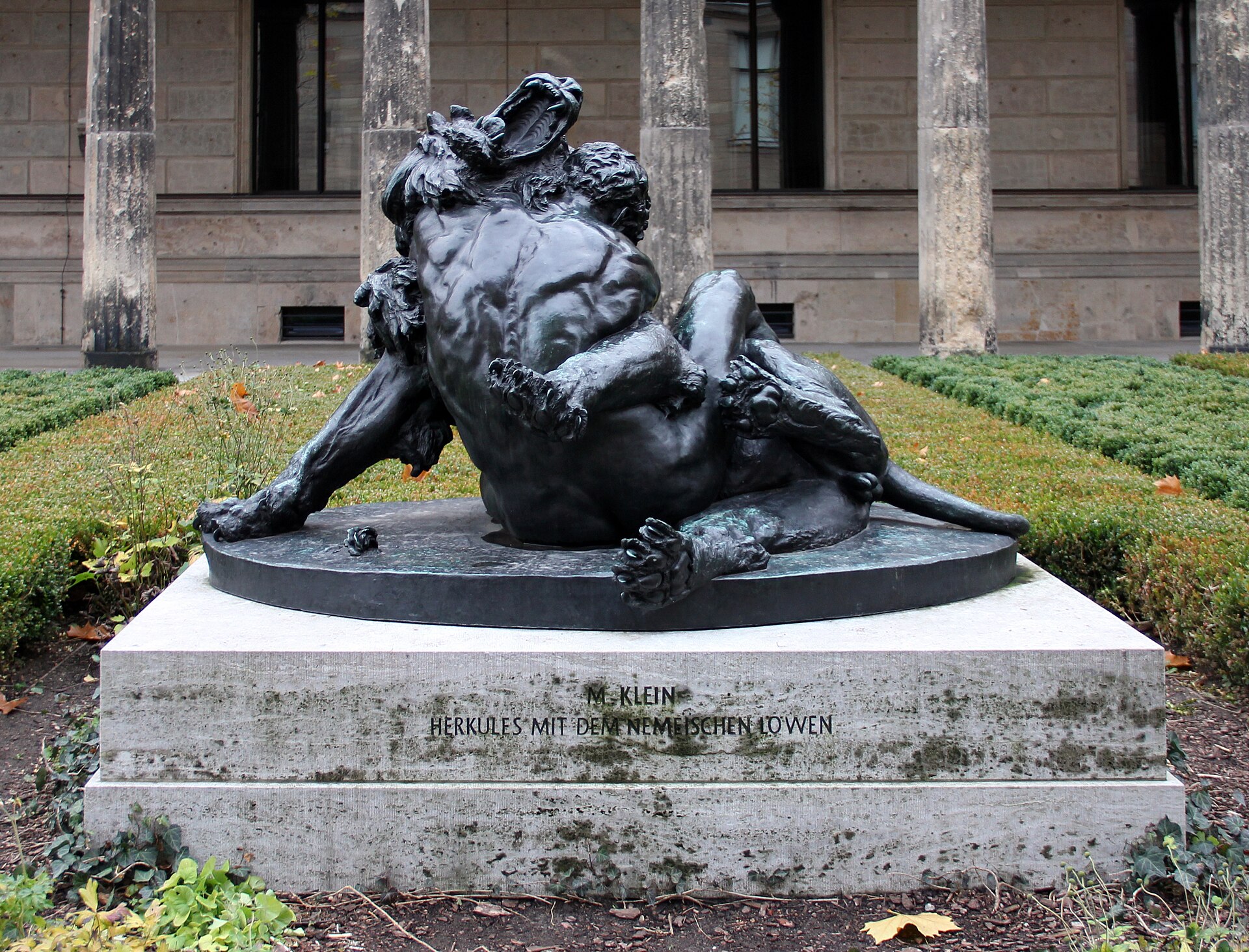
The slaying of the Nemean Lion was the first of the famous Twelve Labours of Heracles. It introduced the Greek hero to a cycle of extraordinary trials involving monsters, sacred animals, distant kingdoms and even the realm of the dead.
The First Labour of Heracles
The Nemean Lion was no ordinary animal. It was a supernatural creature whose hide could not be pierced by bronze, iron or stone. Arrows bounced from its body, swords failed to cut it and spears could not penetrate its skin.
The lion lived near Nemea in the north-eastern Peloponnese. From its lair, it attacked travellers, killed livestock and spread fear throughout the surrounding countryside.
King Eurystheus ordered Heracles to kill the beast and bring back proof of the victory. The king hoped that the monster would destroy the hero before he could complete even his first task.
Heracles travelled to Nemea armed with his bow, arrows, sword and heavy wooden club. He soon discovered that his usual weapons were useless against the lion.
To defeat it, Heracles would need more than strength. He would need patience, courage and the ability to adapt when every ordinary method failed.
Heracles Before the Labours
Heracles was the son of Zeus, king of the gods, and Alcmene, a mortal woman descended from the hero Perseus.
Zeus had disguised himself as Alcmene’s husband Amphitryon in order to approach her. From their union came a child with extraordinary strength and a partly divine nature.
Hera, the wife of Zeus, hated Heracles because he was evidence of her husband’s unfaithfulness. She attempted to destroy him from the beginning of his life.
When Heracles was still an infant, Hera sent two snakes into his sleeping chamber. The child seized the serpents with his hands and strangled them.
This early feat revealed that he possessed strength far beyond that of an ordinary human being.
As Heracles grew older, he became a skilled warrior, hunter and athlete. He received training in music, weaponry, chariot driving and combat.
His great power made him capable of heroic achievements, but it did not protect him from suffering or poor judgement.
The Madness of Heracles
The events leading to the labours began with tragedy.
Heracles married Megara, the daughter of King Creon of Thebes. They had children and appeared to establish a successful household.
Hera caused Heracles to fall into a state of madness. While his mind was clouded, he attacked and killed members of his own family.
Ancient accounts differ over exactly who died and how the violence occurred. In every version, Heracles eventually recovered his senses and understood the horror of what he had done.
He was overwhelmed by grief, guilt and shame.
Although Hera had caused the madness, Heracles still believed that he needed purification. He could not simply return to ordinary life after the deaths.
He travelled to the sanctuary of Apollo at Delphi and asked the oracle how he might cleanse himself of the crime.
The Command of the Oracle
The Delphic Oracle instructed Heracles to serve King Eurystheus.
Eurystheus ruled Tiryns and Mycenae and belonged to the same wider family line as Heracles.
Through the interference of Hera, Eurystheus had been born before Heracles and gained the kingship that Zeus had intended for the next descendant of Perseus.
Heracles therefore possessed greater courage and strength, while Eurystheus held greater legal authority.
The oracle ordered Heracles to complete a series of tasks chosen by the king.
If he obeyed and survived, he would be purified and gain lasting glory.
The service was humiliating. The strongest hero in Greece had to accept commands from a ruler frequently portrayed as fearful and jealous.
King Eurystheus
Eurystheus feared Heracles and resented his reputation.
He understood that the hero’s strength made him admired throughout Greece.
The king therefore designed tasks that seemed impossible and expected Heracles to die while attempting them.
His first command was to kill the Nemean Lion.
The task was suitable as an opening test because the lion had already defeated every hunter and warrior who approached it.
Eurystheus believed that strength alone would not be enough to overcome an animal whose skin resisted every weapon.
The Land of Nemea
Nemea was located in the north-eastern Peloponnese between important regions such as Argos and Corinth.
The landscape contained valleys, hills, rocky ground and areas suitable for farming and grazing.
In later Greek history, Nemea became famous for athletic games held in honour of Zeus.
Within mythology, however, the region was first associated with danger and the supernatural lion.
The beast moved through fields and hills, attacking people and animals before retreating to its cave.
Farmers could not safely protect their herds. Travellers feared passing through the region, and ordinary hunting parties were powerless.
The Origins of the Nemean Lion
Ancient writers gave several different accounts of the lion’s birth.
One tradition described it as a child of Typhon and Echidna.
Typhon was a gigantic enemy of the Olympian gods, while Echidna was a monstrous being who was partly woman and partly serpent.
Their offspring included many famous creatures, such as the Hydra, Cerberus and Orthrus.
By making the lion part of this family, the myth connected it with the ancient forces of chaos defeated by gods and heroes.
Another tradition said that the lion was the offspring of Orthrus and the Chimera.
Some stories connected it with the moon goddess Selene, who may have sent or dropped the animal from the sky.
Hera was also said to have guided the lion towards Nemea so that it would eventually confront Heracles.
The Invulnerable Hide
The Nemean Lion’s most important feature was its invulnerable skin.
No ordinary blade or spear point could cut through it.
The hide transformed the lion into a living fortress.
A hunter could aim perfectly and strike the animal without causing serious injury.
This quality made the first labour more complicated than simply finding and killing a dangerous beast.
Heracles needed to understand the nature of his enemy before he could defeat it.
The invulnerable hide also gave the lion symbolic importance.
It represented a problem that could not be solved through familiar methods.
The Lion’s Terror
The lion hunted livestock, wild animals and human beings.
It could move silently through the countryside and attack with overwhelming force.
Its roar spread fear long before the animal appeared.
Those who attempted to pursue it risked being drawn towards the cave where the lion had every advantage.
The creature’s strength and resistance to weapons allowed it to dominate the region.
Nemea remained trapped between the danger of the lion and the inability of ordinary people to remove it.
Heracles Begins the Journey
Heracles left the court of Eurystheus and travelled towards Nemea.
He carried the weapons commonly associated with a Greek hero.
His bow allowed him to strike enemies from a distance.
His sword offered speed in close combat.
His club provided crushing force.
Heracles may have expected the labour to be difficult, but he had not yet learned that the lion’s hide was completely resistant to human weapons.
Molorchus
During the journey, Heracles encountered a poor farmer named Molorchus.
Molorchus had suffered because of the lion and lived with little wealth.
Despite his poverty, he welcomed Heracles and wished to offer a sacrifice in the hero’s honour.
Heracles asked him to wait for thirty days.
If Heracles returned alive, Molorchus should sacrifice to Zeus the Saviour in celebration.
If Heracles failed to return, Molorchus should sacrifice to him as a dead hero.
The agreement revealed the seriousness of the task.
Even Heracles understood that he might not survive his first labour.
Searching for the Lion
Heracles searched the countryside for signs of the beast.
He examined tracks, broken vegetation and the remains of animals.
The lion did not simply wait in the open. It hunted across a wide area and then returned to its rocky shelter.
The search required Heracles to behave as a hunter rather than a warrior on a battlefield.
He needed to observe, follow and predict the movements of the animal.
The First Attack
Heracles eventually saw the Nemean Lion and prepared his bow.
He fired an arrow directly at the animal.
The arrow struck the hide but failed to enter the body.
Another arrow produced the same result.
The lion’s skin turned aside the sharp points as though they were harmless objects.
Heracles immediately understood that distance and archery would not defeat the beast.
The Sword Fails
Heracles next attempted to attack with his sword.
A powerful blade could normally cut through flesh and armour.
Against the Nemean Lion, it was useless.
The edge failed to penetrate the skin and may have bent or broken under the impact.
Heracles was forced to abandon another familiar weapon.
The Club
Heracles then used his heavy club.
The club did not need to cut the hide. Its force could crush bones or stun an enemy beneath protective skin.
Heracles struck the lion with tremendous power.
The blow shocked or dazed the creature, but it did not kill it.
The lion withdrew towards its cave.
Heracles followed, knowing that the battle had moved into a more dangerous stage.
The Cave of the Lion
The lion’s lair was a dark cave with two entrances.
The design allowed the creature to enter from one side and escape from the other.
If Heracles followed carelessly, the lion could avoid him or attack from an unexpected direction.
The darkness also reduced the value of sight and long-range weapons.
Inside the cave, the struggle would depend upon physical control and courage.
Blocking the Entrance
Heracles recognised that he could not defeat the lion if it continued escaping through the second opening.
He gathered heavy stones and blocked one entrance.
This decision transformed the cave into a closed arena.
The lion could no longer flee.
Heracles entered through the remaining opening and prepared to confront it at close range.
The tactic demonstrates that intelligence played an important role in the victory.
Strength alone would not have prevented the lion from escaping.
Entering the Darkness
Heracles entered the cave without knowing exactly where the lion waited.
The enclosed space increased the sound of its breathing and growling.
The lion knew the shape of the cave, while Heracles moved through unfamiliar darkness.
His bow and sword had already failed.
The club had stunned the animal but could not guarantee victory in the narrow passage.
Heracles understood that he would need to seize the lion with his hands.
The Hand-to-Hand Struggle
The lion attacked with claws, teeth and the full weight of its body.
Heracles moved close enough to prevent it from building speed for another charge.
He wrapped his arms around its neck and body.
The animal struggled violently, attempting to tear him with its claws.
Heracles protected himself as well as possible while tightening his grip.
The fight was not quick or easy.
It was a contest between the strength of the greatest human hero and the power of an invulnerable monster.
Heracles Strangles the Lion
Because the hide could not be cut, Heracles attacked the lion through pressure rather than penetration.
He locked his arms around its neck and squeezed.
The creature twisted, roared and struck at him.
Heracles continued tightening his grip until the lion could no longer breathe.
Eventually, its resistance weakened.
The Nemean Lion died through strangulation.
Heracles had defeated a creature that could not be harmed by the weapons of ordinary warriors.
Strength Without Weapons
The final struggle proved that Heracles’ greatest weapon was his own body.
His bow, sword and club had each failed to complete the task.
Only direct physical strength allowed him to overcome the lion.
However, the victory was not based upon strength alone.
Heracles had first needed to understand the lion’s invulnerability, discover its cave and block the second exit.
The labour joined intelligence with physical power.
Removing the Hide
After killing the lion, Heracles faced another problem.
Eurystheus had ordered him to bring proof of the victory.
Heracles wanted to remove the lion’s skin, but his knife could not cut it.
The hide remained invulnerable even after the creature’s death.
According to one tradition, Athena appeared and advised Heracles to use the lion’s own claws.
The claws could cut the skin that resisted every human blade.
Heracles used them to remove the hide.
The Lion Skin
Heracles placed the Nemean Lion’s skin over his shoulders.
The upper part of the animal’s head formed a helmet, while the rest of the hide covered his back and body.
The skin became powerful armour.
Weapons that would have wounded ordinary warriors could not easily penetrate it.
Heracles had transformed the monster’s greatest defence into his own protection.
This act made the victory more than destruction.
The power of the defeated creature became part of the hero’s identity.
The Lion-Head Helmet
Ancient artists often represented the lion’s open jaws resting above Heracles’ forehead.
The animal’s paws could be tied across his chest.
The image made Heracles immediately recognisable in sculpture, pottery and painting.
Even when his club or bow was absent, the lion skin identified him.
The head of the monster appeared to become a second heroic face surrounding his own.
The Return to Molorchus
Heracles completed the labour within the period agreed with Molorchus.
He returned to the farmer before the sacrifice intended for his death could be performed.
Molorchus instead honoured Zeus in celebration of the victory.
Some traditions connected this sacrifice with the later religious importance of Nemea.
The return showed that the region was free from the creature that had terrorised it.
Heracles Returns to Eurystheus
Heracles carried the lion or wore its skin as he returned to the court of Eurystheus.
The sight terrified the king.
Eurystheus had expected the hero to die and was unprepared to see him return wearing the hide of the monster.
In some versions, the king fled and hid inside a large bronze storage jar.
He ordered Heracles not to enter the city with the results of future labours.
Instead, the hero would display them outside the gates.
Eurystheus also began communicating through a herald rather than facing Heracles directly.
The Bronze Jar
The image of Eurystheus hiding in a jar became a popular comic scene in ancient art.
The frightened king peers from the container while Heracles approaches with a captured monster.
The image reverses the official relationship between the two men.
Eurystheus has the right to command, but Heracles possesses the courage and strength.
The king’s fear exposes the weakness beneath his political authority.
The Completion of the First Labour
Eurystheus was forced to recognise that Heracles had completed the task.
The Nemean countryside was safe, the lion was dead and its skin had become the hero’s armour.
The king then prepared a second and even more dangerous labour.
Heracles would be sent to destroy the many-headed Hydra of Lerna.
The first victory therefore did not bring freedom.
It marked only the beginning of a much longer period of service and suffering.
The First Labour as a Beginning
The Nemean Lion was an ideal first opponent for Heracles.
The creature tested the strength for which he was already famous.
It also forced him to learn that power must be combined with observation and adaptation.
The labour established the pattern of the adventures that followed.
Eurystheus would give an impossible command, ordinary methods would fail and Heracles would discover a new way to succeed.
The Cave as a Symbol
The cave represents a place of darkness, danger and transformation.
Heracles enters wearing the equipment of an ordinary warrior.
He emerges carrying the skin of a supernatural monster.
Within the cave, he leaves behind dependence upon weapons and discovers the full extent of his physical power.
The struggle can therefore be understood as a form of heroic initiation.
The man who enters the darkness is not exactly the same hero who returns.
The Lion as a Symbol of Chaos
The Nemean Lion represents a wild force existing beyond human law and settlement.
It attacks farms, roads and livestock, making organised community life difficult.
Heracles restores order by removing the creature.
This pattern appears throughout Greek heroic mythology.
Heroes defeat monsters associated with wilderness, disorder and dangerous boundaries.
The victory allows roads, fields and towns to become safe again.
The Lion as a Royal Symbol
Lions were also associated with kingship, courage and overwhelming strength.
Although lions later disappeared from most of Europe, they remained present in the imagination and artistic traditions of the ancient Mediterranean.
A hero who defeated a lion demonstrated mastery over one of the most powerful animals known to the Greeks.
By wearing the skin, Heracles took on the lion’s royal and military symbolism.
He became both the destroyer of the beast and the human bearer of its strength.
Heracles and the Animal World
The labour places Heracles in direct conflict with the natural world.
The lion is not evil in the same way as a dishonest king or murderer.
It behaves according to its predatory nature, but its supernatural power makes coexistence with humans impossible.
Heracles acts as the protector of communities threatened by the creature.
Later labours would require him to kill some animals and capture others without harming them.
The Nemean Lion introduces this complex relationship between heroism and mastery over nature.
The Importance of Adaptation
Heracles does not continue firing arrows after discovering that they are useless.
He changes his method.
He tries the sword, then the club and finally his hands.
He changes the battlefield by blocking the second entrance to the cave.
After the victory, he uses the lion’s claws because his own blade cannot remove the hide.
Every stage of the labour requires adaptation.
The story therefore celebrates flexible thinking as much as physical force.
The Failure of Ordinary Weapons
The useless weapons carry an important meaning.
They represent the limits of ordinary human technology.
Bronze blades, arrows and clubs are powerful against normal enemies, but the Nemean Lion belongs to a supernatural world.
Heracles must move beyond conventional warfare and use a method suited specifically to the creature.
The story warns that the strongest familiar tool may still fail when the problem itself is unusual.
The Use of the Lion’s Own Claws
Using the lion’s claws to remove its skin shows Heracles turning the nature of the monster against itself.
The creature’s body contains both the defence and the means of overcoming that defence.
No human knife can cut the hide, but the lion’s claw can.
Heracles succeeds because he understands that the solution may exist within the problem.
Victory and Transformation
The labour permanently changes the appearance of Heracles.
Before Nemea, he may be represented like any other warrior carrying a bow or club.
After Nemea, the lion skin becomes inseparable from him.
The monster survives symbolically through the hero who defeated it.
Its strength is no longer a threat to humanity but a protection worn by humanity’s champion.
The Role of Athena
Athena was frequently associated with Heracles during the labours.
She represented wisdom, strategy and controlled strength.
If she taught Heracles to use the lion’s claws, her intervention emphasised the importance of intelligence.
Heracles possessed the power to kill the lion, but Athena helped him understand how to use the victory.
The partnership between them appears repeatedly in ancient art.
The Role of Hera
Hera’s hostility formed the larger background to the labour.
She had caused the madness that led Heracles into the service of Eurystheus.
Some traditions also connected her directly with the Nemean Lion.
By sending dangers against Heracles, Hera hoped to destroy him.
Instead, each challenge increased his fame.
Her hatred unintentionally helped create the greatest hero of Greek mythology.
The Role of Eurystheus
Eurystheus did not fight the lion or protect the people of Nemea.
He issued the command from the safety of his palace.
When Heracles succeeded, the king reacted with fear rather than gratitude.
The contrast questions the relationship between authority and worthiness.
Eurystheus is legally powerful, but Heracles performs the actions required of a true protector.
Heroism and Service
Heracles does not undertake the labour simply because he desires adventure.
He serves another ruler as part of his purification.
This makes the victory different from an ordinary hunt.
Every danger endured at Nemea belongs to a larger attempt to live with guilt and rebuild a damaged life.
The first labour is therefore both a public service and a personal act of redemption.
Redemption Through Action
Heracles cannot undo the deaths caused during his madness.
No victory can restore his family.
The oracle gives him a path through which he can continue living and perform good actions for others.
By killing the lion, Heracles removes suffering from the region of Nemea.
His personal punishment becomes protection for a community.
The myth suggests that redemption cannot erase the past, but it can change the meaning of the future.
Heracles and Fear
Heracles is famous for courage, but courage does not require the complete absence of fear.
His agreement with Molorchus shows that he recognised the possibility of death.
He entered the cave despite understanding the danger.
Courage lies in acting with knowledge of risk rather than pretending that risk does not exist.
The Lion’s Roar
The roar of the Nemean Lion represents the psychological power of the monster.
It terrifies people before the physical attack begins.
Fear keeps travellers away and weakens those who attempt to hunt it.
Heracles defeats not only the lion’s body but also the fear surrounding its reputation.
After the victory, the roar is replaced by the visible image of the hero wearing the skin.
The Labour in Ancient Art
The struggle with the Nemean Lion became one of the most popular scenes in ancient Greek art.
Vase painters often showed Heracles wrestling the lion with his bare hands.
The hero and animal could be represented as a tightly connected group of bodies, emphasising the physical intensity of the fight.
Athena sometimes appears nearby, offering support or watching the struggle.
Iolaus or other figures may also be present in certain versions.
The Labour in Sculpture
Sculptors represented Heracles wearing the lion skin or resting after the labour.
The hide could be carved with the head lying over his hair and the paws tied across his chest.
The lion skin gave artists a way to show both the earlier battle and the hero’s later identity within one figure.
Even without the lion itself, the viewer understood that Heracles had already completed the first labour.
The Temple of Zeus at Olympia
The Twelve Labours appeared on the metopes of the Temple of Zeus at Olympia.
These sculpted panels showed Heracles completing his tasks with the assistance or presence of Athena.
The scenes did not present him simply as an unstoppable giant.
They often showed effort, strain and the gradual development of the hero.
The first labour helped establish the beginning of this visual journey.
The Nemean Games
Nemea later became associated with one of the major athletic festivals of ancient Greece.
The Nemean Games were held in honour of Zeus.
Different myths explained the origin of the festival.
One tradition connected it with the death of the infant Opheltes, while another associated Heracles with the founding or reorganisation of the games.
The presence of Heracles suited an athletic festival because he represented strength, endurance and victory through effort.
The Lion in the Stars
Some traditions connected the Nemean Lion with the constellation Leo.
After the creature’s death, Hera or Zeus placed it among the stars.
The lion therefore continued to exist within the night sky.
Its transformation into a constellation reflected the ancient practice of linking mythology with visible patterns in the heavens.
The Lion and the Zodiac
Leo became one of the signs of the zodiac.
The constellation was associated with strength, heat and the power of the summer sun.
The connection with the Nemean Lion gave the star pattern a heroic and mythological identity.
Through this tradition, the first labour became part of both storytelling and ancient astronomy.
Heracles and Other Lion Slayers
Heracles belongs to a wider tradition of heroes who confront lions.
In the ancient Near East, kings and heroes were often shown hunting lions as proof of courage and royal power.
The Mesopotamian hero Gilgamesh was represented carrying or fighting lions.
Later biblical tradition described Samson killing a lion with his hands.
These stories use the lion as the ultimate natural opponent of exceptional human strength.
The Nemean Lion and the Hydra
The first and second labours are closely connected.
The Nemean Lion cannot be pierced, while the Hydra grows stronger whenever one of its heads is cut away.
Both monsters defeat ordinary methods of attack.
Heracles must discover a specialised solution for each.
He strangles the lion and cauterises the Hydra’s necks.
The two opening labours immediately establish that strength must be guided by thought.
The Lion Skin in Later Labours
The lion skin protects Heracles throughout later adventures.
He wears it while confronting monsters, warriors and supernatural dangers.
During the capture of Cerberus, the skin helps protect him from the guardian’s claws and serpents.
The reward of the first labour therefore contributes directly to the success of later tasks.
Heracles carries the memory and power of his first victory into every new challenge.
The Club of Heracles
The club became another major symbol of Heracles.
It was often imagined as a simple weapon cut from an olive tree or another strong wood.
Unlike the refined spear or sword of a noble warrior, the club emphasised direct force and the hero’s connection with wilderness.
During the Nemean labour, the club could stun the lion but not kill it.
This limitation showed that even the hero’s most familiar symbol was not enough by itself.
The Bow of Heracles
Heracles was also a skilled archer.
His bow later became important in many adventures and was passed to Philoctetes after his death.
At Nemea, however, the arrows fail completely.
The opening of the labour therefore immediately removes the advantage of distance.
Heracles must approach the monster and place himself within reach of its claws.
The Struggle as a Test of Identity
The Nemean Lion forces Heracles to discover what makes him unique.
Any trained warrior can carry a sword or fire an arrow.
Only Heracles possesses the strength to strangle the invulnerable lion.
The labour strips away ordinary equipment and reveals the essential quality of the hero.
At the same time, his strategy shows that strength without judgement would still fail.
The Difference Between Killing and Conquering
Heracles does more than kill the lion.
He conquers everything the creature represents.
He enters its territory, survives its attack, uses its own claw and takes its skin.
The lion no longer controls Nemea or spreads fear among its people.
Its strength is absorbed into the image of the hero.
The Ethics of the Labour
Modern readers may view the killing of a wild animal differently from ancient audiences.
Within the myth, the Nemean Lion is not presented as an endangered natural creature or ordinary predator.
It is a supernatural monster that deliberately terrorises human communities and cannot be controlled through normal means.
The story therefore presents the killing as an act of protection rather than sport.
The First Labour and Civilisation
Greek heroes often made dangerous landscapes safe for settlement and travel.
Heracles’ defeat of the lion allows farmers to protect their animals and travellers to move through Nemea.
The victory represents civilisation overcoming destructive wilderness.
However, the hero himself remains partly connected with the wild world.
By wearing the lion skin and carrying a club, Heracles becomes a bridge between civilisation and nature.
Heracles as Protector
The labour helps establish Heracles as a protector of ordinary people.
He is not defending a rich palace or gaining territory for himself.
He removes a danger that has affected farmers, travellers and herders.
Even though Eurystheus gives the command for selfish reasons, the result benefits the people of Nemea.
Heracles as Sufferer
Heracles is powerful, but his story is also defined by suffering.
He undertakes the labour because of guilt, divine persecution and forced service.
The victory does not immediately free him or bring peace.
It leads directly to another dangerous command.
This combination of strength and suffering made Heracles especially important within Greek culture.
People could admire him not only because he defeated enemies but because he endured hardship.
Heracles as a Mortal and Divine Figure
Heracles was both the son of Zeus and a mortal woman.
His divine ancestry gave him extraordinary power, but his mortal nature exposed him to pain, guilt and death.
The struggle with the lion displays this combination.
He possesses almost superhuman strength, yet he must risk physical injury in a dark cave.
He is neither an invulnerable god nor an ordinary man.
The Meaning of Invulnerability
The lion’s invulnerable hide creates the illusion that it cannot be defeated.
Heracles discovers that invulnerability is limited.
The skin cannot be pierced, but the lion still needs to breathe.
Every strength has conditions and possible weaknesses.
The labour teaches that defeating an apparently invincible opponent requires understanding what the protection does not cover.
The Meaning of the Cave Entrances
The two entrances allow the lion to avoid danger and control pursuit.
Heracles changes this advantage by blocking one opening.
The act represents the importance of controlling the environment before confronting a stronger opponent.
Rather than allowing the lion to choose the terms of the fight, Heracles reshapes the battlefield.
The Importance of Patience
Heracles does not defeat the lion with one dramatic blow.
He searches, experiments, follows and traps it.
The hand-to-hand struggle also requires sustained pressure rather than a single strike.
The labour therefore presents endurance as a form of strength.
Victory belongs to the hero who continues after his first methods fail.
Failure as Part of Success
The arrows fail.
The sword fails.
The club fails to kill the beast.
These failures do not end the labour.
Each one teaches Heracles something about the opponent.
By abandoning methods that do not work, he moves closer to the correct solution.
The story presents failure as information rather than final defeat.
The Labour as a Lesson in Leadership
Although Heracles is not leading an army, the labour demonstrates qualities important to leadership.
He accepts responsibility for a dangerous problem.
He adapts when circumstances change.
He places himself at risk rather than sending others into the cave.
He completes the task and returns with clear proof.
Eurystheus, by contrast, commands from safety and hides when confronted with the result.
The Labour as a Lesson in Courage
Courage is not simply the ability to overpower an enemy.
Heracles shows courage when he continues after discovering that his weapons are useless.
He knows that entering the cave will remove his ability to retreat easily.
He enters anyway.
The decision to confront danger at close range defines the heroic centre of the story.
The Labour as a Lesson in Resourcefulness
Resourcefulness allows Heracles to transform limited options into victory.
He blocks the cave, uses strangulation and cuts the hide with the lion’s claw.
None of these solutions depends upon the original plan.
The story suggests that success belongs to those who can create new methods when established tools fail.
The Labour as a Lesson in Transformation
Heracles turns the lion from hunter into armour.
The animal that once made people vulnerable now protects the hero.
This transformation reflects the wider purpose of the labours.
Heracles attempts to transform guilt into service, suffering into achievement and danger into protection.
Different Versions of the Myth
Ancient mythology did not exist as one fixed account.
Poets, artists and local communities told the story in different ways.
Some versions emphasised the bow and club, while others focused almost entirely upon the wrestling match.
The number of days spent in Nemea and the role of Molorchus could also vary.
Athena’s assistance with the lion skin appeared in some traditions but not all.
These differences reflect the flexible nature of Greek myth.
Heracles and Hercules
The hero’s Greek name was Heracles.
The Romans called him Hercules.
The name Heracles can be understood as connected with the glory of Hera, which is deeply ironic because Hera persecuted him.
Through overcoming the dangers created by the goddess, Heracles gained the glory associated with his name.
The Roman Hercules inherited the Nemean Lion story and the same famous lion-skin appearance.
The Nemean Lion in Roman Culture
Roman artists, writers and rulers adopted the image of Hercules wearing the lion skin.
The hero represented strength, victory and the ability to defeat chaos.
Some Roman emperors associated themselves with Hercules to suggest that they possessed heroic power.
The lion skin became a political as well as mythological symbol.
The Story in Later Literature
The slaying of the Nemean Lion continued to appear in medieval, Renaissance and modern literature.
Writers used the labour as an example of impossible strength and courage.
The story could also be interpreted symbolically as the defeat of pride, violence or uncontrolled instinct.
The Story in Modern Art
Modern paintings and sculptures often focus upon the moment when Heracles wrestles the lion.
The close physical struggle allows artists to show movement, muscle and tension.
Other works show the hero resting after the victory or standing proudly in the lion skin.
Each type of image emphasises a different part of the story.
The wrestling scene shows effort, while the lion skin shows completed transformation.
The Story in Film and Popular Culture
Films, television programmes, comics and games frequently include the Nemean Lion as the first major challenge of Heracles.
Modern versions may change the creature’s size, appearance or powers.
Some portray it as a realistic giant lion, while others make it a magical beast covered in supernatural armour.
The central pattern usually remains the same.
Weapons fail, and Heracles must defeat the lion through direct strength and intelligence.
Why the Story Endures
The story remains memorable because its structure is simple and powerful.
A hero faces an apparently invincible enemy.
His normal tools fail.
He enters the enemy’s own territory and discovers a different way to win.
He then transforms the source of danger into protection.
This pattern can be understood in many situations beyond physical combat.
The First Step in a Greater Journey
The Nemean Lion is only the beginning of the Twelve Labours.
Heracles still has to confront the Hydra, capture the Ceryneian Hind, trap the Erymanthian Boar and clean the Augean Stables.
He will travel to Crete, Thrace, the land of the Amazons and the edge of the world.
His final task will take him into the Underworld itself.
The first labour prepares him for all of these challenges by teaching him not to depend upon one form of strength.
The Legacy of the Nemean Lion
The Nemean Lion became one of the most recognisable monsters in Greek mythology.
Its importance comes not from a long list of adventures but from its role in creating the familiar image of Heracles.
Without the lion, the hero would not possess his famous armour or lion-headed hood.
The first monster becomes permanently connected with the identity of the man who defeated it.
Conclusion
The slaying of the Nemean Lion was the first great labour imposed upon Heracles by King Eurystheus.
The lion terrorised the countryside around Nemea and possessed a hide that could not be pierced by ordinary weapons.
Heracles travelled to the region carrying his bow, sword and club.
His arrows failed, his blade could not cut the animal and the club could only stun it.
Rather than surrender, Heracles adapted.
He followed the lion to a cave with two entrances and blocked one opening with heavy stones.
He entered through the remaining entrance and confronted the creature in darkness.
Without relying upon weapons, Heracles seized the lion and strangled it with his bare hands.
After the victory, he discovered that his knife could not remove the invulnerable hide.
Using one of the lion’s own claws, he cut through the skin and turned it into armour.
The lion’s head became his helmet, while the hide protected his body during later adventures.
When Heracles returned, Eurystheus was so frightened that he hid inside a bronze jar and refused to meet the hero directly during future labours.
The first labour established Heracles as a hero of extraordinary strength, but it also revealed his intelligence and adaptability.
He succeeded because he learned from failure, changed his approach and understood the weakness hidden beneath the lion’s invulnerability.
The story transformed both hero and monster.
The Nemean Lion ceased to be the terror of the countryside and became the armour of its conqueror.
Heracles entered the cave as a powerful but untested servant of Eurystheus.
He emerged wearing the symbol that would identify him forever.
The slaying of the Nemean Lion therefore represents more than the death of a monster.
It is the beginning of Heracles’ journey towards redemption, legendary fame and eventual immortality.