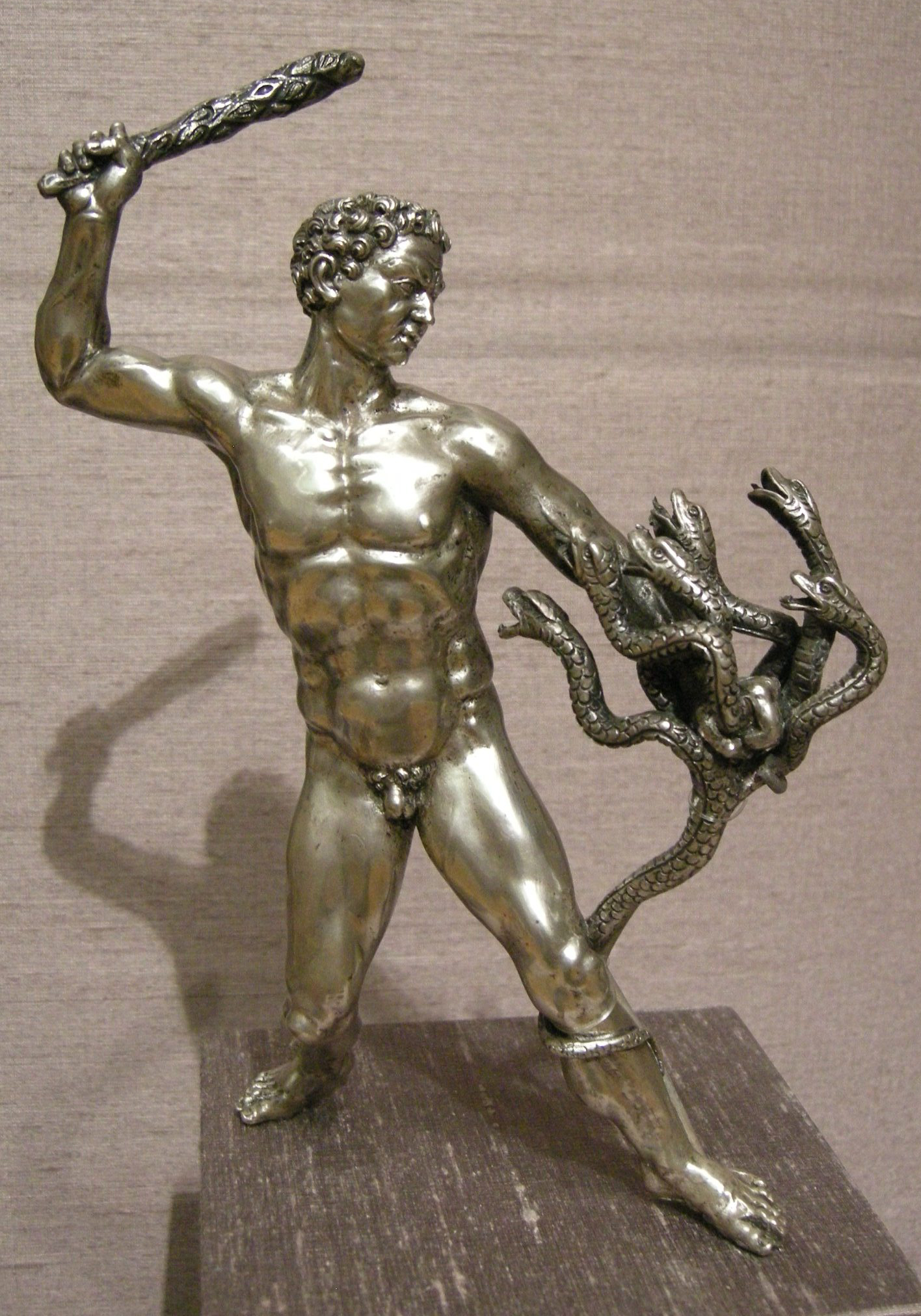
The second labour of Heracles was the destruction of the Lernaean Hydra, one of the most terrifying monsters in ancient Greek mythology. The creature lived in the marshes of Lerna, where it guarded a region associated with deep water, ancient religious traditions and entrances to the Underworld.
The Slaying of the Lernaean Hydra
The Hydra was a gigantic serpent with several heads. Ancient writers disagreed about the exact number. Some described nine heads, while others imagined fifty or even one hundred.
One of the Hydra’s heads was immortal. The others possessed a supernatural ability that made the monster almost impossible to destroy. Whenever one head was cut away, two new heads grew from the wound.
The Hydra’s breath was poisonous, and its blood and venom were deadly. Merely approaching its lair could place a person in danger.
King Eurystheus ordered Heracles to kill the creature after the hero returned from slaying the Nemean Lion. Eurystheus hoped that the second labour would succeed where the first had failed and finally destroy Heracles.
The battle with the Hydra tested far more than physical strength. Heracles had to recognise that ordinary attacks only made the monster stronger. Victory required cooperation, intelligence, fire and the courage to continue when every blow appeared to multiply the danger.
Heracles and King Eurystheus
Heracles undertook the labours because he had been ordered to serve King Eurystheus of Tiryns and Mycenae.
Heracles was the son of Zeus and the mortal woman Alcmene. Hera, the wife of Zeus, hated him because he was born from one of her husband’s relationships with a mortal.
Hera persecuted Heracles throughout his life. She eventually caused him to fall into a state of madness in which he killed members of his own family.
When his sanity returned, Heracles was horrified by what he had done. He travelled to the Oracle of Apollo at Delphi and asked how he might be purified.
The oracle instructed him to obey Eurystheus and complete a series of dangerous tasks.
Eurystheus possessed royal authority, but he lacked the courage and strength of Heracles. He frequently assigned impossible labours because he feared the hero and wanted him removed.
The First Labour
Before confronting the Hydra, Heracles had completed his first labour by killing the Nemean Lion.
The lion possessed an invulnerable hide that could not be pierced by arrows, swords or spears.
Heracles trapped the animal inside its cave and strangled it with his bare hands.
He then used one of the lion’s own claws to remove its hide.
The hero wore the skin as armour, with the lion’s head forming a helmet over his own.
This armour accompanied Heracles when he travelled to Lerna and offered protection against the Hydra’s attacks.
The Land of Lerna
Lerna was located near the city of Argos in the north-eastern Peloponnese.
The area contained springs, marshes and deep pools of water.
It was regarded as an ancient and mysterious place associated with the powers beneath the earth.
Some traditions described Lerna as containing an entrance to the Underworld.
The Hydra’s presence therefore linked the creature with death, darkness and the hidden forces of the natural world.
The surrounding marsh made the monster difficult to approach. Soft ground, thick vegetation and poisonous water protected its lair.
The Origins of the Hydra
The Hydra was commonly described as a child of Typhon and Echidna.
Typhon was a gigantic monster who challenged Zeus and the Olympian gods.
Echidna was a creature with the upper body of a woman and the lower body of a serpent.
Together, they produced many of the most dangerous monsters in Greek mythology.
Their offspring included Cerberus, the guardian of the Underworld, Orthrus, the two-headed dog, and the Chimera, a fire-breathing creature combining several animals.
The Nemean Lion was also sometimes included among their descendants.
By making the Hydra part of this monstrous family, Greek mythology presented it as a surviving force from an ancient age of chaos.
Hera Raises the Hydra
Hera was closely connected with the Hydra’s role in the labours.
According to tradition, she raised or placed the creature at Lerna because she knew that Heracles would eventually be sent against it.
The Hydra was therefore not simply a wild monster that happened to cross the hero’s path.
It was another weapon in Hera’s campaign against the son of Zeus.
Her hatred transformed the marshes of Lerna into a carefully prepared trap.
The Many Heads
The Hydra’s many heads made it unlike any ordinary serpent.
Each head could strike independently, surrounding an enemy with snapping jaws and poisonous breath.
A warrior approaching one head might be attacked by another from the side or behind.
The creature’s shape made close combat extremely dangerous.
The heads also represented a problem that became greater whenever it was attacked in the wrong way.
Cutting off one head did not weaken the monster. It caused two new heads to appear.
The Immortal Head
Among the Hydra’s heads, one was immortal.
Even if Heracles removed it from the body, he could not destroy it completely.
The presence of the immortal head meant that the labour could not be completed through killing every part of the monster in the same way.
Heracles would eventually need to isolate and imprison the head rather than destroy it.
The Poisonous Breath
The Hydra’s breath was said to be so poisonous that it could kill anyone who came too close.
Some traditions claimed that even the smell of its tracks or lair could cause death.
The poison protected the creature before physical combat began.
Heracles covered his mouth and nose with cloth or used another form of protection as he entered the marsh.
The lion skin may also have shielded parts of his body from the Hydra’s fangs and venom.
Iolaus
Heracles did not travel to Lerna alone.
He was accompanied by his nephew Iolaus, who was also his close friend and charioteer.
Iolaus was the son of Iphicles, the mortal half-brother of Heracles.
He appears in several stories as a loyal companion who supports the hero during dangerous journeys.
His role in the battle with the Hydra became essential.
Without his assistance, Heracles might have been overwhelmed by the constantly growing heads.
The Journey to the Marsh
Heracles and Iolaus travelled from the court of Eurystheus towards Lerna.
As they approached the marsh, the landscape became wet, dark and difficult to cross.
The air may have carried the smell of stagnant water and poisonous vapour.
The Hydra remained hidden inside a cave or beneath the roots of a great tree.
Heracles could not simply charge towards it across open ground.
He first needed to force the monster from its protected lair.
Forcing the Hydra into the Open
Heracles prepared burning arrows and fired them into the Hydra’s cave.
The smoke and flames disturbed the creature and forced it to emerge.
This opening move demonstrated that Heracles had learned from the first labour.
He did not immediately enter the monster’s hiding place and fight according to its advantage.
Instead, he changed the conditions and forced the Hydra onto ground where he could confront it.
The Hydra Appears
The enormous serpent emerged from the darkness with its heads twisting and striking in every direction.
Its body moved through the mud and water while poisonous breath filled the air.
Heracles approached wearing the Nemean Lion skin and carrying his weapons.
He began striking the Hydra’s heads with his sword, club or sickle.
At first, the attack appeared successful.
One of the heads fell beneath his blow.
The Heads Return
As soon as Heracles removed the first head, two new heads grew from the exposed neck.
He attacked another head, but the same thing happened again.
Every successful strike increased the number of enemies he faced.
The monster became more dangerous as the battle continued.
Heracles quickly recognised that physical strength alone could not complete the labour.
If he continued cutting without changing his method, the Hydra would eventually possess too many heads to resist.
The Problem of Multiplication
The Hydra represented a challenge that grew when attacked incorrectly.
Heracles could not solve it simply by striking harder or faster.
The labour required him to understand the cause of the regeneration.
The new heads emerged from the open wounds left after the old heads were removed.
To prevent regrowth, those wounds needed to be sealed immediately.
Hera Sends the Giant Crab
While Heracles struggled with the Hydra, Hera sent another creature to interfere.
A giant crab emerged from the marsh and attacked the hero’s feet.
The crab seized or pinched him while the Hydra’s heads continued striking from above.
The additional enemy made the battle even more difficult.
Heracles crushed the crab beneath his foot or killed it with his club.
The crab had failed to stop him, but Hera honoured its loyalty.
The Constellation Cancer
After the crab was killed, Hera placed it among the stars.
It became associated with the constellation Cancer.
The Hydra was also linked with a constellation placed in the night sky.
Through these stories, the battle at Lerna became connected with ancient astronomy.
People looking at the stars could remember the creatures that had fought against Heracles.
Heracles Calls to Iolaus
Heracles realised that he needed assistance.
He called to Iolaus and explained that every severed head was producing two more.
Iolaus gathered branches or wooden torches and set them on fire.
The two heroes then developed a coordinated method of attack.
Heracles would remove a head, and Iolaus would immediately burn the exposed neck.
The Fire of Iolaus
Whenever Heracles cut off one of the Hydra’s mortal heads, Iolaus pressed a burning branch against the wound.
The intense heat cauterised the flesh.
The sealed neck could no longer produce new heads.
For the first time, each attack permanently weakened the Hydra.
Heracles and Iolaus continued working together until all the mortal heads had been removed.
Strength and Cooperation
The battle demonstrates that even the strongest hero sometimes requires help.
Heracles possessed the power to cut through the Hydra’s necks.
Iolaus provided the fire and timing needed to prevent regeneration.
Neither part of the plan would have succeeded alone.
The labour therefore celebrates cooperation as well as individual courage.
Heracles did not become less heroic by accepting help. His willingness to recognise the need for assistance allowed him to survive.
The Immortal Head Remains
After the mortal heads were destroyed, the immortal head remained.
Heracles cut it from the Hydra’s body using a sword, golden blade or heavy weapon.
The head remained alive even after being separated.
Its eyes, jaws and venom continued to present a danger.
Heracles could not kill it, so he needed another solution.
Burying the Immortal Head
Heracles carried the immortal head away from the body and buried it beside the road leading through Lerna.
He placed a massive rock over the burial place.
The stone prevented the head from escaping or harming travellers.
The hero had not destroyed the immortal part of the monster, but he had contained it.
This solution showed that some dangers cannot be completely removed and must instead be permanently controlled.
The Death of the Hydra
With every mortal head destroyed and the immortal head trapped beneath the rock, the Hydra’s body collapsed.
The creature that had ruled the marsh and spread poison throughout Lerna was dead.
Heracles had completed the central part of the labour.
However, he did not leave immediately.
He recognised that the monster’s venom could become a powerful weapon.
The Poisoned Blood
Heracles cut open the Hydra’s body and collected its poisonous blood or venom.
He dipped the points of his arrows into the substance.
From that moment, even a small wound caused by one of his arrows could become fatal.
The poison could not easily be healed by ordinary medicine.
The Hydra was dead, but its power continued through the weapons of the hero who defeated it.
The Arrows of Heracles
The poisoned arrows became among the most dangerous weapons in Greek mythology.
Heracles used them against monsters, giants, centaurs and hostile kings.
They allowed him to kill enemies who might otherwise resist ordinary arrows.
One of these arrows later helped him defeat Geryon during the tenth labour.
However, the poison did not distinguish between enemy and friend.
It caused several accidental tragedies and eventually contributed to Heracles’ own death.
The Wounding of Chiron
During a later conflict with centaurs, one of Heracles’ poisoned arrows accidentally struck Chiron.
Chiron was a wise and peaceful centaur who had taught many Greek heroes.
Unlike most centaurs, he was immortal.
The Hydra poison caused him unbearable pain, but his immortality prevented him from dying.
Chiron eventually surrendered his immortality so that he could escape the suffering.
This tragedy showed that the power gained at Lerna carried consequences beyond the original labour.
The Death of Pholus
Another centaur named Pholus also died because of the poisoned arrows.
After a battle, he examined one of the weapons and wondered how such a small object could kill a powerful creature.
The arrow slipped from his hand and pierced his foot.
The poison killed him quickly.
Heracles had not intended the death, but the venom made even accidental contact fatal.
Nessus
Years later, Heracles used a Hydra-poisoned arrow against the centaur Nessus.
Nessus had attempted to attack or abduct Heracles’ wife Deianira while carrying her across a river.
Heracles shot the centaur from a distance.
As Nessus died, he deceived Deianira by telling her that his blood could be used as a love charm.
The blood had mixed with the Hydra poison.
This deception eventually led to the death of Heracles.
The Poisoned Robe
Deianira later feared that Heracles had fallen in love with another woman.
Remembering the words of Nessus, she covered a robe with the centaur’s blood and sent it to her husband.
When Heracles put on the garment, the Hydra poison burned into his body.
The pain became unbearable, and the cloth could not be removed without tearing away his flesh.
The weapon created after the second labour returned to destroy the hero who had made it.
The Return to Eurystheus
After killing the Hydra, Heracles returned to King Eurystheus and reported his success.
He had destroyed the monster, buried its immortal head and turned its venom into a weapon.
Eurystheus was unable to deny that the Hydra had been defeated.
However, he refused to count the task as one of the required labours.
Eurystheus Rejects the Labour
Eurystheus argued that Heracles had not completed the labour alone.
Iolaus had helped by burning the Hydra’s necks.
Because of this assistance, the king declared the task invalid.
The decision was harsh and unfair.
Eurystheus had ordered the monster destroyed, and Heracles had achieved exactly that.
The king used a technical excuse to extend the hero’s service.
From Ten Labours to Twelve
Heracles had originally been ordered to complete ten labours.
Eurystheus rejected the destruction of the Hydra because of Iolaus’ assistance.
He later rejected the cleaning of the Augean Stables because Heracles had arranged to receive payment.
Two additional tasks were therefore added.
The final number became twelve.
Without the king’s refusal to recognise the second labour, the famous cycle might never have included the golden apples of the Hesperides or the capture of Cerberus.
Was Eurystheus Correct?
Eurystheus’ decision raises questions about the meaning of heroic achievement.
If a hero accepts help, does the success become less valuable?
Heracles provided the courage, strength and leadership required to confront the Hydra.
Iolaus provided an essential part of the solution.
The victory belonged to their cooperation.
Modern readers may view the teamwork as a strength rather than a reason for rejection.
Eurystheus, however, wanted excuses to keep Heracles under his control.
The Meaning of the Regrowing Heads
The Hydra’s multiplying heads have often been interpreted symbolically.
They can represent problems that become worse when attacked carelessly.
Violence, hatred, corruption or falsehood may spread when only their visible forms are removed.
Heracles learns that he must address the source of regeneration rather than continue cutting without thought.
Fire seals the wound and prevents the problem from returning.
The Hydra as a Symbol of Repeated Difficulty
The phrase hydra-headed problem is still used to describe a difficulty with many connected parts.
Solving one part may cause several new problems to appear.
The expression comes directly from the Hydra’s ability to replace one severed head with two.
The myth remains relevant because many political, social and personal problems behave in a similar way.
They cannot be solved by attacking only what is immediately visible.
Fire as Purification
Fire plays an essential role in the labour.
It destroys the Hydra’s ability to regenerate and seals the wounds left by Heracles’ weapon.
In Greek religion and mythology, fire could represent purification, sacrifice and transformation.
Iolaus uses it not simply to burn the monster but to stop the return of corruption.
The combination of blade and fire creates a complete solution.
The Marsh as a Symbol
The marsh of Lerna represents a landscape between solid ground and deep water.
It is unstable, hidden and difficult to control.
Such places were often associated with danger, disease and the boundary between life and death.
The Hydra belongs naturally within this environment.
Its serpent body, poison and many heads appear to grow from the darkness of the marsh itself.
The Hydra and the Underworld
Lerna’s connection with the Underworld gives the labour a deeper meaning.
Heracles is not yet descending into the kingdom of Hades, as he will during his final labour.
However, he is already confronting a creature linked with death and subterranean power.
The second labour therefore prepares him for his later journey to capture Cerberus.
The Hydra and Cerberus
The Hydra and Cerberus were often described as members of the same monstrous family.
Both were children of Typhon and Echidna.
The Hydra guarded the marshes of Lerna, while Cerberus guarded the gates of the Underworld.
Heracles defeats the Hydra early in the labours and confronts Cerberus at the end.
The two monsters help frame his journey from local danger to direct mastery over the guardian of death.
The Hydra and the Nemean Lion
The first two labours share several important features.
The Nemean Lion cannot be pierced by ordinary weapons.
The Hydra becomes stronger when its heads are cut off.
Both creatures defeat the obvious method of attack.
Heracles must discover a solution suited to each monster.
He strangles the lion and cauterises the Hydra’s necks.
The opening labours immediately teach that strength without intelligence is incomplete.
Individual Strength and Shared Effort
The first labour is completed through direct individual strength.
Heracles enters the lion’s cave and strangles the beast alone.
The second labour requires partnership.
The Hydra’s many heads create too many simultaneous dangers for one person to manage efficiently.
Heracles and Iolaus divide the work.
The contrast shows that different challenges require different forms of heroism.
Iolaus as a Hero
Iolaus is sometimes overshadowed by the fame of Heracles.
During the battle at Lerna, however, he performs an essential heroic act.
He remains close to the poisonous monster and repeatedly approaches the open wounds with fire.
This requires courage, timing and trust.
His contribution proves that companions can shape the success of even the greatest hero.
Heracles as a Leader
Heracles demonstrates leadership by recognising that his first strategy has failed.
He does not continue attacking blindly.
He calls upon Iolaus, explains the problem and coordinates a new plan.
A strong leader does not need to perform every action personally.
Leadership can involve identifying the right person and method for each part of a difficult task.
The Danger of Pride
Heracles could have refused help because he wanted complete personal glory.
Such pride might have allowed the Hydra to overwhelm him.
Instead, he accepts assistance.
Eurystheus later punishes him for this decision, but the hero survives and the people of Lerna are protected.
The labour suggests that success is more important than appearing completely independent.
The Immortal Head as an Unsolvable Problem
The immortal head cannot be destroyed through any available method.
Heracles does not waste endless effort attempting the impossible.
He buries it beneath a heavy rock and removes its ability to cause harm.
This response represents practical wisdom.
Some dangers cannot be erased, but they can be isolated, contained and prevented from spreading.
The Heavy Rock
The rock placed over the immortal head becomes a symbol of lasting control.
It must be heavy enough to resist the creature’s supernatural strength.
Travellers can pass safely because the danger remains trapped beneath the earth.
The stone also marks the location of the defeated monster and the boundary between safety and hidden threat.
The Poison as a Dangerous Reward
The lion skin gained during the first labour is a protective reward.
The Hydra poison gained during the second labour is more complicated.
It gives Heracles extraordinary power but also creates danger for everyone around him.
The poison kills enemies, friends and eventually Heracles himself.
The labour therefore warns that not every useful reward is safe.
Power taken from evil may continue carrying part of its destructive nature.
The Ethics of the Poisoned Arrows
The poisoned arrows create wounds that cannot be healed.
They give Heracles an overwhelming advantage against many enemies.
However, their effects are often greater than the immediate needs of a battle.
A small wound may produce prolonged suffering and unavoidable death.
The mythology does not present the weapons as morally simple.
They are effective, but their history is filled with unintended tragedy.
The Second Labour as Redemption
Heracles undertakes the labour as part of his attempt to gain purification.
He cannot undo the deaths caused during his madness.
He can remove a deadly monster from the world and protect the people living near Lerna.
The service transforms private guilt into public benefit.
However, the poison he takes from the Hydra reminds the audience that the past cannot be made completely harmless.
The Labour as a Test of Endurance
The battle is not won through one powerful strike.
Heracles must continue cutting while Iolaus repeatedly applies fire.
They work through head after head while surrounded by poison, mud and danger.
The labour demands sustained effort and concentration.
A single mistake could allow new heads to grow or expose either man to venom.
The Labour as a Test of Intelligence
Heracles first discovers that cutting alone causes multiplication.
He then identifies the need to close each wound.
He uses fire to prevent regeneration and burial to control immortality.
Each stage requires a different solution.
The labour shows that a complex problem may contain several separate challenges rather than one answer.
The Labour as a Test of Trust
Heracles must trust Iolaus to act immediately after every blow.
Iolaus must trust Heracles to keep the Hydra’s remaining heads away from him while he approaches with fire.
Their timing and cooperation determine whether the plan succeeds.
Trust becomes as important as strength.
The Labour as a Test of Adaptation
The original plan fails as soon as the first heads regenerate.
Heracles changes his approach instead of surrendering.
He also responds to the unexpected attack of the giant crab.
After reaching the immortal head, he changes from destruction to containment.
The hero succeeds because he repeatedly adapts to new information.
The Labour in Ancient Art
The battle with the Hydra became a popular subject in Greek pottery and sculpture.
Artists often showed Heracles standing beside the serpent and striking at its many heads.
Iolaus frequently appeared holding burning branches or tending a fire.
The giant crab might be shown near the feet of Heracles.
Athena sometimes appeared nearby as a divine supporter.
Problems for Ancient Artists
Representing the Hydra created an artistic challenge.
The creature needed enough heads to appear supernatural without making the image impossible to understand.
Artists used twisting necks and serpent forms to create movement around Heracles.
The many heads filled the scene with danger and visually surrounded the hero.
The calm organisation of Heracles and Iolaus contrasted with the chaotic shape of the monster.
The Hydra in the Stars
The Hydra became associated with one of the largest constellations in the night sky.
The long constellation stretches across a wide area and resembles a serpent.
The nearby constellation Cancer was connected with the crab sent by Hera.
The stars allowed the creatures of the second labour to remain visible long after their defeat.
The Hydra in Later Mythology
The Hydra’s image influenced later stories involving multi-headed dragons and serpents.
Its ability to regenerate made it different from creatures defeated through a simple beheading.
Later writers used the monster as a symbol of enemies or institutions that returned stronger whenever one part was destroyed.
The Hydra in Political Language
Writers and speakers have often compared political threats, criminal organisations and social problems to the Hydra.
Removing one leader or one visible part may cause several replacements to appear.
The comparison suggests that the source of the problem must be addressed.
Attacking symptoms alone may increase the difficulty.
The Hydra in Psychology and Philosophy
The monster can also represent destructive emotions or habits.
Fear, anger or resentment may return in new forms when they are suppressed without understanding their cause.
The fire used by Iolaus can symbolise insight or discipline preventing the problem from regenerating.
Such interpretations are later readings rather than the only meaning intended by ancient storytellers.
They demonstrate the flexibility of the myth.
The Hydra in Modern Culture
The Lernaean Hydra continues to appear in novels, films, television programmes, comics and games.
Modern versions often increase its size and number of heads.
Some portray it as a dragon with legs, while others preserve its serpent form.
The essential feature usually remains the same.
Cutting off a head causes more heads to grow.
The Scientific Use of the Name Hydra
The name Hydra has also been given to a small freshwater organism.
This creature is known for its remarkable ability to regenerate damaged parts of its body.
The scientific name was inspired by the mythological monster’s regrowing heads.
The name demonstrates how ancient mythology continues to influence modern scientific language.
The Difference Between Monster and Animal
The Lernaean Hydra is not presented as an ordinary snake living according to nature.
It is a supernatural creature whose poison and regeneration threaten human communities.
Its destruction is therefore treated as protection rather than hunting for sport.
Heracles restores safety to the region by removing a danger that ordinary people cannot control.
Heracles and Nature
Although the Hydra is a monster, it is deeply connected with the landscape of Lerna.
Its serpent body reflects the water, mud and hidden movement of the marsh.
Heracles enters this environment as an outsider and imposes order upon it.
The story reflects a wider mythological theme in which heroes make dangerous landscapes safe for travel and settlement.
The Role of Athena
Athena frequently assisted Heracles during the labours.
She represented wisdom, strategy and controlled strength.
Some artistic and literary traditions place her near the battle with the Hydra.
Her presence reinforces the lesson that intelligence and divine guidance must accompany physical power.
The Role of Apollo
Apollo does not fight the Hydra directly, but his oracle created the circumstances of the labour.
It was through Apollo’s sanctuary at Delphi that Heracles received the command to serve Eurystheus.
The labour therefore belongs to a process of purification directed by divine authority.
The Role of Zeus
Zeus was the father of Heracles but did not simply remove every obstacle from his son’s path.
The hero was required to suffer, obey and prove himself through action.
Zeus’ distance allowed Hera and Eurystheus to continue their persecution.
Heracles’ achievements gained greater meaning because they were not completed through constant rescue from his divine father.
Hera’s Unintended Contribution
Hera intended the Hydra to kill Heracles.
Instead, the battle increased his fame and gave him powerful arrows.
This pattern appears throughout his life.
Hera’s persecution causes suffering, but it also creates the trials through which Heracles becomes the greatest Greek hero.
Her hostility unintentionally contributes to the glory connected with his name.
Heracles and the Limits of Strength
The second labour directly challenges the idea that strength can solve every problem.
Heracles can cut the heads faster than an ordinary warrior, but doing so only creates more enemies.
His power becomes useful only after the correct strategy has been discovered.
The labour teaches that strength without understanding may increase the danger it attempts to remove.
Heracles and Humility
Calling upon Iolaus requires Heracles to admit that he cannot complete the current strategy alone.
This moment can be understood as an act of humility.
He values success and survival above the appearance of complete independence.
Eurystheus later uses the assistance against him, but the decision remains wise.
The Hero and the King
The contrast between Heracles and Eurystheus becomes clearer after the labour.
Heracles risks his life inside the poisonous marsh and adapts to an impossible monster.
Eurystheus remains safe and rejects the achievement through a technical judgement.
The king possesses authority, but the hero possesses courage, intelligence and service to the wider community.
The Meaning of Unfair Judgement
Heracles completes the task but receives no official credit.
The experience reflects the frustration of performing difficult work for a person determined not to recognise success.
Heracles cannot control Eurystheus’ fairness.
He can control whether he continues with the path of purification.
He accepts another labour rather than abandoning his duty.
The Second Labour and the Wider Cycle
The Hydra’s venom continues influencing the later labours.
It helps Heracles defeat enemies during his journeys to distant regions.
It also causes accidental deaths and future suffering.
The second labour therefore remains present long after the monster itself has disappeared.
The cycle of Heracles is connected by consequences rather than consisting of completely separate adventures.
The Lasting Consequences
The lion skin from the first labour protects Heracles.
The poison from the second labour empowers and eventually destroys him.
Together, these rewards reveal two different ways in which a defeated monster may continue affecting the hero.
One becomes armour, while the other becomes a hidden threat.
Why the Second Labour Endures
The story remains popular because the Hydra is a memorable and imaginative monster.
Its ability to grow two heads for every one removed creates a clear and dramatic problem.
The solution is equally memorable.
Heracles cuts while Iolaus burns.
The story combines action, teamwork, intelligence and danger within one battle.
The Central Lesson
The second labour teaches that a problem must be understood before it can be defeated.
Heracles’ first attacks strengthen the Hydra.
Only after he recognises the pattern does he develop an effective response.
The lesson applies beyond mythology.
Effort without understanding can make a difficulty worse, while cooperation and careful strategy can turn failure into victory.
Conclusion
The second labour of Heracles was the slaying of the Lernaean Hydra, a poisonous multi-headed serpent living in the marshes of Lerna.
The monster possessed several mortal heads and one immortal head.
Whenever Heracles cut away one of the mortal heads, two new heads grew from the wound.
His strength alone could not solve the problem.
Hera made the battle even more dangerous by sending a giant crab to attack his feet.
Heracles crushed the crab and called upon his nephew Iolaus for help.
Together, they created a new strategy.
Heracles cut off each head, while Iolaus immediately burned the open neck with a flaming branch.
The fire prevented new heads from growing.
When only the immortal head remained, Heracles removed it and buried it beneath a massive rock.
He then dipped his arrows into the Hydra’s poisonous blood.
These weapons helped him defeat later enemies but also caused the deaths of Chiron, Pholus, Nessus and eventually Heracles himself.
When Heracles returned, Eurystheus refused to count the labour because Iolaus had assisted him.
The rejection extended the hero’s service and helped increase the original ten tasks to twelve.
The battle with the Hydra is one of the most important adventures of Heracles because it reveals the limits of simple force.
The hero succeeds only when he understands the monster’s power, accepts help and changes his method.
The labour transforms an impossible battle into a lasting lesson about cooperation, intelligence and adaptation.
Heracles defeats the Hydra, but the monster’s poison continues shaping his life.
The victory gives him power while planting the cause of future tragedy.
For this reason, the second labour is not merely the story of a monster being slain.
It is a story about solving problems at their source, trusting a loyal companion and recognising that every powerful victory may carry consequences of its own.