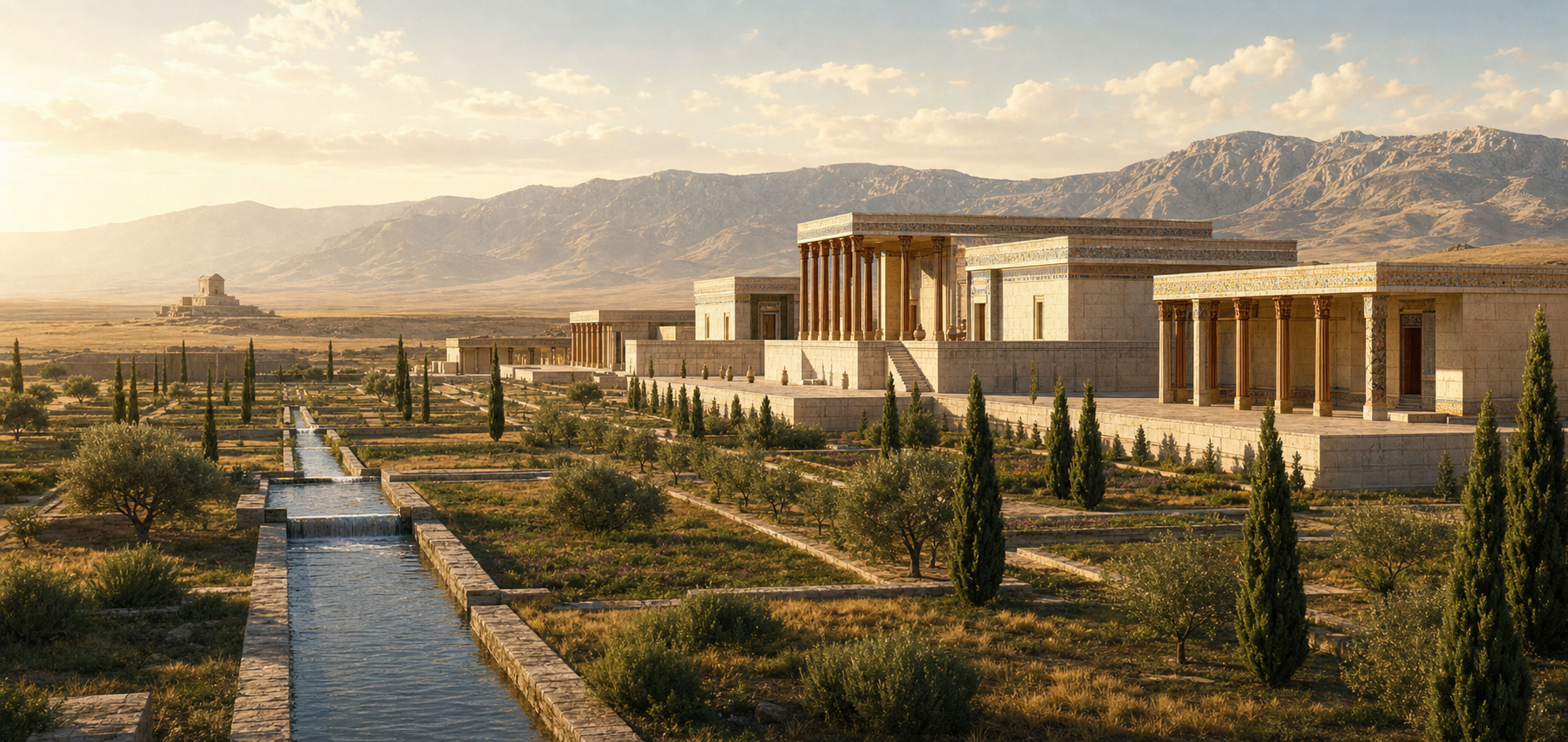
Around 1792 BCE, Hammurabi became king of Babylon, beginning a reign that would transform a relatively modest Mesopotamian city-state into the centre of a powerful kingdom. Hammurabi ruled for more than four decades and became one of the most famous rulers of the ancient Near East. Through warfare, diplomacy, administration and law, he extended Babylonian authority across much of southern and central Mesopotamia.
Hammurabi is remembered above all for the collection of laws associated with his name. The famous Law Code of Hammurabi was carved onto a monumental stone stele and presented the king as a ruler chosen by the gods to establish justice. Yet Hammurabi's achievements extended far beyond law. He strengthened irrigation systems, reorganised government, supported temples, conducted military campaigns and created the political foundations that helped make Babylon one of the most influential cities in ancient history.
When Hammurabi came to the throne, Babylon was only one of several competing kingdoms in Mesopotamia. By the end of his reign, he controlled a territory stretching across much of the region. His success marked an important stage in the rise of Babylon and established traditions of kingship, administration and law that remained influential long after his dynasty disappeared.
Mesopotamia in the Early Second Millennium BCE
Hammurabi lived during a period historians commonly call the Old Babylonian Period. Mesopotamia was divided among numerous kingdoms, each centred on important cities and competing for control of farmland, irrigation systems and trade routes.
Southern Mesopotamia contained ancient cities such as Ur, Uruk, Larsa and Isin. Farther north stood kingdoms centred on cities such as Mari, Eshnunna and Assur.
No single ruler controlled the entire region when Hammurabi inherited the throne. Political alliances changed frequently, and kings regularly fought one another over strategic cities and agricultural territory.
This fragmented political environment created both dangers and opportunities for an ambitious Babylonian king.
The City of Babylon
Babylon stood beside the Euphrates River in central Mesopotamia. Its location gave it access to important river routes connecting northern and southern regions.
Before Hammurabi's reign, Babylon had already grown in importance under earlier rulers of his dynasty, but it was not yet the dominant city of Mesopotamia.
The city benefited from fertile agricultural land and its position near important trade routes.
Over time, Babylon developed into a major administrative, religious and commercial centre.
Hammurabi's military successes would dramatically increase its political importance.
The First Dynasty of Babylon
Hammurabi belonged to a dynasty commonly called the First Dynasty of Babylon.
The dynasty was founded by an Amorite ruler named Sumu-abum during the early nineteenth century BCE.
The Amorites were Semitic-speaking peoples who had established numerous kingdoms throughout Mesopotamia and Syria.
Hammurabi was the sixth king of the Babylonian dynasty and inherited the throne from his father, Sin-Muballit.
By the time Hammurabi became king, his family had ruled Babylon for several generations and had gradually expanded its territory.
The Amorites
The Amorites played an important role in Mesopotamian politics during the early second millennium BCE.
Originally associated with regions west of Mesopotamia, Amorite groups had migrated into cities and agricultural areas over several centuries.
Many eventually established ruling dynasties in existing Mesopotamian cities.
Although these rulers had Amorite origins, they adopted many elements of traditional Mesopotamian culture.
They used the Akkadian language, supported established temples and presented themselves according to older traditions of Mesopotamian kingship.
Hammurabi Becomes King
Hammurabi succeeded his father around 1792 BCE according to the commonly used Middle Chronology.
Exact dates for ancient Mesopotamian rulers remain debated because different chronological systems have been proposed by modern scholars.
When Hammurabi took the throne, Babylon controlled a limited territory compared with several neighbouring kingdoms.
Powerful rivals included Larsa in southern Mesopotamia, Eshnunna to the east and Mari on the middle Euphrates.
Hammurabi therefore began his reign in a dangerous political environment surrounded by rulers who possessed comparable or greater military strength.
The Young King
Hammurabi did not immediately launch a campaign to conquer all of Mesopotamia.
During the early years of his reign, he concentrated on strengthening Babylon and improving his kingdom's internal administration.
Royal year names record projects involving temples, defensive walls and irrigation canals.
These activities were essential because agricultural prosperity depended heavily upon well-maintained waterways.
A king who ensured successful harvests and protected cities could present himself as a legitimate and effective ruler.
The Importance of Irrigation
Mesopotamian agriculture depended upon irrigation because rainfall in much of southern Mesopotamia was insufficient for reliable farming.
Water from the Tigris and Euphrates rivers was directed through networks of canals into agricultural fields.
These canals required regular maintenance because sediment accumulated and river channels could shift.
Hammurabi sponsored irrigation projects and ordered canals to be dug or restored.
Such projects increased agricultural production while demonstrating that the king fulfilled his responsibility to provide prosperity for his subjects.
The Royal Canal
Hammurabi's inscriptions describe important water-management projects undertaken during his reign.
One canal received a name proclaiming that Hammurabi brought abundance to the people.
The language used in such inscriptions reflected royal ideology. Building a canal was not presented merely as an engineering project but as an act of justice and divine responsibility.
Control of irrigation also strengthened the monarchy because agricultural communities depended upon organised water systems.
Babylonian Agriculture
Barley was one of the most important crops grown in Hammurabi's kingdom.
It could be used to produce bread and beer and also served as an important unit in economic transactions.
Farmers cultivated dates, vegetables and other crops while raising sheep, goats and cattle.
Agricultural estates could belong to temples, the palace, wealthy families or private individuals.
Taxes and rents supported the government and religious institutions.
A King Chosen by the Gods
Like other Mesopotamian rulers, Hammurabi presented his authority as approved by the gods.
Mesopotamian kings were expected to maintain temples, administer justice and protect their people.
Royal inscriptions regularly claimed that gods had selected a particular ruler to govern.
Hammurabi's law stele presents him receiving authority from Shamash, the god associated with justice and the sun.
This divine connection strengthened the king's claim that his laws represented legitimate and righteous government.
Marduk and Babylon
Hammurabi's reign helped increase the importance of Marduk, the patron god of Babylon.
Before Babylon became politically dominant, Marduk had been one among many local Mesopotamian deities.
As Babylon's influence expanded, the status of its patron god also increased.
In later Babylonian religion, Marduk became one of the most powerful gods of the Mesopotamian pantheon.
The political rise of Babylon and the religious rise of Marduk were therefore closely connected.
The Great Gods of Mesopotamia
Mesopotamian religion contained numerous gods and goddesses associated with cities and natural forces.
Anu was connected with the heavens, Enlil with authority and wind, Ea with wisdom and fresh water, Sin with the moon, Ishtar with love and warfare and Shamash with the sun and justice.
Different cities possessed their own patron gods and major temples.
Hammurabi respected these traditions and restored temples throughout territories under his authority.
Supporting local religious institutions helped him present himself as legitimate ruler of conquered cities.
Hammurabi the Builder
Ancient Mesopotamian kings were expected to construct and restore temples, city walls and canals.
Hammurabi repeatedly emphasised building projects in his inscriptions.
He repaired defensive fortifications and restored important religious structures.
Construction projects provided practical benefits while also serving as visible demonstrations of royal power.
A king who rebuilt the house of a god could claim divine favour and strengthen relationships with influential temple institutions.
Babylon's Defences
City walls were essential in a world of frequent warfare.
Babylon's fortifications protected inhabitants, administrative buildings, temples and stored wealth.
Hammurabi invested in strengthening defensive structures during his reign.
Walls also carried symbolic meaning because they demonstrated the ruler's ability to protect the city from enemies.
Later Babylon would become famous for its enormous walls, although the most spectacular surviving descriptions belong to periods long after Hammurabi.
A World of Rival Kingdoms
During Hammurabi's early reign, several major kingdoms competed for influence.
Larsa dominated much of southern Mesopotamia under its powerful king Rim-Sin I.
Mari controlled an important region along the Euphrates and maintained extensive diplomatic connections.
Eshnunna was a major kingdom east of the Tigris.
Farther north, Assyria and other states participated in trade and warfare.
Hammurabi had to navigate this complicated political landscape carefully.
Diplomacy
Hammurabi used diplomacy as well as warfare to increase Babylon's power.
Rulers exchanged letters, ambassadors and gifts and entered temporary alliances against common enemies.
Such alliances could change rapidly when political circumstances shifted.
A king who had been an ally one year could become a rival soon afterwards.
Hammurabi proved highly skilled at taking advantage of these changing relationships.
The Archives of Mari
Thousands of clay tablets discovered at the ancient city of Mari provide valuable evidence for Hammurabi's world.
The tablets include letters between kings, officials, generals and diplomats.
They reveal a political environment filled with negotiations, intelligence gathering, military planning and shifting alliances.
Hammurabi appears repeatedly in these records because Babylon was deeply involved in regional politics.
The Mari archives allow modern historians to observe ancient diplomacy in remarkable detail.
Zimri-Lim of Mari
Zimri-Lim was king of Mari during much of Hammurabi's reign.
For a period, the two rulers maintained a cooperative relationship.
Military forces from Mari and Babylon could operate as allies against mutual enemies.
Diplomatic correspondence demonstrates that the kings communicated regularly.
Eventually, however, Hammurabi turned against Mari and brought the kingdom under Babylonian control.
Shamshi-Adad
Another major ruler of the period was Shamshi-Adad I, who created a powerful kingdom in northern Mesopotamia.
He controlled important cities and established members of his family as subordinate rulers.
His death weakened the northern political system and created new opportunities for competing kingdoms.
The decline of Shamshi-Adad's state formed part of the changing political environment in which Hammurabi expanded Babylonian influence.
Rim-Sin of Larsa
One of Hammurabi's greatest rivals was Rim-Sin I of Larsa.
Rim-Sin had ruled for decades and controlled much of southern Mesopotamia.
His kingdom included wealthy agricultural territories and ancient Sumerian cities.
For many years, Larsa was considerably more powerful than Babylon.
Hammurabi eventually defeated Rim-Sin and annexed his territory, dramatically increasing Babylon's size and wealth.
The Struggle for Southern Mesopotamia
Control of southern Mesopotamia was important because the region contained productive agricultural lands, ancient cities and important trade routes.
Larsa had dominated much of this territory before Hammurabi's rise.
Hammurabi initially maintained political relations with Rim-Sin while dealing with other threats.
Once circumstances became favourable, however, Babylon turned against Larsa.
The resulting conflict became one of the decisive moments of Hammurabi's reign.
The Conquest of Larsa
Around the thirty-first year of Hammurabi's reign, Babylonian forces defeated Larsa.
Rim-Sin's long reign came to an end, and Hammurabi gained control over most of southern Mesopotamia.
The conquest brought major cities including Ur and Uruk within the Babylonian kingdom.
Hammurabi could now claim authority over territories that had once formed the heartland of ancient Sumer.
Babylon had changed from a regional kingdom into the dominant power of southern Mesopotamia.
Ur Under Babylonian Rule
Ur was one of the oldest and most prestigious cities in Mesopotamia.
Centuries earlier it had been the capital of the powerful Third Dynasty of Ur.
After Hammurabi conquered Larsa, Ur became part of his kingdom.
Hammurabi presented himself as a protector of the city's temples and religious traditions.
This policy allowed him to combine military conquest with claims of legitimate kingship.
Uruk
Uruk was another ancient city incorporated into Hammurabi's kingdom.
The city had been one of the earliest major urban centres in human history and remained religiously important.
Its temples were associated with gods including Anu and Ishtar.
By controlling Uruk, Hammurabi gained authority over a city possessing enormous cultural prestige.
Eshnunna
Eshnunna was an important kingdom east of the Tigris River.
Its location gave it access to trade routes connecting Mesopotamia with the Iranian plateau.
Hammurabi initially cooperated with other states against Eshnunna but later brought the kingdom under Babylonian domination.
Control over Eshnunna strengthened Babylon's position in central and eastern Mesopotamia.
The Laws of Eshnunna
Eshnunna possessed its own written law collection before Hammurabi issued the famous laws associated with Babylon.
This is important because Hammurabi did not invent the idea of written law.
Mesopotamia already possessed a long tradition of royal legal collections.
Earlier examples include laws associated with Ur-Nammu and Lipit-Ishtar.
Hammurabi's achievement belonged to an established legal tradition that he expanded and presented on a particularly impressive scale.
The Conquest of Mari
After years of cooperation, Hammurabi eventually turned against his former ally Zimri-Lim of Mari.
Babylonian forces captured the city during the later years of Hammurabi's reign.
At first Mari may have continued functioning under Babylonian supervision.
Later, however, the palace was destroyed and the city lost much of its previous political importance.
The destruction preserved thousands of clay tablets because fire baked many of them hard enough to survive for modern archaeologists.
Why Hammurabi Attacked Mari
The exact reasons for the final conflict between Babylon and Mari remain debated.
Control of the Euphrates route was strategically and economically valuable.
A powerful independent Mari could potentially threaten Babylonian interests.
Hammurabi may also have believed that his military successes gave him an opportunity to eliminate a former ally who had become unnecessary or dangerous.
The episode illustrates how quickly alliances could change in Bronze Age politics.
Babylon Becomes a Great Power
By the later years of his reign, Hammurabi controlled most of southern and central Mesopotamia.
His territory included cities that had previously belonged to several independent kingdoms.
This expansion made Babylon the dominant political power of the region.
Hammurabi adopted titles emphasising his authority over Sumer and Akkad and presented himself as ruler of an extensive kingdom.
Was Hammurabi an Emperor?
Hammurabi is sometimes described as an imperial ruler because he conquered numerous kingdoms and governed a large territory.
However, historians use the term empire cautiously because political organisation in the ancient Near East varied considerably.
Hammurabi certainly created a territorial state significantly larger than the Babylon he inherited.
His kingdom contained many cities, cultures and local traditions under one monarch.
The King's Administration
Military conquest was only part of Hammurabi's achievement.
New territories had to be governed after they were conquered.
Royal officials supervised agriculture, taxes, legal disputes and public works.
Hammurabi regularly sent written instructions to administrators.
Surviving letters show the king personally involved in matters ranging from military affairs to irrigation and individual legal disputes.
Royal Officials
Babylonian administration depended on a network of governors, judges, scribes and other officials.
Provincial authorities represented the king in distant regions.
Officials were expected to collect revenues and enforce royal orders.
Written communication helped the central government maintain control across the expanded kingdom.
Cuneiform tablets therefore became essential instruments of administration.
Cuneiform Writing
Babylonian scribes wrote using cuneiform signs impressed into wet clay with a reed stylus.
The main written language of Hammurabi's administration was Akkadian.
Sumerian was no longer the principal everyday language of most people, but it remained important in religious, scholarly and educational traditions.
Scribes therefore often learned both Akkadian and Sumerian.
The Scribal Schools
Learning to write cuneiform required years of training.
Students copied signs, vocabulary lists, mathematical exercises and model documents.
Education prepared scribes for work in temples, palaces and private businesses.
Because administration depended heavily on written records, trained scribes held important positions in Babylonian society.
Letters from Hammurabi
A number of surviving documents preserve royal instructions associated with Hammurabi.
These letters reveal a king deeply involved in government.
He ordered officials to investigate disputes, supervise workers, repair canals and manage property.
The documents make Hammurabi appear not merely as a distant symbolic ruler but as an active administrator concerned with the details of his kingdom.
Justice and Kingship
Justice was considered one of the central responsibilities of Mesopotamian kingship.
A successful ruler was expected to protect the weak, punish wrongdoing and ensure that economic relationships functioned properly.
Hammurabi repeatedly presented himself as a champion of justice.
This royal ideology reached its most famous expression in the collection known as the Code of Hammurabi.
The Code of Hammurabi
The Code of Hammurabi is one of the best-known legal documents from the ancient world.
It contains almost three hundred legal provisions covering a wide range of social and economic issues.
The laws were inscribed on a tall stone stele together with a long introduction and conclusion celebrating Hammurabi's kingship.
The monument presents the king as a ruler appointed by the gods to establish justice throughout the land.
The Law Stele
The most famous surviving copy of Hammurabi's laws was carved onto a dark stone monument more than two metres tall.
At the top is a relief showing Hammurabi standing before a seated god usually identified as Shamash.
The god extends symbols of authority toward the king.
Below the image are columns of cuneiform writing containing the royal prologue, laws and epilogue.
The monument combined art, religion, political propaganda and legal tradition in a single powerful object.
Shamash and Justice
Shamash was the Mesopotamian sun god and was closely associated with justice.
Just as sunlight was believed to reveal what was hidden, Shamash represented the ability to expose wrongdoing and establish truth.
By showing Hammurabi before Shamash, the law stele emphasised that the king's authority to administer justice possessed divine approval.
Was It Really a Code?
Modern readers frequently call the monument the Code of Hammurabi, but scholars debate whether it functioned like a modern comprehensive law code.
The collection does not contain every possible law governing Babylonian society.
Instead, many provisions appear as examples of legal situations and judgments.
The text may have served partly as a statement of ideal kingship and as a scholarly collection demonstrating Hammurabi's wisdom.
Actual courts could rely on custom, contracts, witnesses and judicial decisions as well as royal laws.
Earlier Mesopotamian Law
Hammurabi was not the first ruler to issue a written collection of laws.
Centuries earlier, the Sumerian king Ur-Nammu had issued a legal text.
Other law collections were associated with rulers such as Lipit-Ishtar.
The Laws of Eshnunna also predated Hammurabi.
Hammurabi therefore belonged to a long Mesopotamian tradition in which kings presented themselves as guardians of justice.
Property Law
Many of Hammurabi's laws dealt with property.
Agricultural land, houses, animals and commercial goods possessed considerable economic value.
The laws addressed theft, damage, ownership and responsibility.
Penalties could be severe, particularly when property belonging to temples or the palace was involved.
Agricultural Law
Agriculture occupied a major place in Hammurabi's laws because most of the population depended upon farming.
The text discusses rented fields, crop failure, irrigation and damage caused by negligent water management.
If a farmer failed to maintain a canal or embankment and flooding damaged neighbouring fields, the law could require compensation.
Such provisions demonstrate how essential collective water management was to Mesopotamian society.
Trade and Commerce
Babylonian economic life included merchants, loans and long-distance trade.
Hammurabi's laws addressed commercial partnerships, debts and disputes between merchants and agents.
Written records and witnesses played important roles in transactions.
Contracts were commonly written on clay tablets and could be sealed by the people involved.
Debt
Debt was a serious issue in ancient Mesopotamian society.
Farmers experiencing poor harvests might borrow grain or silver and could struggle to repay what they owed.
Debt could lead to the loss of property or temporary debt servitude.
Hammurabi's laws attempted to regulate some of these relationships and limit certain forms of exploitation.
Kings could also occasionally issue debt-relief measures to restore social stability.
Marriage
The law collection includes numerous provisions concerning marriage and family relationships.
Marriage commonly involved formal agreements between families.
Property, inheritance and dowries were therefore important legal concerns.
The laws addressed divorce, adultery, widowhood and financial obligations between spouses.
These provisions reveal the deeply patriarchal structure of Babylonian society while also showing that women could possess certain legal and property rights.
Women Under Babylonian Law
Women lived within a society dominated politically and legally by men, but their status varied according to class and circumstance.
Women could own property, participate in business and inherit wealth under certain conditions.
Some women served important religious roles.
Widows and wives could possess protections concerning dowries and family property.
At the same time, penalties involving sexual behaviour and family relationships demonstrate strong inequalities between men and women.
Children and Inheritance
Inheritance was important because property usually passed through families.
Hammurabi's laws addressed the rights of sons, daughters, adopted children and children born under different family circumstances.
Adoption was legally recognised and could provide heirs for families without biological children.
Inheritance disputes required careful legal regulation because land and property represented the foundation of wealth.
Adoption
Adoption was common enough in Babylonian society to appear frequently in legal documents.
A child could be adopted for several reasons, including providing support for elderly parents or creating an heir.
Written contracts often established the obligations of both adopter and adopted child.
Hammurabi's laws addressed circumstances in which adopted relationships could be challenged or terminated.
Builders and Responsibility
Some of the most famous provisions in Hammurabi's law collection concern builders.
If a poorly constructed house collapsed and killed its owner, the builder could face an extremely severe penalty.
Other provisions required compensation when property was damaged.
These laws illustrate the principle that skilled workers could be held responsible for the consequences of professional negligence.
Doctors
Physicians also appear in Hammurabi's laws.
The text establishes fees for successful medical treatment and penalties for serious failures.
The exact penalty depended partly on the social status of the patient.
These provisions demonstrate both the existence of specialised medical professionals and the unequal structure of Babylonian law.
Social Classes
Hammurabi's laws distinguish between different social categories.
Penalties and compensation could vary according to the status of the people involved.
Free individuals, dependants and enslaved people did not possess identical legal standing.
This demonstrates that Babylonian justice was not based upon the modern concept of equality before the law.
Law reflected and reinforced existing social hierarchies.
An Eye for an Eye
The phrase commonly translated as an eye for an eye is strongly associated with Hammurabi's laws.
The underlying principle is sometimes called lex talionis, meaning the law of retaliation.
In certain cases, a person who caused a serious physical injury could receive a corresponding injury as punishment.
However, this principle did not apply equally in all cases.
Social status could determine whether punishment involved physical retaliation or financial compensation.
Harsh Punishments
Some penalties in Hammurabi's laws appear extremely severe by modern standards.
Death could be imposed for several crimes, including particular forms of theft and kidnapping.
Other punishments included mutilation and financial compensation.
Such penalties reflected a society in which maintaining hierarchy, property and political authority was considered essential to order.
Evidence and Witnesses
Babylonian legal procedure depended heavily on evidence and witnesses.
Written contracts could establish agreements, while witnesses could testify about transactions and disputes.
False accusations could result in severe punishment.
The importance of written evidence demonstrates the central role played by scribes in Babylonian law and commerce.
Trial by River
Some difficult cases could involve a procedure often described as trial by ordeal.
A person might be required to enter the river and allow divine judgment to determine the outcome.
If the individual survived according to the expected conditions, this could be interpreted as evidence of innocence.
The practice illustrates the close relationship between law and religion in ancient Mesopotamia.
Slavery
Slavery existed in Hammurabi's Babylon.
People could become enslaved through warfare, birth, punishment or economic circumstances.
Enslaved individuals performed domestic, agricultural and other forms of labour.
Some could own limited property, conduct transactions or eventually obtain freedom.
Nevertheless, enslaved people occupied a clearly subordinate legal position.
Debt Servitude
Debt servitude differed in important ways from permanent slavery.
A person facing financial difficulty might temporarily place themselves or members of their family into service to satisfy a debt.
Hammurabi's laws placed limits on certain forms of debt service.
Such measures may have been intended to prevent excessive social disruption caused by widespread indebtedness.
The Ideal of Protecting the Weak
In the introduction and conclusion to his laws, Hammurabi presents himself as a king who prevents the strong from oppressing the weak.
He claims to defend widows, orphans and vulnerable people.
This language reflects an ancient Mesopotamian tradition of ideal kingship.
Whether everyday justice always achieved this ideal is impossible to know, but the claim itself demonstrates what rulers wanted their subjects and the gods to believe about royal government.
The Law Stele as Royal Propaganda
The law stele was not simply a practical legal reference.
It was also a monument celebrating Hammurabi.
The lengthy prologue lists cities and temples favoured by the king and presents him as divinely chosen.
The epilogue praises his achievements and warns future rulers not to alter his judgments.
Law therefore became another method through which Hammurabi communicated his political legitimacy.
The Discovery of the Stele
The most famous copy of Hammurabi's law stele was discovered at Susa in what is now Iran.
It had originally stood in Babylonian territory but was carried to Susa centuries later as war booty.
Its survival outside Babylon helped preserve one of the most important legal monuments from the ancient Near East.
The discovery allowed modern scholars to study Hammurabi's laws in extraordinary detail.
Daily Life in Hammurabi's Kingdom
Most of Hammurabi's subjects were not soldiers, royal officials or judges.
They were farmers, labourers, craftspeople, merchants and members of ordinary households.
Daily life revolved around agriculture, family obligations, religious practices and local economic activity.
The great political events recorded by kings affected ordinary people through taxation, military service and changes in administration.
Houses
Most Babylonian houses were constructed from mud brick.
Urban houses were frequently arranged around central courtyards.
Rooms surrounding the courtyard provided spaces for sleeping, storage and household work.
Roofs could provide additional working or sleeping areas during suitable weather.
Because mud brick deteriorated over time, houses required regular repairs and rebuilding.
Food
Barley formed a major part of the Babylonian diet.
It was used to make bread and beer.
Dates, onions, legumes, fish and dairy products were also important.
Wealthier households had greater access to meat and imported foods.
Food production depended heavily upon successful irrigation and agricultural labour.
Beer
Beer was consumed widely in Mesopotamia.
It was made from grain and formed part of both everyday life and institutional food distribution.
Taverns appear in Hammurabi's laws, demonstrating that drinking establishments were recognised parts of urban society.
The laws attempted to regulate some activities associated with tavern keepers.
Merchants
Merchants played an important role in Babylon's economy.
They transported goods between cities and regions and could act as lenders or commercial investors.
Long-distance trade supplied Mesopotamia with resources that were scarce locally.
Timber, metals and stone entered the region through extensive trade networks.
Commercial activity often depended upon written contracts and partnerships.
Silver and Money
Babylonia did not use minted coins during Hammurabi's lifetime.
Silver measured by weight frequently served as a standard of value.
Grain could also be used for payments and accounting.
Economic transactions therefore relied on measured commodities rather than standard coinage.
Careful systems of weights and measures were essential to commerce.
Weights and Measures
Mesopotamian scribes used standardised systems for measuring grain, land and precious metals.
Units of weight allowed silver and other valuable materials to function effectively in trade.
Accurate measurement was important for taxes, loans and commercial transactions.
Hammurabi's government had an interest in maintaining reliable standards because economic stability strengthened royal authority.
Mathematics
Old Babylonian scribes possessed sophisticated mathematical knowledge.
Surviving tablets contain multiplication tables, geometry problems and techniques for solving complex numerical questions.
A base-sixty numerical tradition was particularly important.
This system ultimately contributed to traditions still visible today in the division of hours into sixty minutes and circles into 360 degrees.
Astronomy
Mesopotamian scholars carefully observed the heavens.
Astronomical knowledge developed over many centuries and became increasingly sophisticated after Hammurabi's period.
The movements of celestial objects were connected with calendars, religion and divination.
Babylon eventually became one of the greatest centres of astronomical study in the ancient world.
Religion in Daily Life
Religion affected nearly every aspect of Babylonian life.
People worshipped gods in major temples but also maintained household religious practices.
Offerings and prayers were used to seek divine protection.
Illness, military defeat and natural disasters could be interpreted through religious explanations.
Specialists attempted to understand divine intentions through rituals and omens.
Divination
Mesopotamian rulers relied on diviners to interpret signs believed to reveal the will of the gods.
These signs could appear in celestial events, dreams, unusual births or the organs of sacrificed animals.
Military and political decisions could be influenced by such interpretations.
Divination was considered a serious scholarly discipline rather than superstition by the people who practised it.
Temples
Temples were major economic as well as religious institutions.
They could own fields, workshops, livestock and other property.
Priests conducted rituals and cared for divine statues.
Offerings of food and valuable goods supported temple activity.
Hammurabi restored temples because religious patronage helped strengthen relationships with the cities he governed.
Babylon's Temple of Marduk
The main temple of Marduk eventually became one of Babylon's most important religious institutions.
Later traditions knew the temple complex as Esagila.
Although much of what is known about its spectacular later form belongs to periods centuries after Hammurabi, the cult of Marduk was already central to Babylonian identity during his reign.
Hammurabi's political victories contributed greatly to the god's increasing prominence.
The People of Sumer and Akkad
Hammurabi ruled a culturally diverse population.
Southern Mesopotamia inherited traditions from ancient Sumer, while Akkadian had become a major spoken language.
Amorite ruling families had established themselves in numerous cities.
Rather than eliminating older traditions, Hammurabi incorporated them into his kingdom.
This ability to present himself as legitimate ruler of different cities helped maintain political control.
Sumerian Cultural Survival
Sumerian was no longer widely spoken as an everyday language during Hammurabi's reign, but it remained extremely important culturally.
Scribes studied Sumerian literature, vocabulary and religious texts.
Many temple rituals preserved Sumerian traditions.
The situation can be compared loosely with later societies preserving prestigious older scholarly languages even after ordinary speech had changed.
Literature
Old Babylonian scribes copied and developed some of Mesopotamia's greatest literary traditions.
Stories associated with Gilgamesh circulated in written form.
Myths, hymns and wisdom texts were copied by students and professional scribes.
This scribal activity helped preserve traditions originating centuries earlier.
Gilgamesh
Gilgamesh was remembered as a legendary king of Uruk.
Stories about his adventures were first written in Sumerian and later developed into Akkadian literary traditions.
Old Babylonian versions preserve important stages in the development of what eventually became the Epic of Gilgamesh.
The story's themes of friendship, kingship, death and the search for immortality remained powerful throughout Mesopotamian history.
Hammurabi as Judge
Royal ideology presented Hammurabi not only as a conqueror but also as a judge.
His surviving correspondence demonstrates that cases could be appealed to royal authorities.
The king could order investigations and require officials to resolve disputes.
Justice therefore formed a practical part of administration as well as a symbolic feature of kingship.
Local Courts
Not every legal case was decided directly by Hammurabi.
Local judges and assemblies handled many disputes.
Witness testimony, documents and oaths could be used as evidence.
Contracts written on clay tablets helped establish property rights and commercial agreements.
The extensive surviving legal documentation reveals a society accustomed to formal procedures.
Contracts
Old Babylonian contracts survive in enormous numbers.
They record land sales, loans, marriages, adoptions, business agreements and other transactions.
Documents often included witnesses and seal impressions.
Written contracts reduced uncertainty by creating a permanent record of agreements.
The widespread use of such documents demonstrates the sophistication of Babylonian economic life.
Cylinder Seals
Cylinder seals remained important tools for identifying individuals and authenticating documents.
A carved stone cylinder could be rolled across wet clay to create a distinctive image.
Seal designs frequently depicted worshippers standing before gods or kings.
Possessing a seal allowed individuals to mark transactions in a recognisable way.
The Babylonian Army
Hammurabi's expansion depended upon an effective military.
Armies included infantry armed with spears, bows and other weapons.
Soldiers could be recruited through systems of royal obligation and service.
Military campaigns required substantial logistical support because troops needed food, equipment and transportation.
Successful warfare therefore depended heavily upon administrative organisation.
Bronze Weapons
Bronze was widely used for military equipment during Hammurabi's period.
Spearheads, axes and other weapons could be made from metal alloys.
Bronze was valuable because copper and tin had to be obtained through trade.
Control of trade networks therefore influenced military as well as economic strength.
Siege Warfare
Many Mesopotamian cities were protected by substantial walls.
Conquering a rival kingdom often required besieging fortified settlements.
Attackers might attempt to breach gates, undermine walls or cut off supplies.
Long sieges demanded patience and large quantities of food for the attacking army.
Hammurabi's conquest of major cities therefore required considerable military organisation.
Intelligence and Spies
The diplomatic archives of the period demonstrate that rulers actively gathered information about enemies and allies.
Messengers reported troop movements, political developments and rumours.
Kings needed accurate intelligence before committing armies to battle.
Information could be as valuable as weapons in the unstable political environment of Hammurabi's world.
Royal Messengers
Messengers connected Babylon with distant provinces and neighbouring kingdoms.
They carried letters written on clay tablets.
Official communication allowed Hammurabi to issue orders over considerable distances.
The ability to maintain communication networks was essential once his kingdom expanded beyond Babylon's immediate surroundings.
Roads and Rivers
Mesopotamian transportation relied upon both overland routes and waterways.
The Euphrates and Tigris rivers provided major channels for moving people and goods.
Boats could transport bulk cargoes more efficiently than land caravans.
Canals connected cities and agricultural districts.
Control of waterways therefore possessed strategic as well as economic importance.
Babylon and Long-Distance Trade
Mesopotamia lacked many natural resources required by its cities.
High-quality timber, metals and certain stones had to be imported.
Trade routes connected Babylonia with Anatolia, Iran, the Persian Gulf and lands farther east.
Merchants and royal institutions participated in these networks.
A strong Babylonian kingdom could protect and profit from important commercial routes.
Dilmun
Dilmun was an important trading centre in the Persian Gulf, commonly associated primarily with Bahrain and surrounding regions.
Merchants travelling between Mesopotamia and lands farther south and east passed through Gulf networks.
Copper and other goods circulated through these routes.
Connections with Dilmun had existed long before Hammurabi and remained important during the Old Babylonian world.
Social Hierarchy
Babylonian society was deeply hierarchical.
The king and royal household stood at the top of the political order.
Officials, priests, merchants and wealthy landowners could possess significant influence.
Farmers, craftspeople and labourers formed much of the population.
Enslaved people and dependent workers occupied lower social positions.
The Palace
The royal palace was both the residence of the king and a centre of government.
Officials managed resources, received messengers and prepared royal correspondence.
Storehouses contained goods collected through taxes and tribute.
The palace also supported soldiers, craftspeople and servants.
Its administration connected the king with the wider economy of the kingdom.
Taxes and Tribute
Hammurabi's government required resources to maintain officials, armies and construction projects.
Taxes could be collected in agricultural products, labour and other forms rather than modern money.
Conquered territories could also provide tribute.
The redistribution of these resources helped support the institutions of the state.
Military Service
Some individuals received land or other benefits in return for military obligations.
Hammurabi's laws include provisions concerning soldiers and their property.
A soldier's duties to the king could have serious legal consequences if neglected.
The state therefore connected landholding and military service in ways that strengthened royal armies.
Soldiers and Their Families
Extended military service could create problems for households left behind.
Legal provisions addressed property belonging to absent soldiers.
The government had an interest in protecting the economic foundations of military families because soldiers were essential to royal power.
Hammurabi's Titles
As his territory expanded, Hammurabi adopted prestigious royal titles.
He presented himself as king of Babylon and ruler connected with the ancient traditions of Sumer and Akkad.
Titles were political statements that communicated claims of authority.
By associating himself with famous regions and cities, Hammurabi portrayed his rule as universal within Mesopotamia.
Royal Inscriptions
Hammurabi commissioned inscriptions celebrating his achievements.
These texts describe military victories, building projects and acts of religious devotion.
Like most royal inscriptions, they present events from the king's point of view.
Historians therefore compare them with administrative documents and letters to reconstruct a more complete picture of his reign.
Year Names
Mesopotamians commonly identified years using memorable events rather than continuously numbered years.
A year might be named after the construction of a temple, the digging of a canal or the defeat of an enemy.
Hammurabi's year names provide valuable information about the sequence of events during his reign.
They reveal that military conquest became particularly important during his later years.
Hammurabi's Later Campaigns
Much of Hammurabi's most dramatic territorial expansion occurred relatively late in his reign.
For many years, he remained one ruler among several competing kings.
Once the regional balance of power shifted, however, he moved rapidly against major rivals.
Within a comparatively short period, Larsa, Eshnunna and Mari all came under Babylonian control or were defeated.
This transformation demonstrates the speed with which political power could change in Mesopotamia.
The Problem of Holding an Empire Together
Conquering territory was easier than maintaining permanent control over it.
Hammurabi's kingdom contained cities with long histories of independence.
Local elites, temples and regional traditions remained powerful.
Royal officials therefore had to balance central authority with local administration.
The difficulties of maintaining such a large state became particularly clear after Hammurabi's death.
Samsu-iluna
Hammurabi was succeeded by his son Samsu-iluna.
The new king inherited a large but difficult kingdom.
Rebellions broke out in several regions, and Babylon gradually lost control of territories conquered by Hammurabi.
The rapid fragmentation of the kingdom demonstrates how much its unity depended upon Hammurabi's personal military and political success.
Rebellions After Hammurabi
Southern cities rebelled against Babylon during the reign of Samsu-iluna.
Political instability and economic problems weakened central authority.
Territories that Hammurabi had conquered did not necessarily remain loyal to his successors.
Babylon survived as an important kingdom, but the enormous territory of Hammurabi's later reign proved difficult to preserve.
The End of Hammurabi's Dynasty
The First Dynasty of Babylon continued for more than a century after Hammurabi.
Eventually Babylon itself was attacked by the Hittite king Mursili I around the sixteenth century BCE.
The Hittites withdrew after the raid, but Hammurabi's dynasty came to an end.
Other rulers later gained control of Babylonia.
Despite these political changes, Babylon remained one of Mesopotamia's most prestigious cities.
The Kassites
After the fall of Hammurabi's dynasty, a group known as the Kassites eventually established long-lasting rule over Babylonia.
They adopted Babylonian language, religion and traditions.
Babylon continued to possess enormous cultural importance.
The ability of later foreign-origin dynasties to adopt Babylonian traditions demonstrates the lasting prestige created by earlier rulers.
Babylon After Hammurabi
Hammurabi did not create the enormous city later associated with famous monuments such as the Ishtar Gate.
Those structures belonged to the Neo-Babylonian period more than a thousand years later.
Nevertheless, Hammurabi's reign marked a decisive moment in the city's rise.
Babylon became the political centre of a major Mesopotamian kingdom and increasingly gave its name to the surrounding region of Babylonia.
Babylonian Identity
The political success of Babylon gradually created a broader Babylonian cultural identity.
Older Sumerian and Akkadian traditions were preserved and combined within Babylonian scholarship.
The city's religious importance increased as Marduk became more prominent.
Later rulers repeatedly sought control of Babylon because possession of the city carried enormous political and religious prestige.
The Rise of Marduk
Marduk's importance continued to grow after Hammurabi.
In later Babylonian theology, he became the chief god associated with kingship and cosmic order.
The famous Babylonian creation poem later known as the Enuma Elish presents Marduk defeating forces of chaos and becoming king of the gods.
This later religious development reflected Babylon's political and cultural prestige.
Hammurabi and Modern Ideas About Law
Hammurabi is often described as one of history's earliest great lawgivers.
This description captures part of his importance but can be misleading if it suggests that he invented law or created the first legal system.
Mesopotamian communities had possessed legal customs and written legal collections long before Hammurabi.
His importance lies partly in the scale, preservation and ideological power of the monument associated with his laws.
Law Was Not Equal
The Code of Hammurabi should not be interpreted as an early declaration of modern human rights.
The laws clearly distinguished between social classes and genders.
The same injury could produce different penalties depending upon the status of the people involved.
Slavery was accepted, and some punishments were extremely severe.
The document reflects the values and hierarchy of an ancient Bronze Age society.
Why the Laws Matter
Despite these differences from modern law, Hammurabi's collection remains extremely valuable.
It reveals how Babylonians thought about property, family, responsibility, labour and justice.
It demonstrates that rulers considered the administration of justice a fundamental royal duty.
It also provides evidence for the highly developed legal and economic systems operating in Mesopotamian cities almost four thousand years ago.
The Stele's Journey to Susa
Centuries after Hammurabi, an Elamite ruler carried the law stele from Babylonia to Susa.
Taking monuments from conquered cities was a common way of displaying victory.
The stele remained at Susa until archaeologists discovered it in the early twentieth century.
Its displacement ultimately helped preserve the monument for modern study.
Hammurabi in Historical Memory
Hammurabi's name survived in Mesopotamian scribal tradition long after his kingdom fragmented.
Students copied legal texts and remembered earlier kings as models of scholarship and royal authority.
Modern discovery of the law stele transformed Hammurabi into one of the most widely recognised rulers of ancient Mesopotamia.
Hammurabi Compared with Other Ancient Rulers
Hammurabi belonged to a long tradition of rulers who combined military power with claims of divine approval and justice.
Earlier kings such as Ur-Nammu and Sargon of Akkad had also attempted to unify large territories.
Later Assyrian and Babylonian rulers would build even larger empires.
Hammurabi nevertheless occupies a particularly important position because unusually rich written evidence survives from his reign.
Hammurabi and Sargon
Sargon of Akkad had created a major territorial empire several centuries before Hammurabi.
Both rulers conquered numerous Mesopotamian cities and presented themselves as powerful universal kings.
However, they operated in different political environments and belonged to different dynastic traditions.
Hammurabi's surviving legal and administrative records provide a more detailed picture of government and society.
Hammurabi and Ur-Nammu
Ur-Nammu ruled the Third Dynasty of Ur centuries before Hammurabi.
He also issued a surviving legal collection and sponsored major building projects.
Both rulers connected justice with legitimate kingship.
The comparison demonstrates that Hammurabi's legal monument developed from older Mesopotamian traditions rather than appearing without precedent.
The Importance of Babylon's Location
Babylon's geographical position contributed greatly to its success.
It stood close to the region where major routes from northern and southern Mesopotamia converged.
The Euphrates provided transportation and irrigation.
Control of Babylon allowed rulers to influence trade and communication between different parts of Mesopotamia.
Hammurabi's conquests turned this favourable location into the centre of a large political system.
Urban Life in Babylon
Babylon during Hammurabi's reign contained houses, temples, workshops, markets and administrative buildings.
Its streets would have been filled with traders, labourers, animals and officials.
Most structures were built from mud brick because stone was scarce in southern Mesopotamia.
The city required constant maintenance because mud-brick buildings were vulnerable to weather and flooding.
Craftspeople
Babylonian cities supported numerous skilled occupations.
Potters produced household containers, metalworkers manufactured tools and weapons and textile workers produced cloth.
Carpenters worked with valuable imported timber.
Stone carvers produced seals and monuments.
Specialised labour depended upon agricultural surpluses supplied by farmers.
Textile Production
Wool textiles were among the important products of Mesopotamian economies.
Sheep were raised in large numbers, and wool could be spun and woven into cloth.
Women played a major role in textile production.
Palaces and temples could supervise workshops producing cloth for local use or trade.
Family Life
The household was the fundamental unit of Babylonian society.
Families managed property, arranged marriages and cared for children and elderly relatives.
Written contracts could formalise marriage, inheritance and adoption.
Hammurabi's laws devoted considerable attention to households because family stability was closely connected with property and economic order.
Education
Formal education was mainly available to the children of families able to support specialist training.
Scribal students spent years learning complicated cuneiform signs.
They copied traditional texts and mathematical exercises.
Successful scribes could obtain valuable positions in administration and commerce.
Medicine
Babylonian medicine combined practical treatment with religious and magical practices.
Specialists could diagnose symptoms, prepare remedies and perform certain procedures.
Other experts used incantations designed to combat supernatural causes of disease.
Hammurabi's laws show that physicians could receive payment for successful treatment and punishment for serious failures.
Justice for Ordinary People
Most legal disputes concerned ordinary matters rather than dramatic crimes.
Neighbours argued over land or irrigation.
Merchants disputed payments.
Families disagreed over inheritance.
Written tablets allowed such transactions and disputes to leave unusually detailed records for modern historians.
The King and the Poor
Hammurabi repeatedly claimed that his rule protected vulnerable people.
Ancient kings sometimes cancelled certain debts or obligations when they came to the throne or during periods of crisis.
Such policies were not modern welfare systems, but they could prevent powerful creditors from gaining excessive control over the population.
Royal concern for social balance also strengthened political stability.
Military Glory and Justice
Hammurabi's reputation combines two apparently different royal roles.
He was a conqueror who defeated rival kingdoms, but he also presented himself as a ruler of justice and order.
In Mesopotamian political ideology these roles were closely connected.
The king defeated external enemies and internal wrongdoing because both represented threats to the proper order of society.
The Limits of Hammurabi's Power
Although Hammurabi became extremely powerful, he did not control the entire ancient Near East.
Major political centres existed beyond his kingdom in Anatolia, Syria, Iran and Egypt.
His influence was greatest within Mesopotamia.
Even there, maintaining control required constant administration and military strength.
Hammurabi's Final Years
The later part of Hammurabi's reign was dominated by his greatest military successes.
Within a relatively short period, Babylon defeated several major rivals and absorbed their territories.
The king then faced the enormous task of administering his enlarged state.
His legal monument and administrative reforms can be understood partly within this context of political consolidation.
Hammurabi's Death
Hammurabi died around 1750 BCE according to the Middle Chronology.
He had ruled for approximately forty-two years.
The Babylon he left to his son was far larger and more powerful than the kingdom he had inherited.
Yet the difficulty experienced by his successors shows that Hammurabi's achievements were not automatically permanent.
A Kingdom Built Around One Ruler
The rapid decline of Babylonian control after Hammurabi demonstrates the importance of personal kingship in ancient states.
Institutions existed, but political unity often depended heavily upon the military prestige and alliances of an individual monarch.
When a powerful king died, rivals could challenge his successor.
Hammurabi had built an impressive kingdom, but its enormous territorial expansion proved difficult to sustain.
The Long-Term Rise of Babylon
Although Hammurabi's political empire did not survive intact, his reign permanently elevated Babylon's status.
The city would repeatedly become the centre of powerful kingdoms over the following centuries.
Babylonian scholarship, religion and literature influenced the entire ancient Near East.
Later rulers sought to control Babylon because it had become a symbol of legitimate Mesopotamian kingship.
Babylonian Scholarship
Babylon eventually became famous for astronomy, mathematics, literature and religious scholarship.
Scribes preserved texts for centuries and created enormous collections of knowledge.
Some of these intellectual traditions developed long after Hammurabi, but the political importance established during his reign contributed to Babylon's rise as a cultural centre.
A King Remembered for Law
Many ancient rulers conquered larger territories than Hammurabi, yet few are as strongly associated with the idea of law.
The survival of his monumental legal inscription shaped his modern reputation.
The stele gives historians a rare combination of visual imagery, political ideology and detailed legal provisions.
It provides an extraordinary glimpse into how a Bronze Age king wanted justice and royal authority to be understood.
Why Hammurabi Matters
Hammurabi matters because his reign represents an important stage in the political development of Mesopotamia.
He transformed Babylon from one regional kingdom among many into the dominant power of much of Mesopotamia.
His military victories changed the political map, while his administration attempted to integrate territories with long traditions of independence.
His laws preserve valuable evidence about Babylonian society and demonstrate the importance ancient rulers placed upon justice.
More Than a Lawgiver
Focusing only on Hammurabi's laws can obscure the wider significance of his reign.
He was also a military strategist, diplomat, administrator and builder.
He maintained irrigation systems, supported temples, managed provincial officials and communicated directly with governors.
His success depended upon his ability to combine all these forms of power.
Hammurabi's Legacy
Hammurabi's immediate empire fragmented after his death, but his historical legacy endured.
Babylon remained a major centre of Mesopotamian civilisation.
Marduk eventually became one of the most important gods in Babylonian religion.
Hammurabi's laws continued to be copied and studied by scribes.
Thousands of years later, the discovery of his law stele made him an international symbol of ancient justice and government.
A Turning Point for Babylon
When Hammurabi became king around 1792 BCE, Babylon was important but far from supreme.
By the time of his death, its armies had defeated some of the strongest kingdoms in Mesopotamia.
Ancient cities including Ur, Uruk, Larsa and Mari had fallen under Babylonian authority.
The political transformation was so significant that Babylon would give its name to an entire region and civilisation.
The World of Hammurabi
Hammurabi's reign reveals a Bronze Age world far more sophisticated than the word ancient sometimes suggests.
Kings exchanged diplomatic correspondence, merchants used written contracts and judges heard complex legal disputes.
Governments maintained canals, collected taxes and administered distant cities.
Scribes studied mathematics and literature, while merchants moved goods across international trade routes.
Hammurabi ruled within a highly organised urban civilisation with traditions already thousands of years old.
The King of Babylon
Hammurabi's greatest achievement was the transformation of Babylon itself.
Military conquest gave the city political supremacy, while royal patronage strengthened its religious institutions.
The city's god Marduk gained prestige alongside Babylon's rulers.
Later generations would transform Babylon into one of the most famous cities in the ancient world, but Hammurabi played a crucial role in beginning that ascent.
An Enduring Name
More than three and a half thousand years after his death, Hammurabi remains one of the best-known rulers of ancient Mesopotamia.
His name appears in discussions of law, government and early civilisation throughout the world.
The monumental stele associated with his reign preserves the image he wanted future generations to remember: a king standing before the god of justice and receiving authority to rule.
That image captures the central ideal of Hammurabi's kingship. Military power had allowed him to conquer Mesopotamia, but he wanted his reign to be remembered as one that established order.
The Legacy of c. 1792 BCE
Hammurabi's accession around 1792 BCE marked the beginning of a reign that would reshape Mesopotamian history.
Over the following four decades, Babylon expanded from a modest kingdom into a major territorial power.
Hammurabi defeated rival kings, absorbed ancient cities and created an administration capable of governing much of southern and central Mesopotamia.
His famous laws reveal a society concerned with property, trade, family, agriculture and social responsibility while also exposing the deep inequalities of the ancient world.
A Ruler Who Changed Mesopotamia
Hammurabi's kingdom did not last forever, and many of his conquests were lost soon after his death.
His broader achievement nevertheless proved far more durable.
Babylon had entered the political centre of Mesopotamian history.
Future generations would repeatedly rebuild and glorify the city, while Babylonian religion, literature and scholarship became enormously influential.
Hammurabi therefore stands at a crucial turning point. He was not the first Mesopotamian conqueror and not the first lawgiver, but he combined warfare, administration and royal justice with exceptional success. His reign transformed Babylon and ensured that both the city and the king would be remembered for thousands of years.